
Archive for the ‘Movies’ Category
Star Wars rebooted as a Western, with humanized droids [Star Wars]
22
Feb
3 awesome depictions of the golem in art [Video]
31
Oct

Beethoven’s Fifth Sith-Phony
25
Oct
Yes this video is a year and a half old, but it's so unbelievably awesome that I had to share it in case you hadn't seen it. Basically, it's seven minutes of pianist Richard Grayson (yes) playing the Imperial March from Empire Strikes Back in the manner of Beethoven. It's beautiful and exceedingly impressive in its reimagining. That sound you hear at the very end? It's John Williams weeping and putting a gun in his mouth.Thanks to Brandon M. for the tip.
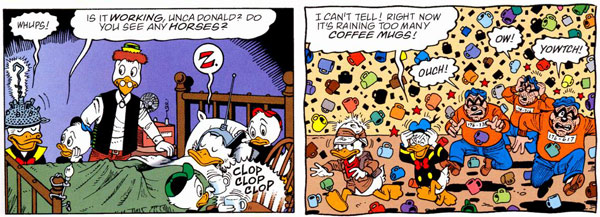
Inception ripped off a Scrooge McDuck comic
03
Aug
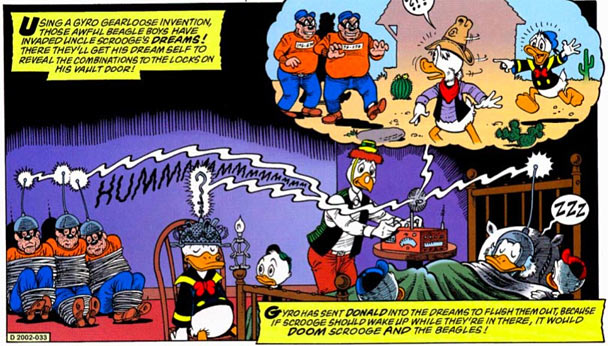
Many thanks to Videogum editor Gabriel Delahaye for having the balls to reveal the truth all others fear to blog: Christopher Nolan's Inception was nothing but a Scrooge McDuck ripoff. Read the full, original comic here: Uncle Scrooge in "The Dream of a Lifetime"


Public Libraries Are Beating Netflix, Redbox and Blockbuster in DVD Rentals [DVD]
31
Jul


Rotten Tomatoes Now Integrated with iTunes
21
May


 Popular movie review aggregator Rotten Tomatoes is now integrated with Apple’s iTunes Store, giving viewers the chance to instantly see the rating of a movie in the form of a popularity gauge called the Tomatometer.
Rotten Tomatoes is a popular site that’s been around since 1998, and it was been acquired by Flixster early this year. It takes the reviews of professional movie critics around the world, counts the positive (fresh) and the negative (rotten) reviews and turns them into a percentage-based grade.
Now, you can see the Tomatometer in movie descriptions on iTunes, along with a couple of blurbs taken from some of the top critics’ reviews. It’s a great way to quickly check out whether a movie is worth watching; if you want more info, you can jump to Rotten Tomatoes for more reviews with a click.
[img credit: visualdensity]
For more entertainment coverage, follow Mashable Entertainment on Twitter or become a fan on Facebook
Reviews: Facebook, Rotten Tomatoes, Twitter
Tags: itunes, Movies, rotten tomatoes
“A Galactic Empire State of Mind”
30
Mar
The four kajillion of you guys who sent me this probably figured out that I was saving it for the end of the day; I mean, I love Star Wars and nerdy rap, but this is pretty special besides. Not only is it a pretty decent song by itself -- always a plus -- there's the following:
• Each original trilogy movie gets a verse
• Leia plays Max Rebo's piano thing
• Rebel pilots and Stormtroopers bust a few moves
• Leia's obvious but still funny DJ headphones
• Ewoks which somehow manage to be more disturbing that actual Ewoks
• Slave Leia
• "Daddy power activate."
If you want to check out the full lyrics, head here -- I highly recommend it. At the very least to take your mind off those Ewoks.
In This Horror Movie, the Call Comes From Inside the Theater [Interactivity]
10
Mar


Roger Ebert gets his voice back: “Uncanny. A good feeling.”
02
Mar
 If you haven't read the epic Equire interview, go do that before reading the rest of this post. Famed film critic and all-around awesome human being Roger Ebert has not been able to speak for four years, since undergoing cancer-related surgery. He's been communicating with hand signals, monotone text-to-speech software, and a wonderful ongoing stream of Twitter updates.
Today is a big day, though: on Oprah, he debuts his new voice, which sounds a lot like the old voice we all knew and loved. In the video above, his wife Chaz hears it for the first time. Yeah, I cried.
Scotland-based tech company CereProc create the text-to-speech voice using archived recordings of Ebert speaking (specifically, DVD commentary tracks). The result is amazing. More: Ebert's own blog, CNN, ABC News, Videogum
Previously:
The Formula For a Perfect Movie [Science]
20
Feb
 A Cornell University professor analyzed 150 of the highest grossing movies of the last 70 years. The more recent the movie, he found, the closer it adhered to the mathematical formula that describes the human attention span.
In the 1990s, researchers at University of Texas in Austin determined that our attention spans could be described by the 1/f fluctuation, a pattern representing the ebb and flow of our concentration over a period of time. In a new study, professor James Cutting found that the more recent the blockbuster, the more closely the length of its shots followed that same fluctuation.

Whereas Detour, made in 1945, has shots that only vaguely correspond to the 1/f fluctuation, the 2005 King Kong remake stays surprisingly snug with the attention span wave.
As Cutting explains, this increasing correlation means that films "resonate with the rhythm of human attention spans," but just because movies are increasingly pleasing to our subconscious minds doesn't mean that we will necessarily like them more: the Star Wars prequels strictly followed the formula. [PhysOrg and PopSci]