RSS
 

Author Archive

The 28 Best Fictional Characters on Twitter

22 Jul

You can spice up your Twitter feed by following characters from movies, TV, and literature! Twitter is full of people who don’t exist, but have plenty to say anyway. Buzzfeed searched for the most entertaining of those feeds and listed them for your convenience. Link


Humans’ treatment of other animals shaped our evolution [Evolution]

22 Jul
Humans are one of the few animals that adopts and cares for other animals. Our cross-species connections might be older and more important than we ever imagined, driving human evolution for millions of years and even helping us invent language. More »


The Miniature Guns of Michel Lefaivre

22 Jul

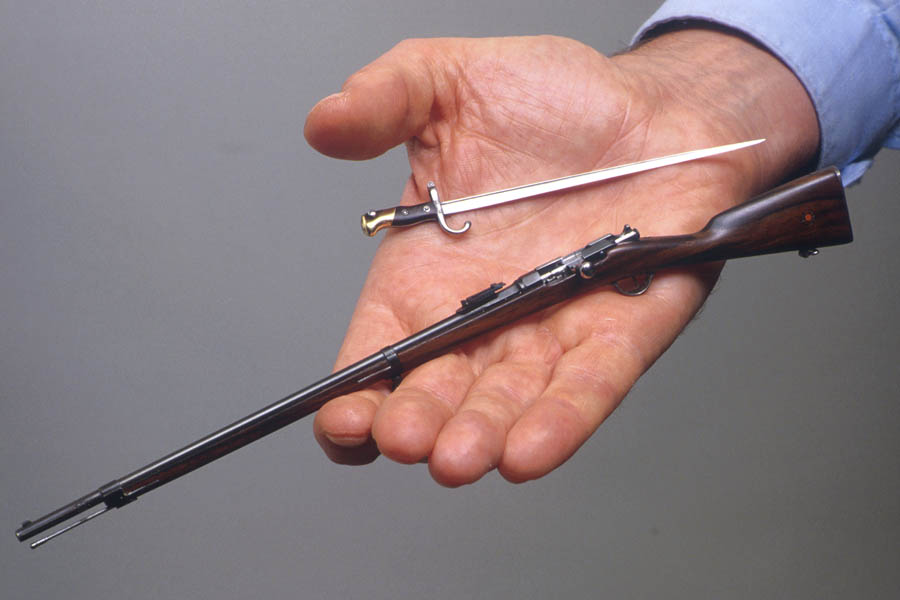
Michel Lefaivre is a gunsmith who makes miniature, functional firearms. Pictured above is one example of his work, a 1/4 scale Gras rifle model 1874. Lefaivre writes about how he does it:

Each part starts from a raw piece of material, reduced in size with a milling machine or a precision lathe. The biggest part of the work is made with a file in the fitting vice. At a quality of manufacture and finish equal to the full size, it is more difficult to make a functioning piece reduced to 1/3 scale. The more minute the detail, the more time it takes, and the more risk of making a mistake. Few pieces were successful the first time round. All those not strictly in conformity were scrapped without pity.

To perfect the work and to give it its final touch, the best specialist of our country have been called upon for the engraving, inlaying, gilding, checkering and the wood carving.

Mandatory tooling includes a toolmaker’s lathe, a clockmaker’s lathe, a precision milling machine and hundreds of needle files of all shapes and grades. Burrs and polishing tools of all shapes, pertaining to clockmakers, jewellers, dentists, chisellers and sculptors are used. Very good eyesight and an infinite reserve of patience, tenacity and elbow grease are also required.

Link via Hell in a Handbasket | Photo: The Craftsmanship Museum | Previously: The World’s Smallest Gun


Real-Life Money Tree

22 Jul


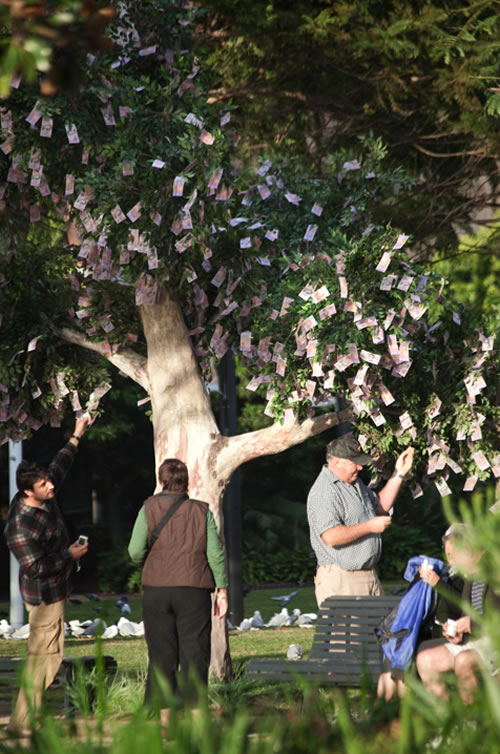
Photo: RaboDirect Australia [Flickr]

Money doesn't grow on trees. Or does it? As a publicity stunt, RaboDirect of Australia sponsored a stunt where a tree in a park in Sydney is festooned with real $5 bills:

An Overview of Responses:

Lost Opportunity
In the early stages, almost 100 people passed the tree without noticing that anything was different. Even when a group of joggers noticed, they were too busy to stop. The first groups who eventually stopped to interact couldn’t believe it. They inspected the notes and took pictures, but left empty handed.

Follow the Crowd
Only once one brave participant started taking the money, did momentum gather. Legitimised by the crowd, a wide spectrum of behaviour ensued.

Frugality
Some took just one or two notes, satisfied by their modest and unexpected gains.

Opportunist
Consumed by the fantasy, a group of braver participants made the most of the opportunity by filling their pockets.

Employing Tools and Working Together
When the low hanging $5 notes were depleted, participants employed tools such as swinging coats and umbrellas, to help them reach higher branches. Teamwork also came into play as spectators formed human pyramids to reach the notes seemingly out of reach.

Altruism
Perhaps the most comforting observation from the participants was that of altruism. Taller participants shared their earnings with shorter spectators, while one gentleman on identifying the undercover observation team, requested his money be donated to charity.

Link [with video clip] - via Marketing Alternatif


Found: Stonehenge’s Second Henge

22 Jul

Archaeologists have found something at Stonehenge that is so exceptional that they’re calling it the most exciting find there in fifty years: a second, Neolithic henge.

The new "henge" – which means a circular monument dating to Neolithic and Bronze Ages – is situated about 900m (2,950ft) from the giant stones on Salisbury Plain.

Images show it has two entrances on the north-east and south-west sides and inside the circle is a burial mound on top which appeared much later, Professor Gaffney said.

"You seem to have a large-ditched feature, but it seems to be made of individual scoops rather than just a straight trench," he said.

"When we looked a bit more closely, we then realised there was a ring of pits about a metre wide going all the way around the edge.

"When you see that as an archaeologist, you just looked at it and thought, ‘that’s a henge monument’ – it’s a timber equivalent to Stonehenge.

Link


Google raises the prize for Chrome bug discovery to $3000+ – Gadgets Reviews

22 Jul

Product Reviews (blog)

Google raises the prize for Chrome bug discovery to $3000+
Gadgets Reviews
Yesterday, Google announced that it will pay $3133.70 for every single critical security bug discovery in Chrome web ...
Google Chrome: Critical Bug Discovery Reward RaisedProduct Reviews (blog)
Mozilla Patches Firefox for 14 VulnerabilitieseSecurity Planet

all 71 news articles »


The Star Thrower: sweetly moving comic

21 Jul

I found Jake Parker's short comic "The Star Thrower" to be sweetly moving and well, just lovely. What a nice way to have started my morning.

The Star Thrower (Thanks, Fipi Lele!)


End Call button for the iPhone 4

21 Jul
 Twitpic Photos Large 131133375

Aaron Draczynski made an "End Call" button for the iPhone 4. (It's not really for sale).


Creepy ‘Human Fish’ Can Live 100 Years

21 Jul

The olm, a foot-long salamander nicknamed “the human fish” because of its fleshy skin and tubular shape, is certainly a strange-looking animal. But beneath the surface, they’re even weirder: Olms can live for 100 years, far longer than any other amphibian.

Scientists have no idea why.

“This species raises questions regarding aging processes,” write researchers led by biologist Yann Voituron of France’s Université Claude Bernard in a July 21 Biology Letters study.

The olms studied by Voituron’s team are part of a population established 48 years ago to help conserve the rare amphibian, which is found in caves in Croatia and Slovenia.

When the project began, the olms were about 10 years old, making them nearly 60 now. Yet they “do not show any time of senescence,” write the researchers, who estimate the olm’s average lifespan to be 69 years, with an upper limit at the century mark.

Living in a stable environment without predators has made it possible for olms to have long lives, but the mechanisms underlying their longevity are unknown. In general, long life correlates with a large body size, but the half-pound salamanders are pipsqueaks compared to the next-longest-lived amphibian, the 50-pound Japanese salamander, which clocks in with a 55-year lifespan.

Voituron’s team thought olms might have extremely slow metabolisms, but they proved metabolically similar to other amphibians, including African bullfrogs and European toads that live for about 40 years.

The researchers also wondered if olms might have special tricks for cleaning up oxygen-free radicals, the DNA-damaging molecules produced when cellular mitochondria turn nutrients into energy. Free-radical accumulation is linked to aging, but the olm’s antioxidant activity is nothing special.

“The olm presents a paradox,” wrote the researchers. “Neither its basal metabolic rate nor its antioxidant activity, the two most cited mechanisms that should be involved in enhancing lifespan, differ from species with a more reduced lifespan.”

Voituron is now testing whether the olm might have extra-efficient mitochondria that emit fewer free radicals to begin with. “If you manage to produce more energy with less free-radical production, then you can avoid aging and increase lifespan,” he said.

Image: Olivier Guillaume.

See Also:

Citation: “Extreme lifespan of the human fish (Proteus anguinus): a challenge for ageing mechanisms.” By Yann Voituron, Michelle de Fraipont, Julien Issartel, Olivier Guillaume Jean Clobert. Biology Letters, online publication, July 21, 2010.

Brandon Keim’s Twitter stream and reportorial outtakes; Wired Science on Twitter. Brandon is currently working on a book about ecological tipping points.




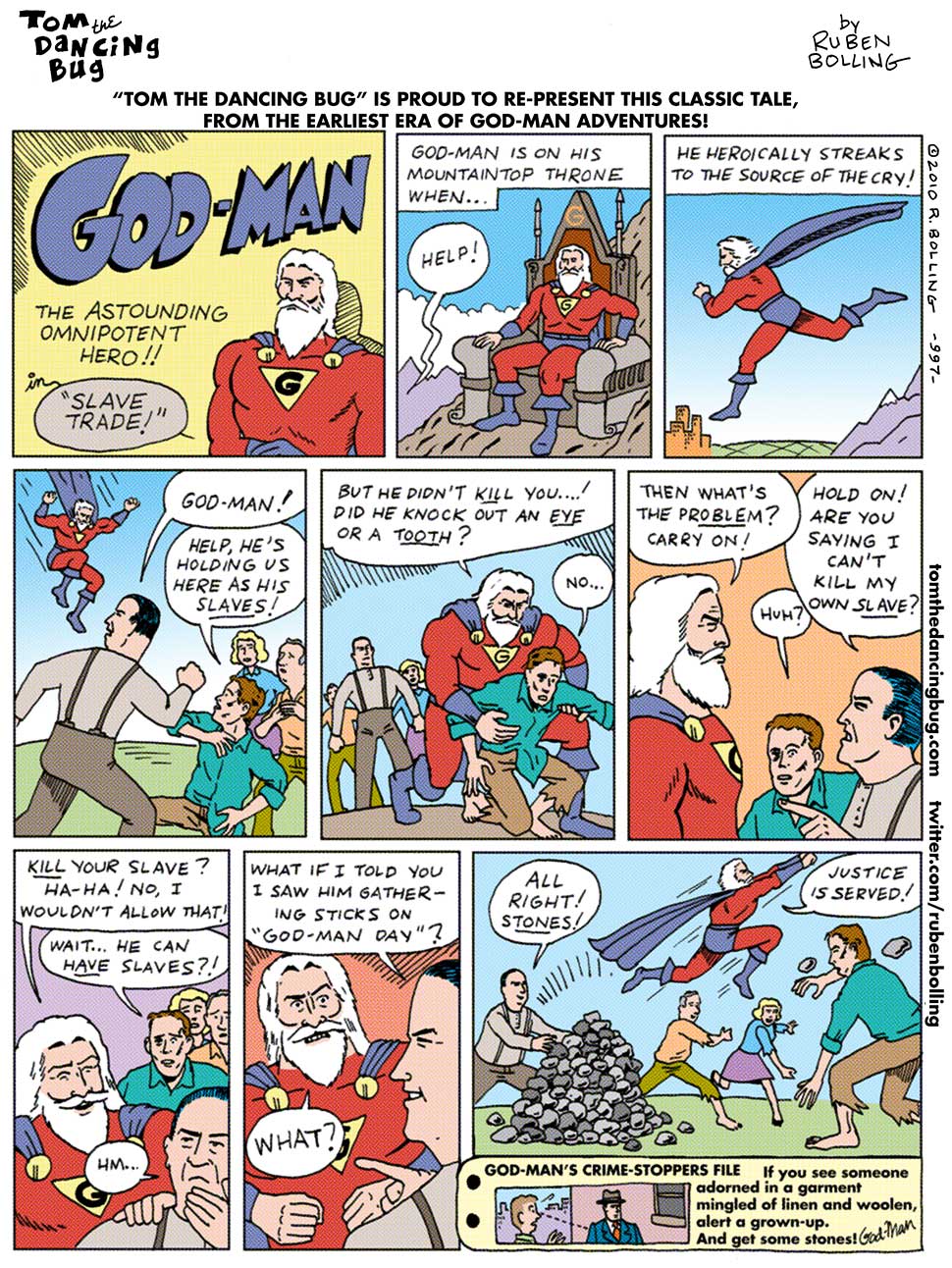
Tom the Dancing Bug: God-Man in “Slave Trade”

21 Jul