

Read more of this story at Slashdot.
Read more of this story at Slashdot.
Read more of this story at Slashdot.

Robert Richardson got a Nobel Prize for creating the first superfluid, a Bose-Einstein condensate comprised of chilled helium. But he started his talk at the Lindau Nobel Laureates Meeting by announcing that he'd be focusing purely on science policy—policy related to his work, given that the policy in question is the one that governs much of the world's stockpile of helium.
Because of how the US is privatizing its stock of the gas, prices are artificially low, which is encouraging a pattern of consumption that may leave us without significant supplies of the gas midway through the century.
Why is that significant? Richardson started by describing helium's more interesting properties, which are key to its commercial use. These include its chemistry—his slide led with the text, "helium has no chemistry; it is a mere placeholder between hydrogen and lithium on the periodic table." Being completely inert may seem rather dull, but for industries that work with highly reactive materials, this absence of chemistry can be essential.

Read the comments on this post
Read more of this story at Slashdot.
Read more of this story at Slashdot.
Everyone knows that Google and the other search engines between them crawl, spider, and slurp up the whole internet, right? Wrong! The millions of websites that are obviously available on the internet are readily searchable, Google Bing, Yahoo, and their ilk have seen to that, we can usually find documents, pages, digital images, videos, music, and public scientific datasets at low cost, rapidly and accurately. But, that’s just the surface, there are countless resources that are simply inaccessible to search engine bots, not least emails, FTP sites, IRC, and IM.
Then there is the Invisible Web, something about which I first wrote way back in the mid-1990s. The Invisible Web is the term used to describe the contents of publicly accessible databases that are revealed on a per-user basis on demand and mostly off-limits to search engines, with a few exceptions.
Definitely off-limits to all public search engines and all members of the public for that matter are private databases, corporate and institutional sites that are locked behind firewalls, passwords, and protective scripts.
However, some owners of chunks of the private web might be amenable to letting trusted users access their private parts, it’s just that the users don’t know the private data is there and the owners don’t know who to trust. Now, Peter Mork and colleagues at the Mitre Corporation in McLean, Virginia, have come up with a way to bring the two parties together. They have developed a way to publicize the existence of private web resources that draws on various summarization strategies and demonstrates a way to create a database summary, which they call a digest, that then becomes part of the announcement. They have then looked at the trade-off between the data owners’ desires to minimize disclosure of sensitive information and the searchers’ desires to maximize the accuracy of their searches.
As an example of the kind of private web Mork and colleagues are alluding to. Imagine a specialist in the spread of flu during an epidemic hoping to trawl medical records to figure out how many people might become infected, these are strictly off-limits to the general public and to most researchers for that matter? Or, what about an economist hoping to spot trends in stock market dealings to help warn of another credit crunch well before it happens? Again private deals, are…private, so they will have no access to that information. On the other, anonymized data might be available to help the specialist find data sources relevant to current research. Similarly, summarized data can point the economist to data relevant to his inquiry. But, these data can only be utilized if they can be found.
Mork and colleagues’ digest approach allows data owners to publish less sensitive versions of their data so that searchers can determine with which data owners they should negotiate access. In this way, the private web maintains its privacy, while becoming a little more searchable, thereby allowing researchers to spend more time doing research and less time struggling to find data.
 Peter Mork, Ken Smith, Barbara Blaustein, Christopher Wolf, Ken Samuel, Keri Sarver, & Irina Vayndiner (2010). Facilitating discovery on the private web using dataset digests International Journal of Metadata, Semantics and Ontologies, 5 (3), 170-183
The hidden, invisible, and private web is a post from: Sciencebase Science Blog

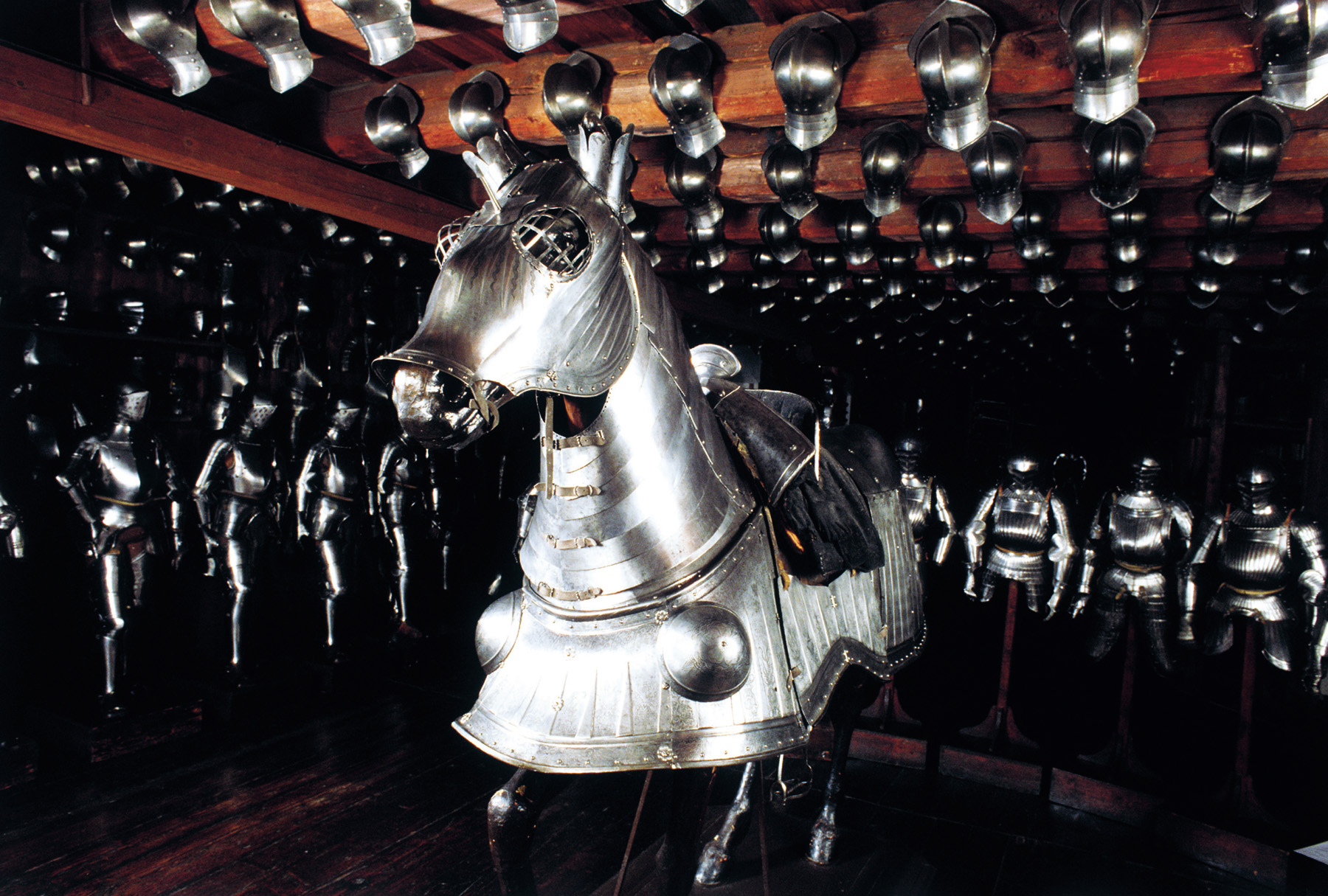
Home to close to 30,000 pieces of historical weaponry, the Zeughaus Museum in Graz Austria represents the area’s rich military heritage. The museum’s collection includes guns, swords, and armor, including this complete set of armor for a horse.
From the Upcoming  ueue, submitted by


As a site owner, possibly the worst experience that you could serve upon your visitors is a frustrating wait whilst the clock spins and the page loads. In most cases, most of your potential customers would have pressed the back button in their browser and headed off somewhere else; this inevitably means a loss of potential business.
Site speed is predicted to become one of Google’s next ranking factors, although as per normal, the company tends to keep the nitty-gritty close to its chest.
In a presentation in Las Vegas, when pressed on the subject of site speed integration into the Google search ranking algorithm, Matt Cutts, member of the Search Quality group at Google and a highly-regarded person in the SEO community, described this as one of his "what to expect in 2010" bullet points. He went on to explain that the company wanted search to be "real fast, as if you are flipping through a magazine."
What all of this should tell us is that if you wish your site to be user-friendly and well-positioned within the ranks of the major search engines, then you should be looking at ways to improve your web page performance. Apart from the myriad of options displayed in Google Webmaster Tools, including consolidating and compression of external files, and checking for broken links on your website, I would recommend looking at the way you use images. One of the best web design techniques out there is the use of CSS sprites.
It may be a common misconception that a sprite implies a series of small images. The opposite, in fact, is the truth — a CSS sprite is one large image.
You may be aware of the CSS technique of displaying an "on/off" state for a button which is contained within a single image and positioned using the background-position CSS attribute on :hover (see the tutorial on a button that uses CSS sprites). CSS sprites are basically the same concept: The image is displayed on the page using the coordinates specified in your CSS, and only this area will be visible.
It is easy to believe that a number of small images are likely to be less heavy in total file size than one containing all of the images positioned together. But even if you may have images that are only a few bytes in size, each one is giving your web server unnecessary work to do by sending an HTTP request. Each request contains a portion of overhead information that uses valuable site bandwidth.
Using CSS sprites can reduce the number HTTP requests and can make the web page seem more responsive because all interface elements are already downloaded before the user handles them. This technique can be very effective for improving site performance, particularly in situations where many small images, such as menu icons, are used.
Let’s discuss this topic using an example. Using Photoshop, I created a document with a series of images (logos of companies) and divided the area into chunks of 100 pixels (see the images below). I saved the file and named it logos.jpg.
I used 100-pixel measurements between logos for the purposes of illustrating the concept in this article and because this was a convenient distance to move the position of the CSS background image each time when manipulating the coordinates in my CSS (you should be more accurate when actually applying CSS sprites to reduce its file size further).
The CSS background image is focused on displaying only the first logo as defined by the green border — the coordinates of which are y = 0 and x = 0.

To position them, we use the background-position attribute.

To display the second image alongside the first, all that is necessary is to adjust the coordinates on the x-axis.
Because of the way we have constructed the image (at 100-pixel intervals), all we need do is add a line of CSS advancing the x-axis by 100 pixels to display each logo.

#logos {height: 64px; margin: 0; padding: 0; position: relative;}

#logos li {background: url(/logos.jpg) no-repeat top left; margin: 0; padding: 0; list-style: none; position: absolute; top: 0;}

#logos a {height: 64px; display: block;}
// First logo
#logos li a.jaz {background-position: 0 0}
// Second logo
#logos li a.iberotel {background-position: 0 -100px;}
// Third logo
#logos li a.solymar {background-position: 0 -200px;}
// Fourth logo
#logos li a.travcotels {background-position: 0 -300px;}
// Fifth logo
#logos li a.intercity {background-position: 0 -400px;}

In the example above, it was possible to reduce the file size from 52kb to 22kb and the number of HTTP requests from 5 to 1. This represents a good saving, and is only one small section of a web page!
Our new CSS sprite method tests well in most modern browsers. The notable exception is Opera 6 (all Opera versions, not just Opera 6, comprise 1.98% of all web browser usage[1]), which doesn’t apply a background image on link hover states. The links still do work, and if they’ve been labeled properly, the net result will be a static — but usable — image map in Opera 6. This could be an acceptable price to pay, especially now that Opera 7 has been around for a while.
Here is a list of suggested reading resources about CSS sprites.
 Peter Richards is a SEO engineer based near Brighton in the UK. He has also spent time as web designer and front-end developer (HTML, CSS, JavaScript). If you wish to connect with him, you can follow Peter on Twitter as @pgrichards.
