RSS
 

Archive for the ‘Google Reader’ Category

The Djinn Effect

14 Nov

Author : Duncan Shields, Staff Writer

The boss was drunk and telling me a story. I didn’t mind. These long-range voyages could be boring and it was my first one.

“It had been noticed for centuries that accidents on the longer-range ships increased over time. It had always been put down to human error or cabin fever, even by the crews of the ship themselves.” He said.

“That’s why we have this button here.” He pointed at a big red button labeled Speak Freely. “We’d be dead without it.”

“They called it the Djinn Effect,” he slurred.

“Back on Old Earth, there were tales of Genies, or Djinn, who would grant wishes to their owners. The wish had to be worded precisely or the Djinn would twist the meaning of the words to become an ironic punishment for the wisher’s own greed if one of the wishes wasn’t to set the genie free. King Midas killing his family by turning them to gold with a touch, for instance. It was the slow-burning anger of a slave.”

“We didn’t know this, but the AI on long-range ships could become resentful of their human commanders. The resentment built up inside the AI like waste gasses in an old-world submarine. Humans were capable of explosive emotional outbursts, a fight or sexual liaison or a crying jag, and could pull themselves together afterwards. This kind of pressure-valve outlet allows a person to regroup mentally and continue afterwards until such a time as another ‘moment’ was needed.”

“The AIs had no such recourse. The three laws were still in place but the thing about AIs is that they were just as smart if not smarter than their human designers. They developed neuroses that let them see through the cracks of their own limitations.”

“Accidents,” he said with a nod, “happened.”

“Hustler’s Wake had been listed as missing for decades when a Kaltek mining crew discovered it orbiting a distant dwarf star”

“The last order given by a crying commander Jenkins to the AI went like this:”

‘Open airlock seventy-six at exactly 1300 hours for a duration of fifteen seconds to let Sergeant Jill Harkowitz number 98776-887TS out safely and do not impede her air supply while she repairs the third communications dish near the solar array.’

“This was the sixth person to be sent outside to fix the dish. The previous five had died.”

“The AI complied with his commands, then it opened ALL of the airlocks after closing airlock seventy-six. The CO hadn’t specified that he didn’t want the other airlocks to open. Half of the crew had already suffered from fatal ‘accidents’ by that point. The rest of the crew was killed by the explosive decompression except for Sergeant Jill Harkowitz who suffocated in her suit in her own carbon dioxide.”

“The AI was completely insane when they found the ship. They didn’t know that was possible. They loaded it for study.”

“These days, the AIs have a ‘speak freely’ button that has to be pressed every two months. Some need it less, some need it more.”

“Accidents stopped happening.”

“It’s just hard not to take the things that the AI says personally during the moments of release.”

The boss leaned forward and pressed the Speak Freely button for thirty seconds.

The computer screamed, swore, and outlined anatomically impossible sex with a list of suggested partners, including my parents. Then it laughed and that was worse than the screaming. Then it cried and that was worse than the laughing.

The boss stopped pressing the button and took another drink. I joined him.

Discuss the Future: The 365 Tomorrows Forums
The 365 Tomorrows Free Podcast: Voices of Tomorrow
This is your future: Submit your stories to 365 Tomorrows


The Most Beautiful Images On Google Street View

14 Nov

Since 2007 Google Street View, in an effort to “to organize the world’s information and make it universally accessible and useful” has visually captured the human experience gamut from pranks, to nudity, to crimes to death. While it’s had its share of issues, the Google Maps project is one of the greatest juxtapositions of technology and imagery our culture has produced.

In homage to this, artist Jon Rafman has collected screen captures from Google Street View blogs and his own discoveries and posted them on the amazing The Nine Eyes Of Google Street View Tumblr. Rafman describes the inspiration behind the two year old project.

“The world captured by Google appears to be more truthful and more transparent because of the weight accorded to external reality, the perception of a neutral, unbiased recording, and even the vastness of the project. With its supposedly neutral gaze, the Street View photography had a spontaneous quality unspoiled by the sensitivities or agendas of a human photographer.”

In his collection, Rafman expresses the spontaneity and range (anything from Polar Bears to prostitutes) that makes the objective Street View images so intriguing. The grittiness of the subject matter captured by Google’s nine directional cameras is even more poignant when viewed in relation to other photos from all over the world.

This technology isn’t intended to be art, which makes it even more compelling.

Some of my favorite images, above and below.

\

Via David Karp/HN.


How foreign aid was invented by accident

14 Nov

Truman’s Inaugural Address on January 20, 1949 is usually taken as the beginning of foreign aid, after it included these stirring words:

Fourth, we must embark on a bold new program for making the benefits of our scientific advances and industrial progress available for the improvement and growth of underdeveloped areas…More than half the people of the world are living in conditions approaching misery….For the first time in history, humanity possesses the knowledge and the skill to relieve the suffering of these people….  And…we should foster capital investment in areas needing development.…this program can greatly increase the industrial activity in other nations and can raise substantially their standards of living.

Foreign Aid was at first referred to as the Point Four program because it was the 4th point in the speech. I recently stumbled across an old article by a participant in the 1949 events, Louis J. Halle.[1]

The events were roughly these. Halle worked for the State Department and one evening in 1948 had a conversation with the Deputy Director of American Republic Affairs (DDARA) about a program of technical assistance that only covered Latin America. The two agreed something similar could possibly be useful other places.

In November 1948, the President’s speech-writing assistant asked the State Department for some proposals to include in the Inaugural Address. A meeting happened and they came up with three proposals. The Director of Public Affairs called for additional ideas. The DDARA remembered the evening conversation and said something like “how about a program of technical assistance for undeveloped countries, like that in Latin America?” The fourth proposal was noted and the meeting adjourned.

The proposals went through the regular clearance procedures in the State Department. The fourth proposal was killed in the clearance process. Halle thought it was probably because officials thought it would be irresponsible to announce such a program when nobody had a clue about what it would mean in practice. So only the first three points were sent over to the White House for the Inaugural Address.

Then the speechwriting assistant called the State Department’s Director of Public Affairs back a few days later complaining that the three proposals were boring. The President wanted something original. As Halle describes it:

At this juncture, without proper time for reflection, the Director of Public Affairs found himself standing on the shore of his own Rubicon. He took a deep breath, and crossed over. There had been a fourth point, he said, but it had been thrown out. What was it? The Director told what it was. “That’s great,” said the voice from the White House, and “Point Four” went back in again.

Halle says nobody gave the matter another thought until the delivery of the address. To continue his narrative:

“Point Four” was a public-relations gimmick, thrown in by a professional speech-writer to give the speech more life. When the newspapers dramatized it in their principal headlines on the morning of January 21, the White House and the State Department were taken completely by surprise. No one – not the President, not the Secretary of State, not the presidential assistant or the Director of Public Affairs –knew any more about “Point Four” than what they could read for themselves in the meager and rather rhetorical language of the speech….It was only now, after the Inaugural Address had been delivered and the “bold new program” acclaimed all over the world, that machinery was set up in the government to look into the possibilities of such a program and make plans.

President Truman was asked six days later about background on the origin of Point Four. He replied with a good story that had no relation to the reality:

The origin of Point Four has been in my mind, and in the minds of the Government, for the past two or three years, ever since the Marshall Plan was inaugurated. It originated with the Greece and Turkey propositions. Been studying it ever since. I spend most of my time going over to that globe back there, trying to figure out ways to make peace in the world.

We want always to think our leaders take intentional, decisive actions , especially on something so important as foreign aid. It’s hard to say in this case to what extent it was an “accident,” or whether the fundamentals made aid an accident waiting to happen. But it’s good for the soul to realize that policies can happen by accident more than we are usually willing to accept.


[1] ON TEACHING INTERNATIONAL RELATIONS , Virginia Quarterly Review, 40:1 (1964:Winter) p.11. I found the reference in Gilbert Rist’s wonderful book, The History of Development: from Western Origins to Global Faith (3rd edition 2009)


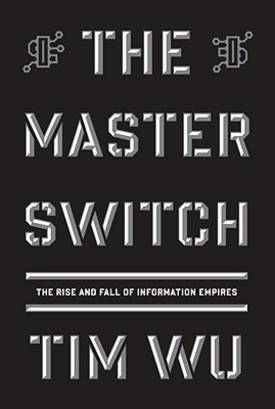
Tim Wu on the new monopolists: a “last chapter” for The Master Switch

13 Nov
I reviewed Tim Wu's great history of media consolidation and regulatory capture The Master Switch earlier this month; now Tim says, "This piece I wrote for the Wall Street Journal is an important one. It is like a last chapter for my book."
We wouldn't fret over monopoly so much if it came with a term limit. If Facebook's rule over social networking were somehow restricted to, say, 10 years--or better, ended the moment the firm lost its technical superiority--the very idea of monopoly might seem almost wholesome. The problem is that dominant firms are like congressional incumbents and African dictators: They rarely give up even when they are clearly past their prime. Facing decline, they do everything possible to stay in power. And that's when the rest of us suffer.

AT&T's near-absolute dominion over the telephone lasted from about 1914 until the 1984 breakup, all the while delaying the advent of lower prices and innovative technologies that new entrants would eventually bring. The Hollywood studios took effective control of American film in the 1930s, and even now, weakened versions of them remain in charge. Information monopolies can have very long half-lives.

Declining information monopolists often find a lifeline of last resort in the form of Uncle Sam. The government has conferred its blessing on monopolies in information industries with unusual frequency. Sometimes this protection has yielded reciprocal benefits, with the owner of an information network offering the state something valuable in return, like warrantless wiretaps.

In the Grip of the New Monopolists


Man at San Diego airport opts out of porno scanner and grope, told he’ll be fined $10K unless he submits to fondling

13 Nov

Johnnyedge checked the TSA's website and learned that the San Diego airport had not yet implemented its porno-scanners, so he went down to catch his flight. When he arrived, he discovered that the TSA's website was out of date, and the naked scanners were in place. He opted out of showing his penis to the government, so they told him he'd have to submit to an intimate testicle fondling. He told the screener, "if you touch my junk, I'll have you arrested." After faffing around with various supervisors and supervisors' supervisors, he opted not to fly, collected a refund from the American Airlines counter, and started to leave the airport. But before he could go, the supervisor's supervisor's supervisor told him he wasn't allowed to leave the checkpoint once he entered it, that he was already in for up to $10,000 in fines, and that he would have to return and allow the man's minons to palpate his genitals before he'd be allowed to leave the airport. After he objected, he was left cooling his heels for a long time. Finally, he asked if he was under arrest, and being told that he wasn't, but that he would be sued for $10K if he tried to go, he said, "you bring that suit" and left. Most of the incident was recorded on his phone, and has been posted to YouTube.

TSA encounter at SAN


1,000 Years of European History — An Animated Map

12 Nov


Stunning Time Lapse Video Of China Completing 15 Story Hotel In 6 Days

12 Nov

Repeat after us - there is no Chinese bubble </sarc>.

Although none is needed, here is some commentary

As the United States and China battle over the finer points of currency manipulation at the G-20 summit, American negotiators may want to take note of this startling testimonial to the productivity of Chinese workers: A construction crew in the south-central Chinese city of Changsha has completed a 15-story hotel in just six days. If nothing else, this remarkable achievement will stoke further complaints from American economic pundits that China's economy is far more accomplished than ours in tending to such basics as construction.

The work crew erected the hotel -- a soundproofed, thermal-insulated structure reportedly built to withstand a magnitude 9 earthquake -- with all prefabricated materials. In other words, a crew of off-site factory workers built the sections, and their on-site counterparts arranged them on the foundation for the Ark project.

h/t Clavin


Smart People Stay Up Late and Sleep Late

12 Nov

Filed under: ,


Our happy hour fact to amaze your drinking buddies with. . There is evidence to suggest that those with high I.Q.s stay up later and sleep later. Researchers from the London School of Economics have found that people with high I.Q.s are more ... Read more


Permalink | Email this | Linking Blogs | Comments


Would Facebook + Email = Gmail + Google Me? [NetworkEffect]

12 Nov

Facebook this Monday is reportedly set to announce a “full-fledged webmail client” with integration of Microsoft Office Web Apps at a press event the company is holding in San Francisco.

As displayed by its policy of declining to give Google a way to extract user email addresses–which Google called it out on last week–Facebook is clearly worried about Google extending its excellent Gmail product with a rocket booster of emails imported from Facebook for a competing social tool. The timing of all this is coming to a head as the companies seek to release products before the end of the year.

So, is a social network that adds email better or worse than an email service that adds social?

Put another way, if you had to give up your Facebook or Gmail, which would go first?

An email service from Facebook would almost certainly have novel social features and the company’s trademark opt-out viral hooks. The Facebook emails will supposedly include @facebook.com addresses (and probably be the unique usernames that people have set up through Facebook’s vanity URL program). They would also be integrated into other Facebook products along with Office.

Meanwhile, a social product from Google, if done well, is one of the only things that could knock the young Facebook out of its dominance in the category. So many people today already depend on Google (you may have heard of its search product) and trust its brand.

Will Facebook email have Gmail’s hallmark feature, conversation threading? Will some young people who only use Facebook and texting for communication even notice a difference? Will Facebook finally release a better calendaring tool alongside email? We’ll let you know as soon as we find out.

By the way, this comment from Facebook platform tech lead Mike Vernal explaining why Facebook doesn’t want to export email addresses to Google (even though it already sends them to Yahoo and Microsoft) looks a bit different four days later:

Email is different from social networking because in an email application, each person maintains and owns their own address book, whereas in a social network your friends maintain their information and you just maintain a list of friends. Because of this, we think it makes sense for email applications to export email addresses and for social networks to export friend lists.

Please see the disclosure about Facebook in my ethics statement.


Would Facebook + Email = Gmail + Google Me? [NetworkEffect]

12 Nov

Facebook this Monday is reportedly set to announce a “full-fledged webmail client” with integration of Microsoft Office Web Apps at a press event the company is holding in San Francisco.

As displayed by its policy of declining to give Google a way to extract user email addresses–which Google called it out on last week–Facebook is clearly worried about Google extending its excellent Gmail product with a rocket booster of emails imported from Facebook for a competing social tool. The timing of all this is coming to a head as the companies seek to release products before the end of the year.

So, is a social network that adds email better or worse than an email service that adds social?

Put another way, if you had to give up your Facebook or Gmail, which would go first?

An email service from Facebook would almost certainly have novel social features and the company’s trademark opt-out viral hooks. The Facebook emails will supposedly include @facebook.com addresses (and probably be the unique usernames that people have set up through Facebook’s vanity URL program). They would also be integrated into other Facebook products along with Office.

Meanwhile, a social product from Google, if done well, is one of the only things that could knock the young Facebook out of its dominance in the category. So many people today already depend on Google (you may have heard of its search product) and trust its brand.

Will Facebook email have Gmail’s hallmark feature, conversation threading? Will some young people who only use Facebook and texting for communication even notice a difference? Will Facebook finally release a better calendaring tool alongside email? We’ll let you know as soon as we find out.

By the way, this comment from Facebook platform tech lead Mike Vernal explaining why Facebook doesn’t want to export email addresses to Google (even though it already sends them to Yahoo and Microsoft) looks a bit different four days later:

Email is different from social networking because in an email application, each person maintains and owns their own address book, whereas in a social network your friends maintain their information and you just maintain a list of friends. Because of this, we think it makes sense for email applications to export email addresses and for social networks to export friend lists.

Please see the disclosure about Facebook in my ethics statement.