


Nestled in bustling Covent Garden, the Royal Opera House is home to The Royal Opera, The Royal Ballet and the Orchestra of the Royal Opera House. In its third structural incarnation since 1732 — two previous buildings were burned in fires in 1808 and 1856 — the Royal Opera House is a preeminent international performing arts venue but, unfortunately, the same couldn't be said of its crest, which looks like it has survived its own set of fires.

Old crest.

New crest.
The new identity has been designed by London-based SomeOne, who worked with master engraver Christopher Wormell to update the crest. Simon Manchipp, founder of SomeOne explains the challenges of the project:
1) The old royal crest was not digitally adept, it struggled to be clear at smaller sizes and wasn't elegant when employed on large scale applications.
2) The word mark typography only reflected the more classical side of the organization.
3) There were no firm rules for coherent design systems across the multiple messages given to their audiences.
We solved their issues with a re-cut royal crest designed to be equally elegant on both small and large applications. A new typographic approach based in the typeface 'Gotham' that updated the feel of the communications. Finally a series of design principles, grids and systems ensured that all the print, pixel and press applications join up in coherent and flexible branded applications.

The bottom-right image, if you are wondering (as I was), is the woodblock itself with ink and ready to print.



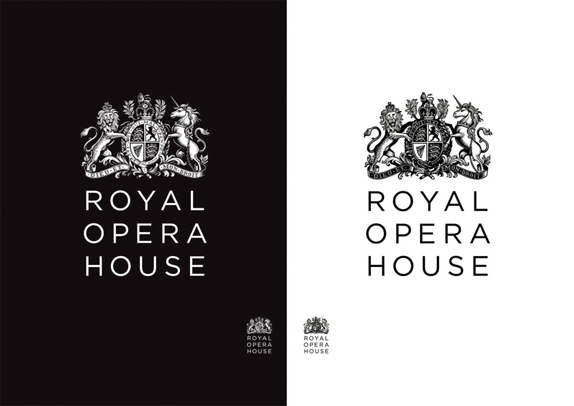
It goes without saying that the new crest is simply fantastic and I'm not one to easily compliment crests. The previous lion and unicorn looked as if Bambi had eaten their families and had nothing but droopy, sad eyes to show for it. The updated versions are proud and strong. And probably ate Bambi. My favorite aspect of it is that they created two versions, positive and negative, to use on light and dark backgrounds — instead of just inverting the positive version, as the old one did.
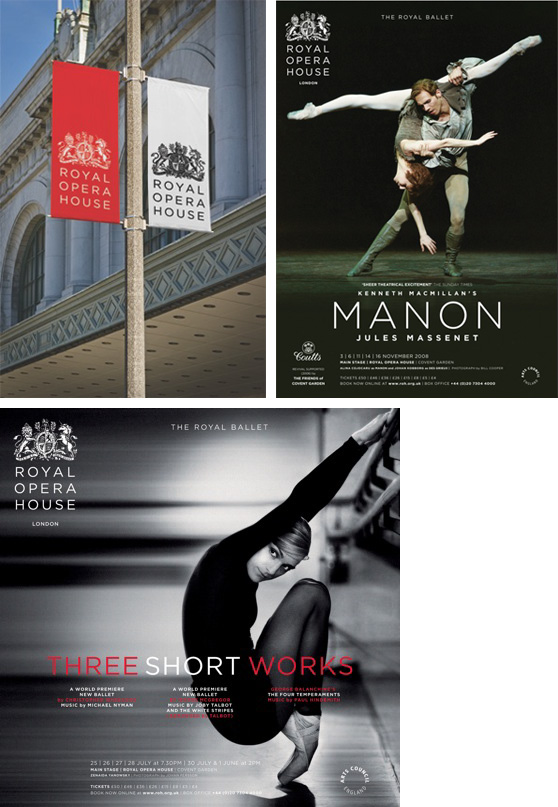

As striking as the new crest is, it would have been easy to screw it up with bad typography or poor use, but SomeOne has created a really sophisticated and contemporary identity that gives more prominence to the name of the venue and provides solid ground to build on the striking imagery of the performers. Set in one of the lighter versions of Gotham this is one of those instances where you forget you are looking at Gotham, because its use is subtle in the role of supporting actor, giving a new-fashioned twist to the old-fashioned crest. As whole, the identity is a very successful evolution of a centuries-old institution. Plus, the Queen agrees:
Naturally "The Palace" was consulted before anything went out, they very kindly granted the branding with Royal approval on the first proposal.


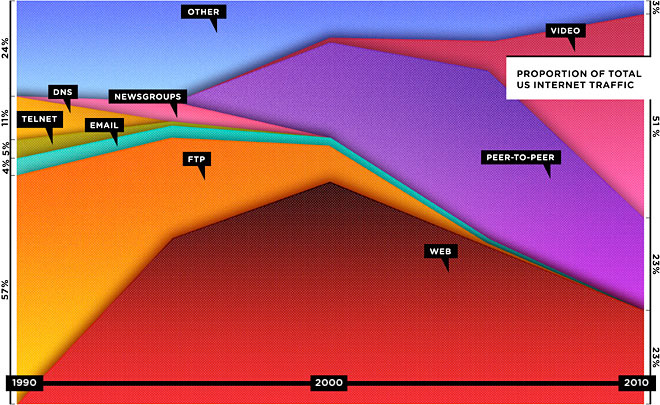 Their feature, The Web is Dead. Long Live the Internet, is live at Wired's own website.
Without commenting on the article's argument, I nonetheless found this graph immediately suspect, because it doesn't account for the increase in internet traffic over the same period. The use of proportion of the total as the vertical axis instead of the actual total is a interesting editorial choice.
Their feature, The Web is Dead. Long Live the Internet, is live at Wired's own website.
Without commenting on the article's argument, I nonetheless found this graph immediately suspect, because it doesn't account for the increase in internet traffic over the same period. The use of proportion of the total as the vertical axis instead of the actual total is a interesting editorial choice.You can probably guess that total use increases so rapidly that the web is not declining at all. Perhaps you have something like this in mind:
In fact, between 1995 and 2006, the total amount of web traffic went from about 10 terabytes a month to 1,000,000 terabytes (or 1 exabyte). According to Cisco, the same source Wired used for its projections, total internet traffic rose then from about 1 exabyte to 7 exabytes between 2005 and 2010.
So with actual total traffic as the vertical axis, the graph would look more like this.

Clearly on its last legs!
Assuming that this crudely renormalized graph is at all accurate, it doesn't even seem to be the case that the web's ongoing growth has slowed. It's rather been joined by even more explosive growth in file-sharing and video, which is often embedded in the web in any case.
Update: It's also worth adding that bandwidth, though an interesting measure of the internet's growth, isn't so good for measuring consumption. It doesn't map to time spent, work done, money invested, wealth yielded... Does 50MB of YouTube kitteh represent more meaningful growth than a 5MB Wired feature? And, as others point out in the comments, many of the new trends are still reliant on the web to work, especially social networking.


 The Global Footprint Network has announced that Earth Overshoot Day is fast approaching:
This Saturday, we will reach Earth Overshoot Day: the day when human demand on nature surpasses what nature can renewably supply...as of August 21st, humanity will have demanded an amount of ecological resources equivalent to what it takes nature 12 months to produce.From now until the end of the year, we will meet our needs by liquidating stocks and accumulating greenhouse gasses in the atmosphere.
According to the Global Footprint Network humanity crossed a threshold three decades ago when we stopped being able to live off of nature's interest -- "consuming resources and producing carbon dioxide at a rate lower than what the planet was able to regenerate and reabsorb each year" -- and started living beyond nature's capacity. They call this gap between human demand and nature's supply "ecological overshoot" (a concept that was devised by the UK-based new economics foundation).
The pace of this overshoot has grown each year (see links for 2007 and 2008 in the Worldchanging archives). Now the most recent data shows that "it takes one year and five months to regenerate the ecological services (production of resources and absorption of CO2) that humanity requires in one year." While this year's overshoot day comes about a month earlier than last year's, this is not due to a sudden change in human demand, but rather to improvements in the calculation methodology that have enabled the Global Footprint Network to more adequately capture the extent of overshoot. As an example, they report that the world has less biocapacity available, primarily in the area of grazing land, than previously estimated.

2010 Global Ecological Deficit (via "Global Footprint Network, National Footprint Accounts, 2009 edition. Available at www.footprintnetwork.org)
To learn more about how the Earth Overshoot Day is calculated, click here. Global Footprint Network President Mathis Wackernagel had this to say of the calculations:
"We would expect our estimates of overshoot to be, if anything, conservative. We know we are far from living within the means of one planet. The good news is, much of the technology we have to begin to address this problem is available and it is open source: things like compact urban design, energy-efficient housing, ecological tax reform, removal of resource subsidies, safe and affordable family planning, bicycles, low-meat diets, and life-cycle costing."
We couldn't agree more.
Some strategies for addressing the problem in the archives:
Related stories in the archives:
Help us change the world - DONATE NOW!
(Posted by Amanda Reed in Biodiversity and Ecosystems at 4:30 PM)

Pumping up is easier for people who have been buff before, and now scientists think they know why — muscles retain a memory of their former fitness even as they wither from lack of use.
 That memory is stored as DNA-containing nuclei, which proliferate when a muscle is exercised. Contrary to previous thinking, those nuclei aren’t lost when muscles atrophy, researchers report online August 16 in the Proceedings of the National Academy of Sciences. The extra nuclei form a type of muscle memory that allows the muscle to bounce back quickly when retrained.
The findings suggest that exercise early in life could help fend off frailness in the elderly, and also raise questions about how long doping athletes should be banned from competition, says study leader Kristian Gundersen, a physiologist at the University of Oslo in Norway.
Muscle cells are huge, Gundersen says. And because the cells are so big, more than one nucleus is needed to supply the DNA templates for making large amounts of the proteins that give muscle its strength. Previous research has demonstrated that with exercise, muscle cells get even bigger by merging with stem cells called satellite cells, which are nestled between muscle fiber cells. Researchers had previously thought that when muscles atrophy, the extra nuclei are killed by a cell death program called apoptosis.

Memory holding nuclei on muscle fiber light up in green.
In the new study, Gundersen’s team simulated the effect of working out by making a muscle that helps lift the toes work harder in mice. As the muscle worked, the number of nuclei increased, starting on day six. Over the course of 21 days, the hard-working muscle increased the number of nuclei in each fiber cell by about 54 percent. Starting on day nine, the muscle cells also started to plump up, adding an extra 35 percent to their volume. Those results indicate that the nuclei come first and muscle mass is added later.
In another set of experiments, the researchers worked the mice’s muscles for two weeks and then severed nerves leading to the muscle so the tissue would atrophy. As the muscle atrophied, the cells deflated to about 40 percent of their bulked-up volume, but the number of nuclei in the cells did not change.
These results contradict previous studies that show lots of cell death in muscles during atrophy. Gunderson’s team examined individual cells in the wasting muscles and found that there is apoptosis going on, but that other cells are dying, not the muscle fibers or their extra nuclei. The extra nuclei stick around for at least three months — a long time for a mouse, which lives a couple of years on average, Gundersen says.
“I don’t know if it lasts forever,†he says, “but it seems to be a very long-lasting effect.†Since the extra nuclei don’t die, they could be poised to make muscle proteins again, providing a type of muscle memory, he says.
“That’s fascinating thinking, and there’s nice proof in this article to support it,†says Bengt Saltin, a muscle physiologist at the University of Copenhagen in Denmark. “It’s really novel and helps to explain descriptive findings that muscles are quick to respond upon further training.â€
The study is likely to provoke strong reaction from some researchers, says Lawrence Schwartz, a cell biologist at the University of Massachusetts Amherst.
“It does fly in the face of a lot of peer-reviewed, published data,†he says. But the selective death of just some of the nuclei in a muscle cell would require a special kind of apoptosis. “The conventional wisdom doesn’t make much sense from a cell and molecular perspective,†Schwartz says. Gunderson’s group has come up with an explanation that seems more plausible. “Their data just feels right.â€
If the results hold up in people, sports agencies may want to reconsider how long they ban athletes suspended for taking steroids. Previous research has shown that testosterone boosts the number of nuclei in muscle cells beyond the amount produced by working out. “If you have nuclei that last forever, then you would also have an advantage that could last forever,†Gundersen says.
Well, maybe not exactly forever. As people age, their ability to build muscle mass declines. The new study suggests that pumping muscles full of nuclei early in life could help stave off muscle loss with age. “This could be an argument for mandatory physical training in schools,†Saltin says.
See Also:
Images: 1) left to right: Nubret, Schwarzenegger, Lou Ferrigno, ca. 1975. Flickr/d_vdm. 2) J.C. Bruusgaard/University of Oslo

By Duncan Geere, Wired UK
An architecture and design firm called Choi+Shine has submitted a design for the Icelandic High-Voltage Electrical Pylon International Design Competition which proposes giant human-shaped pylons carrying electricity cables across the country’s landscape.
The enormous figures would only require slight alterations to existing pylon designs, says the firm, which was awarded an honorable mention for its design by the competition’s judging board. It also won an award from the Boston Society of Architects Unbuilt Architecture competition.
On their website, the architecture firm said: “Making only minor alterations to well-established steel-framed tower design, we have created a series of towers that are powerful, solemn and variable. These iconic pylon-figures will become monuments in the landscape. Seeing the pylon-figures will become an unforgettable experience, elevating the towers to something more than merely a functional design of necessity.â€
The figures can be placed into different poses, with the suggestion that the landscapes could inform the position that the sculpture is placed into. For example, as a power line ascends a hill, the pylons could look as if they’re climbing. The figures could also stretch up to gain increased height over longer spans.
“Subtle alterations in the hands and head combined with repositioning of the main body parts in the x, y and z-axis, allow for a rich variety of expressions. The pylon-figures can be placed in pairs, walking in the same direction or opposite directions, glancing at each other as they pass by or kneeling respectively, head bowed at a town,†wrote the architects.
That doesn’t mean the manufacturing process has to be complex, however. Each pylon is made from the same basic bits (head, arms, torso, legs, etc.), which could be fabricated and then mounted into the desired position using pre-assembled joints.
Choi+Shine added: “Like the statues of Easter Island, it is envisioned that these 150-foot-tall modern caryatids will take on a quiet authority, belonging to their landscape yet serving the people, silently transporting electricity across all terrain, day and night, sunshine or snow.â€

Images: Choi+Shine
See Also:
