RSS
 

Archive for the ‘Google Reader’ Category

Panera Planning To Add More Pay-What-You-Want Restaurants

27 Jun

A month ago, Panera Bread Co. opened its first non-profit, pay-what-you-can-afford eatery, called the Saint Louis Bread Company Cares Café, in Clayton, MO. And the restaurant chain's chairman is so happy with the results, the company plans to launch two more in the coming months.

"I guess I would say it's performing better than we even might have hoped in our cynical moments, and it's living up to our best sense of humanity," Panera chairman Ron Shaich said of the experiment.

The restaurant's cashiers tell customers the suggested price of their orders and then the customers decide how much to pay. According to Shaich, between 60-70% pay the menu price. Around 15% dig into their pockets to pay a little more, while the other 15% or so pay less or even walk out paying nothing.

The restaurant, which features the same menu as Panera but is technically run by a non-profit organization called Panera Cares, took in $100,000 in revenue its first month. Panera supports the non-profit but is not on the hook financially if the pay-what-you-want restaurants fail.

Shaich didn't say where the non-profit's new locations would be. But a rep for Panera said they are looking for areas that will continue to attract an upscale diner, but is accessible to lower-income communities.


How Much Would You Pay At Panera If You Could Pay What You Want?survey software

Panera Co. to open more pay-what-you-wish eateries [AP]


Pile Isle Bamboo Bench by Elena Goray

25 Jun

Dutch designer Elena Goray, in cooperation with CONBAM, a bamboo distributor in Germany, has created the Pile Isle bamboo bench.

A bundle of brown bamboo poles is strapped together in smart and simple way. Just 4 belts of stainless steel are keeping the shape – no screw and no glue is necessary.

.

.


Aatrial House / KWK PROMES | Arch Daily

24 Jun

via http://www.archdaily.com/8262/aatrial-house-kwk-promes/


Write-only articles

23 Jun

I saw this on Twitter yesterday:

About 200,000 academic journals are published in English. The average number of readers per article is 5.

I don’t know where those numbers came from, but five readers per article sounds about right.

When I was a grad student, I felt like a fraud for writing papers that I wouldn’t want to read. Only later did I realize this is the norm.You’re forced to publish frequently. You can’t wait until you think you have something worthwhile to say.

If the average academic article has five readers, most would have fewer. Since some articles have hundreds of readers, there would have to be even more with practically no readers to balance out the average.

Readership may follow something like a power law distribution. It could be that the vast majority of articles have one or two readers even though some papers have thousands of readers.

Related posts:

Wendell Berry on publish-or-perish
Nearly everyone is above average
Networks and power laws


‘Lucy’s Grandfather’ Fossil Makes Humanity’s Ancestor Seem More Like Us

22 Jun

A 3.6 million-year-old fossil from one of humanity’s earliest ancestors is more human-like than expected — and much taller.

The discovery makes Lucy, the best-known fossil of all, appear to be exceptionally short by comparison. Lucy and the new skeleton are both Australopithecus afarensis, the first fully bipedal primate and a direct ancestor of humanity. Unlike Lucy and every other A. afarensis fossil, the new skeleton has complete forelimb and hindlimb bones, allowing researchers to estimate its size more accurately.

The new A. afarensis specimen stood between 5 and 5 1/2 feet tall, towering over Lucy’s 3-foot height. Other fossil fragments suggested that Lucy was an unreliable measuring stick for A. afarensis, but the new fossil is the most conclusive evidence yet. Dubbed “Kadanuumuu,” or Big Man, it is described June 21 in the Proceedings of the National Academy of Sciences.

Big Man’s limbs also appear well-suited for running, in contrast to the shortened gait implied by Lucy’s skeleton. The proportions compare to those found two million years later in Homo erectus, and would not be out of place in a modern human, said study co-author Owen Lovejoy, a Kent State University paleoanthropologist.

“The difference between Australopithecus and humans is much less than everyone expected,” said Lovejoy. “Upright walking and running were pretty advanced at 3.6 million years ago, and they didn’t change much over the next two million years. Most of the changes in that period of time took place elsewhere.”

Lovejoy was also part of the team that discovered Ardipithecus ramidus, a 4.4 million-year-old possible human ancestor that was officially described last October. Ardipithecus was far less chimp-like than expected.

That raises the possibility that it’s the other Great Apes, rather than humans, whose bodies have evolved the most over the last few million years.

Big Man, with a rib cage shaped more like our own than that of a chimpanzee or gorilla, reinforces that notion.

“Chimps and gorillas are again the unusual form. Hominids and ourselves bear many primitive traits that haven’t been specialized like they have in gorillas,” said Lovejoy.

“The classic cartoon of the ape turning into the human doesn’t work at all.”

Image: Yohannes Haile-Selassie/PNAS.

See Also:

Citation: “An early Australopithecus afarensis postcranium from Woranso-Mille, Ethiopia.” By
Yohannes Haile-Selassie, Bruce M. Latimer, Mulugeta Alene, Alan L. Deino, Luis Gibert, Stephanie M. Melillo, Beverly Z. Saylor, Gary R. Scott, C. Owen Lovejoy.

Brandon Keim’s Twitter stream and reportorial outtakes; Wired Science on Twitter. Brandon is currently working on a book about ecological tipping points.


He’s back: 60-foot Gundam is (almost) ready again

22 Jun

We spent quite a few posts on the uber-cool, gigantic Gundam statue that was erected in Tokyo Bay last year. The 60-foot robot statue was deconstructed in September, with Bandai quickly announcing plans to re-erect the big guy in Shizuoka soon. And now he’s almost ready.

Shizuoka is too far away from me to go and have a look at the big guy myself (it’s (125 miles west of Tokyo – where I live), but there are enough geeks living there, too. And thanks to two of them, we can show you the first photos of Gundam getting constructed.

As you can see (and as we reported earlier), Gundam already holds his “beam saber” in his right hand. According to Bandai, the weapon will start glowing when it gets dark.


If you have the chance to go to Shizuoka: Gundam will be on display from July 24, 2010 till January 10, 2011, right on East Shizuoka Square.


Via Buloblog [JP] and Troian [JP]


He’s back: 60-foot Gundam is (almost) ready again

22 Jun

We spent quite a few posts on the uber-cool, gigantic Gundam statue that was erected in Tokyo Bay last year. The 60-foot robot statue was deconstructed in September, with Bandai quickly announcing plans to re-erect the big guy in Shizuoka soon. And now he’s almost ready.

Shizuoka is too far away from me to go and have a look at the big guy myself (it’s (125 miles west of Tokyo – where I live), but there are enough geeks living there, too. And thanks to two of them, we can show you the first photos of Gundam getting constructed.

As you can see (and as we reported earlier), Gundam already holds his “beam saber” in his right hand. According to Bandai, the weapon will start glowing when it gets dark.


If you have the chance to go to Shizuoka: Gundam will be on display from July 24, 2010 till January 10, 2011, right on East Shizuoka Square.


Via Buloblog [JP] and Troian [JP]


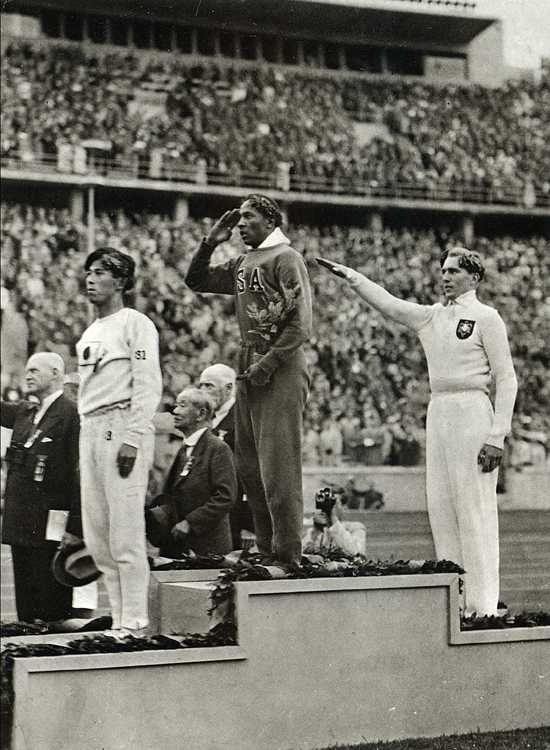
Jesse Owens

21 Jun

Hitler used the 1936 Olympics as a propaganda tool, inadvertently creating the modern Games, complete with torch relays, grand stadiums, publicity films and screens set up outside to transmit the Games. What the Nazis couldn’t stage-manage were the outcomes, and wonderful story of Jesse Owens smashing Hitler’s theories of racial superiority on the 100m sprint is an oft repeated story. (Enthusiastic crowd reaction on this clip suggests that the German people are less Aryan-obsessed than Hitler.Although his coach warned Owens about a potentially hostile crowd, there were German cheers of “Yesseh Oh-vens” or just “Oh-vens” from the crowd. Owens was a true celebrity in Berlin, mobbed by autograph seekers.)

It is oft mentioned that the Nazi leader refused to present Jesse Owens with his medal, shake his hand and subsequently stormed out of the stadium. However, Hitler was not even in the stadium when Jesse Owens was securing his medals, and his absence was more to do with his row with the Olympic organizers than with Owens . Hitler had congratulated German athletes on the first day, only to be informed by the IOC officials that he should congratulate all athletes or none, in order to show neutrality as the presiding head of state. In a characteristic fit of petulance, Hitler refused congratulate anyone after the first day of the competition, not even the German athletes. (Hitler did snub a black American athlete on the first day; just before Cornelius Johnson was to be decorated, Hitler left the stadium.)

Jesse Owens tried his best to correct the myth-making that went on around him: he admitted that he received the greatest ovations of his career at Berlin. he recalled:  “When I passed the Chancellor he arose, waved his hand at me, and I waved back at him. I think the writers showed bad taste in criticizing [Hitler] …. Hitler didn’t snub me—it was FDR who snubbed me. The president didn’t even send me a telegram”. Such was an atmosphere of segregation back in the U.S. that Owens was never invited to the White House to be congratulated. When there was a ticker-tape parade in New York in his honour, he had to attend the reception at the Waldorf-Astoria using the back elevator set aside for blacks. (Even in Berlin, he was allowed to travel and stay together with whites).


Filed under: Politics, Society Tagged: Hitler, Jesse Owens, Nazi, Olympics
 

Quick Tip: Multiple Borders with Simple CSS

21 Jun

Did you know that we can achieve multiple borders with simple CSS, by using the :after amd :before psuedo-classes? This is something I recently learned myself! I’ll show you how to add more depth to your designs, without images, in just a few minutes.


Final Code

<!DOCTYPE html>

<html lang="en">
<head>
	<meta charset="utf-8">
	<title>Multi-Borders</title>
	<style>
		body { background: #d2d1d0; }

		#box {
			background: #f4f4f4;
			border: 1px solid #bbbbbb;
			width: 200px;
			height: 200px;
			margin: 60px auto;
			position: relative;
		}

		#box:before {
			border: 1px solid white;
			content: '';
			width: 198px;
			height: 198px;
			position: absolute;
		}

		#box:after {
			content: '';
			position: absolute;
			width: 196px;
			height: 196px;
			border: 1px solid #bbbbbb;
			left: 1px; top: 1px;
		}
	</style>

</head>
<body>
	<div id="box"></div>
</body>
</html>

In short, any browser that supports the :before and :after psuedo-elements (all major browsers) can take advantage of this effect. Of course, there are alternatives, including the use of box-shadow, as well as adding additional mark-up to the page; however, this is clean solution that you should definitely consider. Thanks for watching!


Whatever Happened to Voice Recognition?

21 Jun

Remember that Scene in Star Trek IV where Scotty tried to use a Mac Plus?

Star-trek-4-apple-mac-plus

Using a mouse or keyboard to control a computer? Don't be silly. In the future, clearly there's only one way computers will be controlled: by speaking to them.

There's only one teeny-tiny problem with this magical future world of computers we control with our voices.

Voice-recognition-accuracy-rate-over-time

It doesn't work.

Despite ridiculous, order of magnitude increases in computing power over the last decade, we can't figure out how to get speech recognition accuracy above 80% -- when the baseline human voice transcription accuracy rate is anywhere from 96% to 98%!

In 2001 recognition accuracy topped out at 80%, far short of HAL-like levels of comprehension. Adding data or computing power made no difference. Researchers at Carnegie Mellon University checked again in 2006 and found the situation unchanged. With human discrimination as high as 98%, the unclosed gap left little basis for conversation. But sticking to a few topics, like numbers, helped. Saying “one” into the phone works about as well as pressing a button, approaching 100% accuracy. But loosen the vocabulary constraint and recognition begins to drift, turning to vertigo in the wide-open vastness of linguistic space.

As Robert Fortner explained in Rest in Peas: The Unrecognized Death of Speech Recognition, after all these years, we're desperately far away from any sort of universal speech recognition that's useful or practical.

Now, we do have to clarify that we're talking about universal recognition: saying anything to a computer, and having it reliably convert that into a valid, accurate text representation. When you constrain the voice input to a more limited vocabulary -- say, just numbers, or only the names that happen to be in your telephone's address book -- it's not unreasonable to expect a high level of accuracy. I tend to think of this as "voice control" rather than "voice recognition".

Still, I think we're avoiding the real question: is voice control, even hypothetically perfect voice control, more effective than the lower tech alternatives? In my experience, speech is one of the least effective, inefficient forms of communicating with other human beings. By that, I mean ...

  • typical spoken communication tends to be off-the-cuff and ad-hoc. Unless you're extremely disciplined, on average you will be unclear, rambling, and excessively verbose.
  • people tend to hear about half of what you say at any given time. If you're lucky.
  • spoken communication puts a highly disproportionate burden on the listener. Compare the time it takes to process a voicemail versus the time it takes to read an email.

I am by no means against talking with my fellow human beings. I have a very deep respect for those rare few who are great communicators in the challenging medium of conversational speech. Though we've all been trained literally from birth how to use our voices to communicate, voice communication remains filled with pitfalls and misunderstandings. Even in the best of conditions.

So why in the world -- outside of a disability -- would I want to extend the creaky, rickety old bridge of voice communication to controlling my computer? Isn't there a better way?

Robert's post contains some examples in the comments from voice control enthusiasts:

in addition to extremely accurate voice dictation, there are those really cool commands, like being able to say something like "search Google for Balloon Boy" or something like that and having it automatically open up your browser and enter the search term -- something like this is accomplished many times faster than a human could do it. Or, being able to total up a column of numbers in Microsoft Excel by saying simply "total this column" and seeing the results in a blink of an eye, literally.

That's funny, because I just fired up the Google app on my iPhone, said "balloon boy" into it, and got .. a search for "blue boy". I am not making this up. As for the Excel example, total which column? Let's assume you've dealt with the tricky problem of selecting what column you're talking about with only your voice. (I'm sorry, was it D5? B5?) Wouldn't it be many times faster to click the toolbar icon with your mouse, or press the keyboard command equivalent, to sum the column -- rather than methodically and tediously saying the words "sum this column" out loud?

I'm also trying to imagine a room full of people controlling their computers or phones using their voices. It's difficult enough to get work done in today's chatty work environments without the added burden of a floor full of people saying "zoom ... enhance" to their computers all day long. Wouldn't we all end up hoarse and deaf?

Let's look at another practical example -- YouTube's automatic speech recognition feature. I clicked through to the first UC Berkeley video with this feature, clicked the CC (closed caption) icon, and immediately got .. this.

Uc-berkeley-physics-lecture

"Light exerts force on matter". But according to Google's automatic speech recognition, it's "like the search for some matter". Unsurprisingly, it does not get better from there. You'd be way more confused than educated if you had to learn this lecture from the automatic transcription.

Back when Joel Spolsky and I had a podcast together, a helpful listener suggested using speech recognition to get a basic podcast transcript going. Everything I knew about voice recognition told me this wouldn't help, but harm. What's worse: transcribing everything by hand, from scratch -- or correcting every third or fourth word in an auto-generated machine transcript? Maybe it's just me, but the friction of the huge error rate inherent in the machine transcript seems far more intimidating than a blank slate human transcription. The humans may not be particularly efficient, but they all add value along the way -- collective human judgment can editorially improve the transcript, by removing all the duplication, repetition, and "ums" of a literal, by-the-book transcription.

In 2004, Mike Bliss composed a poem about voice recognition. He then read it to voice recognition software on his PC, and rewrote it as recognized.

a poem by Mike Bliss

like a baby, it listens
it can't discriminate
it tries to understand
it reflects what it thinks you say
it gets it wrong... sometimes
sometimes it gets it right.
One day it will grow up,
like a baby, it has potential
will it go to work?
will it turn to crime?
you look at it indulgently.
you can't help loving it, can you?
a poem by like myth

like a baby, it nuisance
it can't discriminate
it tries to oven
it reflects lot it things you say
it gets it run sometimes
sometimes it gets it right
won't day it will grow bop
Ninth a baby, it has provincial
will it both to look?
will it the two crime?
you move at it inevitably
you can't help loving it, cannot you?

The real punchline here is that Mike re-ran the experiment in 2008, and after 5 minutes of voice training, the voice recognition got all but 2 words of the original poem correct!

I suspect that's still not good enough in the face of the existing simpler alternatives. Remember handwriting recognition? It was all the rage in the era of the Apple Newton.

Doonesbury-newton

It wasn't as bad as Doonesbury made it out to be. I learned Palm's Graffiti handwriting recognition language and got fairly proficient with it. More than ten years later, you'd expect to see massively improved handwriting recognition of some sort in today's iPads and iPhones and iOthers, right? Well, maybe, if by "massively improved" you mean "nonexistent".

While it still surely has its niche uses, I personally don't miss handwriting recognition. Not even a little. And I can't help wondering if voice recognition will go the same way.

[advertisement] JIRA 4 - Simplify bug tracking for everyone involved. Get started from $10 for 10 users »