During Milan Design Week 2010, Environment Furniture exhibited their most recent pieces in a showroom in Milan’s Zona Tortona district.

.


Visit the Environment Furniture website – here.
.
During Milan Design Week 2010, Environment Furniture exhibited their most recent pieces in a showroom in Milan’s Zona Tortona district.
.
Visit the Environment Furniture website – here.
.
Mount Fuji Architects Studio have designed the PLUS house in Shizuoka, Japan.
Full description after the photos….

.


Description of the PLUS House by Mount Fuji Architects Studio:
The site locates on mountainside of Izu-san, where Pacific Ocean can be looked down on the south. The untouched wilderness, covered with deciduous broad-leaved trees such as cherry trees and Japanese oaks, gives little level ground. But we saw faint glimmer of architectural possibility along the ridge.
The architecture would be used as villa for weekends. I didn’t want to just form the undulating landscape dotted with great trees as normal, nor design an elaborate architecture bowing down to the complex topography. What sprang to my mind is a blueprint for an architecture which is perfectly autonomous itself, at the same time seems to emerge as an underlying shape that the natural environment has been hiding. It’s abstraction of nature, to say. The architecture was realized by crossing two rectangular parallelepipeds at very right angles. The lower one contains private rooms and bathroom, and sticks half of the body out to existing narrow level ground. The upper one incorporates salon and kitchen, and lies astride the lower one and the mountain ridge. It almost seems like an off-centered cross pinned carefully on natural terrain. One axis of the cross stretches toward the Pacific Ocean on south, and the other, the forest of Japanese oak and some white birch on west. The rooms in the lower structure and terrace on it enjoy broad vista of the sea and blue sky. And gentle shade of natural forest embraces the space in the upper one. Water-polished white marble (cami #120) was chosen as interior finishing material. It glows softly like Greece sculptures to blend blue light from the south and green light from the west gradationally, thus creates delicate continuous landscape of light which suggests the character and usage of the space. Exterior is also finished with white marble. The surface get smoother as it approaches to the southern/western end till it takes mirror gloss (cami #1000) at the ends. The southern end of white cross melts into the blue of sky and sea, and the eastern end to the green of forest. Abstraction is nothing to conflict with nature here. Carved out of nature, it never stops being a part of nature itself, however highly abstracted. Never relativizes the nature with its foreignness, nor generate contradiction to settle for being “artificial nature†by giving up being abstract and mimicking the nature.The abstraction inspired by Mother Nature defines the nature itself, and still, stays natural. That’s what I wanted from this abstraction and architecture.
Visit the website of Mount Fuji Architects Studio – here.
Photography by Ken’ichi Suzuki
Mount Fuji Architects Studio have designed the PLUS house in Shizuoka, Japan.
Full description after the photos….
.
Description of the PLUS House by Mount Fuji Architects Studio:
The site locates on mountainside of Izu-san, where Pacific Ocean can be looked down on the south. The untouched wilderness, covered with deciduous broad-leaved trees such as cherry trees and Japanese oaks, gives little level ground. But we saw faint glimmer of architectural possibility along the ridge.
The architecture would be used as villa for weekends. I didn’t want to just form the undulating landscape dotted with great trees as normal, nor design an elaborate architecture bowing down to the complex topography. What sprang to my mind is a blueprint for an architecture which is perfectly autonomous itself, at the same time seems to emerge as an underlying shape that the natural environment has been hiding. It’s abstraction of nature, to say. The architecture was realized by crossing two rectangular parallelepipeds at very right angles. The lower one contains private rooms and bathroom, and sticks half of the body out to existing narrow level ground. The upper one incorporates salon and kitchen, and lies astride the lower one and the mountain ridge. It almost seems like an off-centered cross pinned carefully on natural terrain. One axis of the cross stretches toward the Pacific Ocean on south, and the other, the forest of Japanese oak and some white birch on west. The rooms in the lower structure and terrace on it enjoy broad vista of the sea and blue sky. And gentle shade of natural forest embraces the space in the upper one. Water-polished white marble (cami #120) was chosen as interior finishing material. It glows softly like Greece sculptures to blend blue light from the south and green light from the west gradationally, thus creates delicate continuous landscape of light which suggests the character and usage of the space. Exterior is also finished with white marble. The surface get smoother as it approaches to the southern/western end till it takes mirror gloss (cami #1000) at the ends. The southern end of white cross melts into the blue of sky and sea, and the eastern end to the green of forest. Abstraction is nothing to conflict with nature here. Carved out of nature, it never stops being a part of nature itself, however highly abstracted. Never relativizes the nature with its foreignness, nor generate contradiction to settle for being “artificial nature†by giving up being abstract and mimicking the nature.The abstraction inspired by Mother Nature defines the nature itself, and still, stays natural. That’s what I wanted from this abstraction and architecture.
Visit the website of Mount Fuji Architects Studio – here.
Photography by Ken’ichi Suzuki


 Although before his inauguration U.S. President Barack Obama was rarely seen without his BlackBerry, he has criticized the current crop of popular consumer gadgets for helping make information a “distraction.â€
The context of his comments is important; Obama was talking about the importance of education and Thomas Jefferson’s realization that citizens must stay informed to make a democracy work. If quoted out of context, though, his comments might not be too popular with freedom of speech advocates — or gadget lovers, for that matter.
“You’re coming of age in a 24/7 media environment that bombards us with all kinds of content and exposes us to all kinds of arguments, some of which don’t always rank all that high on the truth meter,†the AFP reports Obama saying during a talk at Hampton University in Virginia.
“With iPods and iPads and Xboxes and PlayStations — none of which I know how to work — information becomes a distraction, a diversion, a form of entertainment, rather than a tool of empowerment, rather than the means of emancipation.â€
Obama, arguably the most social media savvy of all U.S. presidents, went on to suggest that the traction gained by the “craziest claims†from blogs and talk radio outlets is “putting new pressures on our country and on our democracy.â€
What do you think? Is Obama right to highlight how hard it can be to differentiate disreputable sources from the responsible ones (unless you’re really media savvy)? Are iPads, iPods, Xbox 360s and PlayStation 3s making the problem worse, or is he finding causation where none exists? Have your say in the comments section below.
Tags: barack obama, ipad, iphone, media, playstation 3, politics, Xbox 360
* In 1974 with 36.1% of oil from foreign sources, President Richard Nixon said, “At the end of this decade, in the year 1980, the United States will not be dependent on any other country for the energy we need.â€From a presentation by Mike Milken posted at The Money Game, via The Christian Science Monitor, via Oregon Expat.
* In 1975 with 36.1% of oil from foreign sources, President Gerald Ford said, “We must reduce oil imports by one million barrels per day by the end of this year and by two million barrels per day by the end of 1977.â€
* In 1979 with 40.5% of oil from foreign sources, President Jimmy Carter said, “Beginning this moment, this nation will never use more foreign oil than we did in 1977 – never.â€
* In 1981 with 43.6% of oil from foreign sources, President Ronald Reagan said, “While conservation is worthy in itself, the best answer is to try to make us independent of outside sources to the greatest extent possible for our energy.â€
* In 1992 with 47.2% of oil from foreign sources, President George Bush said, “When our administration developed our national energy strategy, three principles guided our policy: reducing our dependence on foreign oil…â€
* In 1995 with 49.8% of oil from foreign sources, President Bill Clinton said, “The nation’s growing reliance on imports of oil…threatens the nation’s security…[we] will continue efforts to…enhance domestic energy production.â€
* In 2006 with 65.5% of oil from foreign sources, President George W. Bush said, “Breakthroughs…will help us reach another great goal: to replace more than 75 percent of our oil imports from the Middle East by 2025.â€
* In 2009 with 66.2% of oil from foreign sources, President Barack Obama said, “It will be the policy of my administration to reverse our dependence on foreign oil while building a new energy economy that will create millions of jobs.â€


If you're like me you're more than a little sick of GM's Ed Whitacre tv ad. So are more than a few U.S. Senators and lawmakers. From Fox:
General Motors has been running ads on all the major networks claiming the company repaid its $6.7 billion U.S. government loan "with interest five years ahead of the original schedule." General Motors Company CEO Ed Whitacre can be seen in the ad walking through an auto plant as he touts the company's progress.
But lawmakers, and even the inspector general for the bailout fund GM borrowed from, point out that General Motors only repaid the bailout money by dipping into a separate pot of bailout money. They say the company did not actually use its own earnings to make the early payment and are questioning why executives are making such a big deal out of it.
The workings of the bailout and what is actually being repaid and how are complex but simplified basically GM is repaying their "loan" with other money from the government, not from any actual earnings.
The $6.7 billion is also just a fraction of the $52 billion General Motors received in government aid. Grassley said lawmakers are being told government losses on GM are expected to exceed $30 billion.
The TARP inspector general, Neil Barofsky, bluntly told the Senate Finance Committee during a hearing last week that the repayment "is just other TARP money" and lawmakers should not "exaggerate" the feat.
"It sounds like they're kind of like taking money out of one pocket and putting it in the other to do that," Sen. Tom Carper, D-Del., said at the hearing.
And of GM’s Vice Chairman Stephen Girsky:
General Motors admits that the company is repaying the loan with other government money, but says a year ago "nobody thought we'd be able to pay this back."
Gee, that's really reassuring.
Here's Ed Whitacre's complete ad, somewhat ironically titled "Trust":



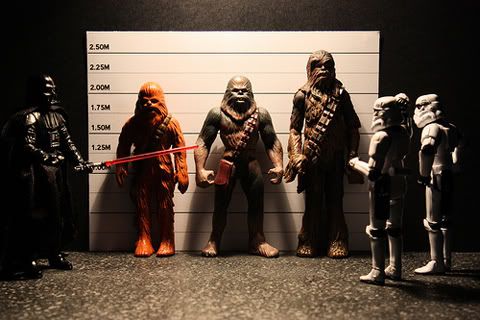
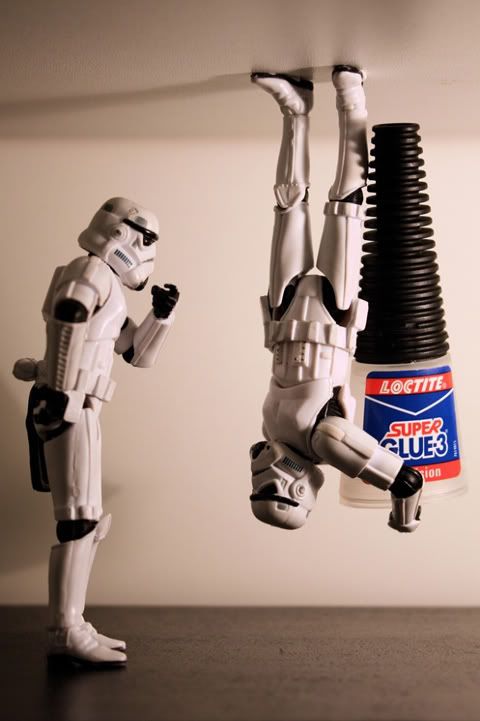
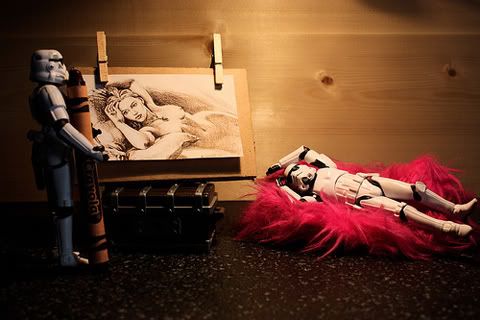
Here’s what Stormtroopers do when they have some free time. Check out Stéfan’s photostream on Flickr for more photos. Thank you Slaven for the link!

Rottet Studio have designed the office interior for Artis Capital Management in San Francisco.

.
Description by Rottet Studio:
The design team aimed to create a relaxing work space tailored to the company’s unique culture, the San Francisco environment and an environment that was more home than office to the 14-person trading team. The office was conceived as a “white box.†As the white planes peel away, the materials, textures and colors behind are revealed resulting in a “visually quietâ€Â space which counteracts the constant visual stimulation of multiple computer screens. No walls touch the perimeter and service areas are located around the core, allowing clear views throughout the space of the entire city. Custom carpet emulates water lapping on the shore. A dark gray cleft stone surrounds the entire floor between columns to reinforce the notion of rippling tides at the water’s edge. Along the Bay side, incisions are cut into the white box in the ceiling in a pattern that emulates barges in the Bay. These incisions are carved away to reveal a warm wood material beyond and provide ambient light. The city side is more rigid and orthogonal mimicking the city’s grid pattern. The six small offices double as mini art galleries. A giant door conceals the work area and, when closed, the room is void of visual elements allowing the impressive art collection to be the feature. The lounge-style chairs with matching ottomans allow employees to retreat into their “home†and relax.


Visit Rottet Studio’s website – here.
.
.
Rottet Studio have designed the office interior for Artis Capital Management in San Francisco.
.
Description by Rottet Studio:
The design team aimed to create a relaxing work space tailored to the company’s unique culture, the San Francisco environment and an environment that was more home than office to the 14-person trading team. The office was conceived as a “white box.†As the white planes peel away, the materials, textures and colors behind are revealed resulting in a “visually quietâ€Â space which counteracts the constant visual stimulation of multiple computer screens. No walls touch the perimeter and service areas are located around the core, allowing clear views throughout the space of the entire city. Custom carpet emulates water lapping on the shore. A dark gray cleft stone surrounds the entire floor between columns to reinforce the notion of rippling tides at the water’s edge. Along the Bay side, incisions are cut into the white box in the ceiling in a pattern that emulates barges in the Bay. These incisions are carved away to reveal a warm wood material beyond and provide ambient light. The city side is more rigid and orthogonal mimicking the city’s grid pattern. The six small offices double as mini art galleries. A giant door conceals the work area and, when closed, the room is void of visual elements allowing the impressive art collection to be the feature. The lounge-style chairs with matching ottomans allow employees to retreat into their “home†and relax.
Visit Rottet Studio’s website – here.
.
.
The shelves in my office are overflowing with so many books that I’ve started hiding them other places around the house (the bathroom closest now has a complete set of the Harvard Classics).
My wife can’t understand why I need to keep buying even more books (and she doesn’t even know about the bathroom library yet) but now I have an excuse to justify my bibliophilism: The more books I have the better our kid will do in school.
After examining statistics from 27 nations, a group of researchers found the presence of book-lined shelves in the home — and the intellectual environment those volumes reflect — gives children an enormous advantage in school.
“Home library size has a very substantial effect on educational attainment, even adjusting for parents’ education, father’s occupational status and other family background characteristics,†reports the study, recently published in the journal Research in Social Stratification and Mobility. “Growing up in a home with 500 books would propel a child 3.2 years further in education, on average, than would growing up in a similar home with few or no books.
“This is a large effect, both absolutely and in comparison with other influences on education,†adds the research team, led by University of Nevada sociologist M.D.R. Evans. “A child from a family rich in books is 19 percentage points more likely to complete university than a comparable child growing up without a home library.â€
This effect holds true regardless of a nation’s wealth, culture or political system, but its intensity varies from country to country. In China, a child whose parents own 500 books will average 6.6 more years of education than a comparable child from a bookless home. In the U.S., the figure is 2.4 years — which is still highly significant when you consider it’s the difference between two years of college and a full four-year degree.
By the way, if you talk to my wife, please don’t mention that whole “correlation doesn’t equal causation†thing to her.
(Via: Neatorama)