RSS
 

Archive for the ‘Uncategorized’ Category

Confederating Social Media

29 Sep
Geoff Livingston via The Buzz Bin shared by 4 people

Fountains.jpg

Confederate: United in a league, alliance, or conspiracy (image by Geoff Livingston).

Creating social media strategies for large organizations can be unwieldy. Disparate divisions, brands, product launches, autonomous departments, budgets and line items can give corporate communicators a tough time as they bridge their companies into the social era.

Some organizations can manage their organizations well enough to federate their social media efforts under one roof. Now some very basic best practices are arising. According to the Fortune 500 Business Blogging Wiki, 62 of the country’s largest companies are already engaged. But others cannot, and they must look to create a different model, one we have started calling the confederate model.

staralliance.jpgThere are many organizations that simply cannot get all of their parts to agree on a unified strategy. For example, consider national non-profits that have local autonomous chapters. Other corporate structures where this problem can arise include partnerships like large law firms, franchise models that feature local owners and undefined marketing structures, and automobile dealerships (Star Alliance image by Nergiz).

For all intents and purposes, these loosely organized bodies can do what they like. This creates enormous challenges online, in large part because of the disparate efforts can confuse customers, as well as fracture brand conversations. Indeed, a communicator needs to acknowledge that there will always be a healthy majority of internal stakeholders who will never engage in the larger social media stratey.

Building a Confederated Model

Instead of trying to control the social media effort under one roof, confederated models try to empower individual stakeholders in the larger organization. A confederated model for a company or non-profit assumes and includes the following:

  • Lack of control on the local frontline
  • An engaged communicator who will use social tools, regardless of corporate communication activities
  • That same communicator will likely cooperate if they are free to communicate as they like
  • Corporate decides to build a framework of tools for local chapters
  • Tools include social network and blogging platforms, graphics, tagging guidelines, and social media best practice training and guidelines
  • A corresponding corporate initiative that embodies best practices
  • “Wayward” efforts are met with suggestions for betterment rather than enforcement
  • A continuing commitment by corporate to highlight great local case studies
  • A continuing commitment to enhance, better and promote the framework
  • In addition to building the actual framework, a great deal of the effort involves internal alliance building and communications. Local stakeholders need to be made aware of and convinced about the effectiveness of the social media tool sets.

    Of course, what would a proposed stategic model be without a case study? One needs to go no further than the Obama campaign’s social media efforts. This is an ongoing effort.

    Partisan politics aside, Obama’s campaign communications involves intense grassroots activities using social media tools. Tens of thousands of Obama campaigners, advocates and even casual voters are enabled to spread the message.

    At the heart of the effort is activism on more than a dozen social networks, as well as the Obama campaign’s web site. Bloggers using the Obama platform have even posted negatively against policies or Obama actions.

    Not your average political campaign, but one that does fit into the confederated model. The Obama campaign is less concerned about individual flare outs and control, and much more oriented towards word of mouth and viral grass roots activism. The results have been self-evident.

     
    Comments Off on Confederating Social Media

    Posted in Uncategorized


    Height

    28 Sep
    (author unknown) via xkcd.com shared by 23 people

    Interestingly, on a true vertical log plot, I think the Eiffel Tower's sides really would be straight lines.
     
    Comments Off on Height

    Posted in Uncategorized


    Persuade People with Subconscious Techniques [People Hacks]

    28 Sep
    Gina Trapani via Lifehacker shared by 6 people

    The power of persuasion can get you far in this world, even if you're not in sales, and a few simple communication techniques can go a long way to get someone to agree with you. Tutorial site wikiHow runs down "subconscious" actions for persuading others, like framing, mirroring, timing, or even touching the person on the arm or shoulder. This list is similar to our previously posted (and controversial!) top 10 conversation hacks. How do you convince someone to come on over to your side in conversation? Let us know in the comments. Photo by jurvetson.


    Comments Off on Persuade People with Subconscious Techniques [People Hacks]

    Posted in Uncategorized


    Hyperwords.net

    28 Sep
    I'm interested in what people think of this browser approach and Firefox plugin, Hyperwords, now in version 5.0

    There's both a user-driven version, demonstrated above, as well as a client-side version that turns every word on a website into a hotlink. The former seems like a great way to be carrying a little toolset with your cursor everywhere you go. The latter seems like a great way to build a giant hypertext community around a book Finnegans Wake or even the Torah.

    Is this a dimensional leap for web browsing, just another plug-in, or somewhere in-between?

     
    Comments Off on Hyperwords.net

    Posted in Uncategorized


    10 tools for listening in social media.

    28 Sep
    Mike Fruchter via MichaelFruchter.com shared by 12 people

    This post highlights 10 tools for discovery and managing url and brand chatter. If you’re doing business online or offline, these tools are essential. As the saying goes, “keeping your ear to the street.”

    1) Google Blog/Web Search:

    Google web search should be your obvious first choice for listening. Web search will sometimes drown you in thousands of pages of results, most of which is often not relevant or current to your search query. Web search is great for research and historical purposes. When you are listening for real time chatter about your brand, Google blog search is the tool you need to be using. Most chatter either positive or negative can track back to the source, bloggers, blog postings, and comments left on blogs.

    2) Google Custom Search:

    Google Custom Search allows you to create a custom search engine that only searches the keywords and sites you specify. It’s basically a filtering layer over the main search engine. Custom Search can be used for an endless amount of purposes. It can be a very effective and a productive tool in your arsenal, and it just takes a few minutes to set up.

    3) Google Alerts:

    Google Alerts are email updates of the latest relevant Google results (web, news, etc.) based on your choice of query or topic. Creating an alert is as simple as the screen shot above shows. Input the keyword, sources to search, or leave it set at the default of comprehensive, this will search everything. Lastly set your email alert frequency.

    4) Google Reader:

    It’s simply not feasible to visit hundreds of websites/blogs a day looking for brand mentions, chatter. Google Reader makes it possible to stay on top of several hundred websites in one place.This is as close to real time as you will get courtesy of RSS feeds. As I mentioned earlier, there is a good chance that you will find chatter on blog postings and comments. Compile a relevant list of these blog RSS feeds and if possible their comment RSS feed as well. As you come across them, input them into Google Reader. If a source does not have RSS implemented, a custom search filter will do the trick. Google Reader should be your central hub for content discovery, digestion, redistribution and monitoring.

    5) Twitter:

    Twitter can be, if not as equally important as Google Blog search for discovery of mentions regarding your brand. Twitter needs to be paid special attention to. It’s no longer the shiny toy for early adopters, it’s gone mainstream. Consumers are voicing their frustrations in growing numbers on Twitter, and corporations are listening. If something is being mentioned on Twitter, it should be relativity easy to track it down using a basic Twitter search. You can also narrow your results down further using search operators or advanced search. Twitter search pages also gives you an RSS feed for the search term. You can add the RSS feeds to your watch lists in Google Reader.

    6) Technorati:

    Technorati is  a good tool for searching a url or brand mentions. It searches a broad base of content sources. It’s built on blogs, so it’s a safe bet any mention of your brand on a blog will usually be picked up by Technorati. Use this in combination with Google Reader.

    7) Yacktrack:

    Yacktrack is a tool for anyone who wants to search for comments on the content they produce. It searches various sources such as Twitter and other blogs for chatter about your content. Yacktrack does a nice job of searching for those distributed comments and pooling them into one place. You can additionally search for comments by either url or keyword. Yacktrack search page results also gives you an RSS feed for the search term. I would recommend adding that to your Google Reader watch lists.

    8 ) Filtrbox:

    Filtrbox is for professional, persistent media monitoring. Filtrbox makes it easy to mashup all your content sources into one monitoring service. It offers a plethora of features and options. It’s “FiltrRank” technology scores content based on three dimensions: contextual relevance, popularity and feedback. In testing I was extremely impressed with the accuracy and relevancy of the test filters I set up.  Some of the various added features are, email alerts, the ability to share articles found by Filtrbox via email, or post them to Facebook, Digg and del.icio.us. Filtrbox offers a free, and a pay to play membership offering.

    9) Social Mention:

    Social mention is a social media search engine. It searches various sources such as Google blog search, Twitter, Delicious, FriendFeed, Digg etc. The data looks to be very fresh, and as close to real time as possible. In addition, they state that they offer email alerts and personalized RSS feeds. I was unable to locate these features on the site.

    10) FriendFeed Search:

    FriendFeed search deserves a notable mention. FriendFeed, at its core is a social content aggregator, but it’s also a very powerful social media search engine.  FriendFeed gives you the ability to search its entire user base for content that is being imported in from over 43 different social media sites and applications. FriendFeed also has a highly active and vocal community. Rest assured if it’s on a blog, it’s being posted, shared or commented on FriendFeed. FriendFeed recently also implemented the capability to search rooms.

    Related Posts

    • No Related Post

     
    Comments Off on 10 tools for listening in social media.

    Posted in Uncategorized


    700Billion bailout ? Ebay it !

    28 Sep
    Shared by Ben Shoemate
    this is an awesome Idea
     
    Comments Off on 700Billion bailout ? Ebay it !

    Posted in Uncategorized


    New York in Black and White – Wired New York Forum

    27 Sep

    via http://wirednewyork.com/forum/showthread.php?t=5010

     
    Comments Off on New York in Black and White – Wired New York Forum

    Posted in Uncategorized


    Why Obama Won Big

    27 Sep
    Andrew Sullivan via The Daily Dish | By Andrew Sullivan shared by 6 people

    Nate Silver is a must-read. This is a fascinating nugget:

    The CBS poll of undecideds has more confirmatory detail. Obama went from a +18 on "understanding your needs and problems" before the debate to a +56 (!) afterward. And he went from a -9 on "prepared to be president" to a +21.

    The more it sinks in, the more I think Obama actually knocked it out of the park last night. He is, in some ways, the inverse McCain. McCain is all drama and explosions but then ... the air smells like damp, finished fireworks smoke. Obama seems calm and cautious but then ... you realize he cleaned your clock.

    A few more morning after thoughts: the body language matters. McCain couldn't look at Obama as if he is offended by even having to share a stage with him. But Obama engaged him directly several times. Check the photo below. Even when shaking hands, McCain looks away. This is, in fact, a sign of insecurity.

    The presidential factor:

    Even Obama's critics will concede that he was McCain's equal last night. For a lot of undecided voters, the big question has always been whether this new and odd-looking guy could look like an American president, whether he passes Middle America's gut-check on how a president Obama feels in their psyches. I think Obama passed that test, as Reagan did in 1980 and as Kennedy did in 1960. We forget now how both those iconic presidents were regarded as iffy and perhaps not ready for prime time as candidates.

    Lastly: the relating to ordinary folks. It has been Obama's greatest weakness. Yet he was far more focused on economic anxiety than McCain last night.

     
    Comments Off on Why Obama Won Big

    Posted in Uncategorized


    How The U.S. Government Engineered The Current Economic Crisis

    26 Sep
    Michael Arrington via TechCrunch shared by 4 people

    These people (the U.S. government) need to be stopped. Every time we get ourselves into an economic mess, there’s usually some milestone idiocy we can point back to as the government action that made the meltdown inevitable.

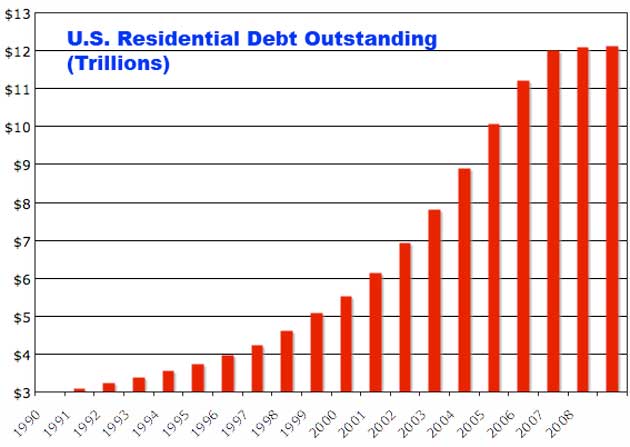
    Take the current housing crisis that has now spread to the financial markets in general. The cause was too-easy credit that fueled a massive increase in housing prices as people bought houses they couldn’t afford with mortgages they weren’t able to pay off.

    In 1999 there was roughly $5 trillion in total U.S. mortgage debt. That number ballooned to $12 trillion by 2007, and we know what happened from there (data is from the U.S. Office of Federal Housing Enterprise Oversight). To put this into perspective, total U.S. GDP is about $11 trillion annually, and U.S. government debt is around $9 trillion. If the housing market really falls apart (meaning more than conservative estimates of a 20% drop), there’s no way the government can simply cover these losses.

    Why did it happen? Let’s go back to 1999, when Fannie Mae, the nation’s biggest underwriter of home mortgages, was under pressure by the Clinton administration to find a way to get more loans to “borrowers whose incomes, credit ratings and savings are not good enough to qualify for conventional loans.” A pilot program was launched, which soon became general policy. Money flowed to people who couldn’t afford to pay it back.

    These new policies came on top of previous changes in the 90’s that let consumers get zero-down payment loans.

    In a 1999 article that now looks absolutely insane, the New York Times reported on the easing of credit terms. Fannie Mae Chairman Franklin Raines, who’s quoted in the article, was all sunshine and roses as he threw away the financial future of millions of Americans. But at least one person. Peter Wallison, had a good idea of how this would all play out:

    In moving, even tentatively, into this new area of lending, Fannie Mae is taking on significantly more risk, which may not pose any difficulties during flush economic times. But the government-subsidized corporation may run into trouble in an economic downturn, prompting a government rescue similar to that of the savings and loan industry in the 1980’s.

    ”From the perspective of many people, including me, this is another thrift industry growing up around us,” said Peter Wallison a resident fellow at the American Enterprise Institute. ”If they fail, the government will have to step up and bail them out the way it stepped up and bailed out the thrift industry.”

    Too bad nobody listened to that guy.

    Crunch Network: MobileCrunch Mobile Gadgets and Applications, Delivered Daily.

     
    Comments Off on How The U.S. Government Engineered The Current Economic Crisis

    Posted in Uncategorized


    Study: 93 Percent of Americans Want Companies to Have Presence on Social Media Sites

    26 Sep
    Frederic Lardinois via ReadWriteWeb shared by 6 people

    cone_logo.pngAccording to the 2008 Cone Business in Social Media Study, 93% of Americans believe that a company should have a presence on social media sites and 85 percent believe that these companies should use these services to interact with consumers. Cone, a Boston-based consulting firm, also found that men are far more likely to interact with a company through social media than women are. 56% of consumers believe that a company is providing them with a better service by interacting with them on social media sites.

    The numbers in this study are bit higher than those we have seen before (we assume that Cone uses a relatively broad definition of 'social media'), though the general trends do fall in line with the latest data from Universal McCann we wrote about last week.

    As Michael Chin points out on the KickApps blog, social media first changed how we interacted with friends, family, and customers. Now, as consumers are getting more familiar with these tools, they also expect them to be a way to interact with companies - and based on this data from Cone, they want this to be a two-way conversation.

    Here are some other interesting data points from the study:

    • 60% of Americans regularly interact with companies on a social media site
    • 43% of consumers say that companies should use social networks to solve the consumers' problems
    • 41% believe that companies should use social media tools to solicit feedback on products and services
    • Men are more likely to use social media tools to interact with a company than women (33% vs. 17%)
    • 33% of younger consumers (18-34) and those with household incomes over $75,000 believe that companies should try to market to them through social networks

    It would be nice to see Cone break these numbers down a bit more. What types of social media sites, for example, do users prefer? Are there any specific categories of companies and brands that they want to see on these sites? How exactly do they want to be marketed to? What do they think about implications for their privacy?

    What is clear, however, is that social media is quickly becoming an important means for companies to reach consumers - and that consumer are also quickly changing their expectations about how, when, and where they want to be marketed to. As more users are embracing social media (and often to the detriment of traditional media), companies have no choice but to follow them.

    Discuss

     
    Comments Off on Study: 93 Percent of Americans Want Companies to Have Presence on Social Media Sites

    Posted in Uncategorized