
Via Esquire
07
Sep
You Must Remember This: What Makes Something Memorable?
07
Sep
One of the signature discoveries of cognitive neuroscience is that a structure called the hippocampus, deep within the brain, is intimately involved in creating memories. This fact was dramatically illustrated by a singular patient, Henry Molaison, who experienced severe epileptic seizures. In 1953, when Molaison was 27, doctors removed his hipÂpocampus and nearby areas on both sides of his brain. The operation controlled his epilepsy, but at a price--from that time on, he was unable to remember the things that happened to him. He could learn skills, such as mirror writing, but would be puzzled by his expertise, because he could not recall having acquired it.
H.M., as he was known during his lifetime to protect his privacy, taught scientists three lessons. First, certain brain structures--the hippocampus and the amygdala, the brain’s emotion center--specialize in remembering. Second, there are different kinds of memory--the ability to recall facts, or personal experiences, or physical skills like riding a bike--each with its own properties. Third, memory is distinct from the brain’s intellectual and perceptual abilities.
[More]

Nike Unveils New iPhone App Just for Runners
06
Sep


Nike has just rolled out a new iPhone app for runners, available for download now [iTunes link].
The Nike+ GPS App for iPhone will pull in data from the device’s accelerometer and GPS to give runners an effective, accurate and useful tool for getting in shape and staying motivated. So far, it’s available in English only and sells for $1.99.
Although fitness apps abound in the App Store, few carry the street cred or instant name recognition of Nike.
The app will allow runners to visually map and track every run, indoor and outdoor, “free range†or treadmill. Nike says the app even works when a GPS signal is unavailable. Mapped routes show a breakdown of the runner’s pace at various points during the run, as well. You can track your distance, time and number of calories burned.
One interesting aspect of the app is the “Challenge Me†feature. It helps runners challenge themselves to run greater distances, longer times or quicker paces than their previous runs. Aside from giving challenges, the app also provides in-run, on-demand motivational messages from pro athletes and celebrities.

And of course the app carries the now-obligatory social sharing features. Through integration with NikePlus.com, runners can save each run to their online profiles and share the run through the site, Twitter and Facebook.
We have no word so far on when to expect Android, BlackBerry or other apps, but Nike says the app will work for iPod touch (second, third and fourth generations), iPhone 3GS and iPhone 4. The company makes no promises about how the app will function on an iPad; then again, if you’re running with your iPad, you might need less motivation to run faster and more motivation to give the tech gadgets a rest.
Here’s a video sent to us by Nike showing some of the ins and outs of the app:
What do you think of Nike’s app so far? Is this something you’d use for your running routine, or will you stick to the free apps already available?
Reviews: Android, App Store, Facebook, Twitter
More About: App, fitness, iphone app, Nike, Nike+GPS, runner, runners, running, sport
For more Apple coverage:
- Follow Mashable Apple on Twitter
- Become a Fan on Facebook
- Subscribe to the Apple channel
- Download our free apps for iPhone and iPad
Hugo Awards 2010: some of the best results in recent memory
05
Sep
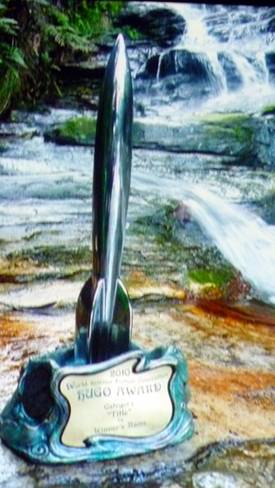 Last night, the Hugo Awards, one of science fiction's most prestigious prizes, were presented in Melbourne at Aussiecon 4. The Hugo ceremony is one of my favorite parts of any WorldCon, and last night's event, emceed by Garth Nix, was a particularly outstanding edition. The ballot was extremely strong, with works that I really enjoyed competing in several categories. The voter and nominator turnout were both much higher than usual, and the program moved at a very, very good clip. This year's award, designed by Nick Stathopolous, was gorgeous, incorporating aboriginal motifs and an organic, Belle Époque look inspired by the Paris Metro signs. Kudos to the administrators on a smooth, well-run ceremony!
The fiction prizes were especially sweet this year. Best novel was an almost-unheard-of tie between China Mieville for his brilliant, mind-bending The City and the City and Paolo Bacigalupe for his stellar debut novel The Windup Girl. Best novella went to my collaborator Charlie Stross for Palimpsest, from his wonderful, mind-bending solo short story collection Wireless. Best novelette went to Peter Watts for The Island, from The New Space Opera 2. Boing Boing readers will remember Peter as the SF writer who was beaten and gassed near the US/Canada border when he got out of his car to ask why US customs officers were searching his car; he spent tens of thousands of dollars fighting the charge and the potential two-year sentence; was found guilty but received a suspended sentence. SF fans raised money to bring Peter to Australia, and his acceptance speech in which he called this the "best and worst year of his life," was brilliant. The best short story, which I presented, went to Will McIntosh for "Bridecicle," a lovely story.
Net-based media was a big winner this year: the podcast Starship Sofa (often presented here) won for Best Fanzine. And of course, there was Fred Pohl's Hugo for Best Fan Writer for his excellent blog The Way the Future Blogs.
Other categories whose winners made me especially glad include the Best Editor prize for my editor at Tor, Patrick Nielsen Hayden (this was his second prize in the very new category, and he has taken his name out of the running for next year). The graphic novel category went to Phil and Kaja Foglio's steampunk comic Girl Genius. The Campbell Award for best new writer to Seanan McGuire, whose heartfelt acceptance speech made me burst into tears.
Tor.com has the full list of nominees and winners here.


Websites for scifi’s most famous evil corporations, based on real-life corporate websites [Design]
03
Sep

Websites for scifi’s most famous evil corporations, based on real-life corporate websites [Design]
03
Sep
Mass Extinctions Change the Rules of Evolution
02
Sep

A reinterpretation of the fossil record suggests a new answer to one of evolution’s existential questions: whether global mass extinctions are just short-term diversions in life’s preordained course, or send life careening down wholly new paths.
Some scientists have suggested the former. Rates of species diversification — the speed at which groups adapt and fill open ecological niches — seemed to predict what’s flourished in the aftermath of past planetary cataclysms. But according to the calculations of Macquarie University paleobiologist John Alroy, that’s just not the case.
“Mass extinction fundamentally changes the dynamics. It changes the composition of the biosphere forever. You can’t simply predict the winners and losers from what groups have done before,†he said.
Alroy was once a student of paleontologist Jack Sepkoski, who in the 1980s formalized the notion that Earth has experienced five mass extinctions in the 550 million years since life became durable enough to leave a fossil record. Graphs of taxonomic abundance depict lines rising steadily as life diversifies, plunging precipitously during each extinction, and rising again as life proliferates anew.
As the fossil record is patchy and long-term evolutionary principles still debated, paleobiologists have historically disagreed about what these extinctions mean. Some held that, in the absence of extinctions, species would diversify endlessly. The Tree of Life could sprout new branches forever. Others argued that each taxonomic group had limits; once it reached a certain size, each branch would stop growing.
Sepkoski’s calculations put him on the limits side of this argument. He also proposed that, by looking at the rate at which each group produced new species, one could predict the winners and losers of each mass extinction’s aftermath. Groups that diversified rapidly would flourish. Their destiny was already established.
“It’s a clockmaker vision of evolution. Each group has fixed dynamics, and if there’s an extinction, it just messes it up a bit,†said Alroy. “That’s what I’m challenging in this paper. There are limits, and that’s why we don’t have a trillion species. But those limits can change.â€
Alroy crunched marine fossil data in the Paleobiology Database, which gathers specimen records from nearly 100,000 fossil collections around the world. He used a statistical adjustment method designed to reduce the skewing influences of paleontological circumstance — the greater chances of finding young fossils rather than old, the ease of studying some types of rock rather than others.

Historical species diversity among marine animals of Cambrian, Paleozoic and Modern origin.
The analysis, published September 2 in Science, produced what Alroy considers to be the most accurate reflection of extinction dynamics to date. And while his data supported the notion that each group’s diversity eventually hits a limit, he didn’t find Sepkoski’s correlation between pre-mass-extinction diversity rates and post-extinction success. Each mass extinction event seemed to change the rules. Past didn’t indicate future.
In an accompanying commentary, paleontologist Charles Marshall of the University of California, Berkeley noted that Alroy’s statistical methods still need review by the paleobiology community. The Paleobiological Database, for all its thoroughness, might also be incomplete in as-yet-unappreciated ways. “There will be no immediate consensus on the details of the pattern of diversity,†he wrote. But “the pieces are falling into place.â€
Enough pieces have come together for Alroy to speculate on his findings’ implication for the future, given that Earth is now experiencing another mass extinction. Starting with extinctions of large land animals more than 50,000 years ago that continued as modern humans proliferated around the globe, and picking up pace in the Agricultural and Industrial ages, current extinction rates are far beyond levels capable of unraveling entire food webs in coming centuries. Ecologists estimate that between 50 and 90 percent of all species are doomed without profound changes in human resource use.
In the past, many evolutionary biologists thought life would eventually recover its present composition, said Alroy. In 100 million years or so, the same general creatures would again roam the Earth. “But that isn’t in the data,†he said.
Instead Alroy’s analysis suggests that the future is inherently unpredictable, that what comes next can’t be extrapolated from what is measured now, no more than a mid-Cretaceous observer could have guessed that a few tiny rodents would someday occupy every ecological niche then ruled by reptiles.
“The current mass extinction is not going to simply put things out of whack for a while, and then things will go back to where we started, or would have gone anyway,†said Alroy. Mass extinction “changes the rules of evolution.â€
Images: 1) A fossil skull of Dunkleosteus, an apex predator fish that lived between 380 million and 360 million years ago, and had what is believed to be history’s most powerful bite./Michael LaBarbera, courtesy of The Field Museum. 2) Graph of species diversity among marine animals of Cambrian, Paleozoic and Modern origin./Science.
See Also:
- Ecosystem Engineering Could Turn Sprawl Into Sanctuary
- 9 Environmental Boundaries We Don’t Want to Cross
- Death Star Off the Hook for Mass Extinctions
- A New Explanation for Ancient Mass Extinction
- Latest Extinction is the Greatest
- Megafauna Extinctions Not Entirely Humans’ Fault
Citations: “The Shifting Balance of Diversity Among Major Marine Animal Groups.†By J. Alroy. Science, Vol. 329 No. 5996, September 3, 2010.
“Marine Biodiversity Dynamics over Deep Time.†By Charles R. Marshall. Science, Vol. 329 No. 5996, September 3, 2010.
Brandon Keim’s Twitter stream and reportorial outtakes; Wired Science on Twitter. Brandon is currently working on a book about ecological tipping points.