RSS
 

Ten key indicators show global warming “undeniable”

29 Jul

By Deborah Zabarenko, Environment Correspondent

WASHINGTON (Reuters) - Melting glaciers, more humid air and eight other key indicators show that global warming is undeniable, scientists said on Wednesday, citing a new comprehensive review of the last decade of climate data.

[More]


10 Reasons Why Software Project Estimates Fail

29 Jul

Think about the web and software projects you’ve completed. How many were delivered on time and on budget? How many estimates were accurate? IT projects are notorious for over-running, and here are several reasons why it occurs…

1. The project is poorly scoped
How can you estimate time on a project when you don’t know what that project is? It’s rare to find a client who appreciates exactly how their system should work.

Almost every large project I’ve undertaken has requested “flexibility”. In other words, the client wants the system to handle anything they want at any future point in time — even though they have no idea what those features might be. Flexibility is not a requirement!

2. Development time is estimated by non-programmers
If you’re not a programmer, don’t guess at development times. A project is doomed the moment a manager writes their own fictional estimate. At best, they’ll be completely incorrect. At worst, the programmers will be tempted to prove them wrong.

3. Developer estimates are too optimistic
Developers think in terms of coding hours. Time passes quickly when you’re in the zone and it’s difficult to assess your own speed. Appreciating the speed of other developers is impossible.

Many developers are over-optimistic. They tend to forget the softer side of the development process, such as project management, collating requirements, discussions with colleagues, absences, PC problems, etc.

4. The project is not adequately dissected
Be wary if the development estimate for an individual feature exceeds a week. That chunk should be sub-divided further so the developer can analyze a complex problem in more detail.

5. Estimated time is used
Give a programmer 5 days to complete a task and it’ll take 5 days. Software development is infinitely variable and any code can be improved. If a developer takes 3 days to finish the task, they’ll spend the remaining time tweaking it or doing other activities.

Unfortunately, this results in a situation where estimates become the minimum number of development days. The actual delivery time can only get worse.

6. More developers != quicker development
A 100-day project will not be completed in 1 day by 100 developers. More people results in an exponential increase in complexity. See Why Larger Teams Do Not Result in Faster Development…

7. The project scope changes
This is perhaps the most irritating problem for a developer. A feature is changed or added because customer X has requested it or the CEO thinks it’s a cool thing to do.

Is the impact of that new feature documented?…

8. Estimates are fixed
Estimates should be continually assessed and updated as the system development progresses. Programmers often believe they can make up lost time — it rarely happens.

9. Testing time is forgotten
It’s impossible for a developer to adequately test their own code. They know how it should work, so they consciously or sub-consciously test in a specific way. In general, you can expect to spend another 50% of the development time on testing and debugging.

10. Estimates are taken too literally
Non-programmers rarely appreciate the complexity of software development yet few businesses plan for schedule slippages. The project often sits at the bottom of a huge unstable tower of other activities, such as literature printing, marketing, distribution, etc.

Development hold-ups can cause a costly chain reaction of delays. Unfortunately, it becomes easy to blame the programmer at the bottom of the pile. That’s doesn’t bode well for future projects — the programmer will either refuse to provide estimates or inflate them dramatically.

Have you encountered other reasons why project estimates fail?

Related Posts

  1. How To Estimate Time For A Project
  2. Has project management gone out the window?
  3. Windows 7 Launch Marred by Software Pirates


Nuclear Energy Now More Expensive Than Solar

29 Jul
js_sebastian writes "According to an article on the New York Times, a historical cross-over has occurred because of the declining costs of solar vs. the increasing costs of nuclear energy: solar, hardly the cheapest of renewable technologies, is now cheaper than nuclear, at around 16 cents per kilowatt hour. Furthermore, the NY Times reports that financial markets will not finance the construction of nuclear power plants unless the risk of default (which is historically as high as 50 percent for the nuclear industry) is externalized to someone else through federal loan guarantees or ratepayer funding. The bottom line seems to be that nuclear is simply not competitive, and the push from the US government to subsidize it seems to be forcing the wrong choice on the market."

Read more of this story at Slashdot.


Nerds Win

28 Jul

nerds-win.jpg


Postcard from Language Camp

28 Jul
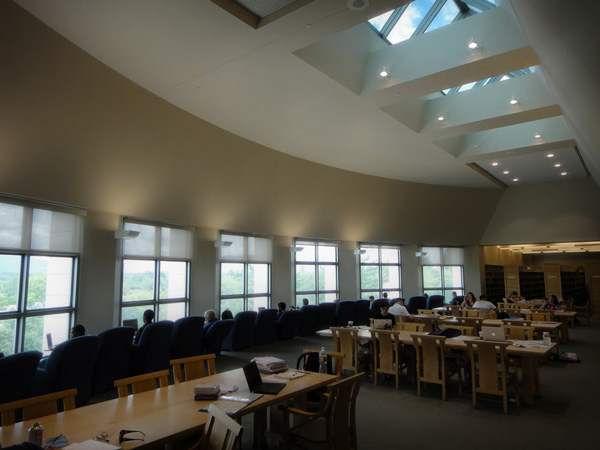
langcamp.jpg Greetings from one of the best places in the world to learn foreign languages! DLI, CIA University? No, a small town in Vermont that hosts an annual summer language institute: Middlebury. To call the Middlebury language schools a camp is like calling a hurricane a rain shower.

At the core of the language program here is the contractual agreement of all participants to only use their language of study for the duration of their stay. The "language pledge" is in effect 24-7 and contributes to the full-immersion environment. In many ways, you are exposed to more of the language than in a country where it is spoken. There is simply no escape from the language outside of withdrawal from the program, resulting in a strange environment in this small Vermont town near the Green Mountain National Forest. Pictured above is Sunday morning at the library where students pore over word lists, prepare for the upcoming week, and listen to audio files to improve their listening comprehension.

Giving up English for 7-10 weeks has a strange, Kafkaesque effect on the brain. You live in a heterotopian space, one that makes you question where and when you exactly are, and how you came to be there. Time seems to stand still in this environment as the new language permeates you, even as an instructor. The frustration of not being able to express yourself in English either gives way to creative uses of the new language, or a bout of 'language breakdown' when students are incapable of any form of communication. This intense committment to staying in the language has resulted in the occasional call from the local hospital asking for a translator for an injured student who is 'stuck' in the language.

I am teaching beginning German this summer to students who have had almost no exposure to the German language. They too sign away English for seven weeks, and of course they often make the most progress of all students. It is a testament to the hard work of the students and to the human brain's ability to acquire languages.

Middlebury started with a school of German in 1915, when Vassar professor Lilian Strobe thought that Middlebury's isolated geography would make an ideal place to allow students to focus on language learning. Today, Middlebury teaches 10 languages and on any Friday night, the town pub becomes an even more surreal place. As you walk in you can hear a table of German speakers, a table of French, a table of Spanish, etc. If you passed through town accidentally and did not know what was going on, you might question where in the world you were. If you try to speak to the students, you would only get a strange look or an answer in the language they study. The motto of the Language Schools is "No English Spoken Here".

Teaching a language without the aid of any English explanations or translations is an interesting challenge, but the challenge forces both me and the students to strain our minds to comprehend and communicate. It forces a more efficient, comprehensive teaching and learning style that manages to promote quick and effective language acquisition.

Students from a variety of backgrounds come here, including many graduate students who need a language for their research, government types whose first phrase in the language is "I'm not permitted to tell you what I do for a living," and students who are preparing to move abroad and need to learn as much of a language as possible in a short period of time.

The program runs from June-August only and is roughly the equivalent of two years of instruction. The real trick is the constant immersion and steady interaction with other speakers. Contrary to popular belief, there is no way to 'pick up' a language quickly with self-study. Languages are spoken among people and that spoken interaction is critical to learning. Here, students only sit in classes 3-4 hours daily. The rest of the day is spent doing other activities involving high frequency vocabulary such as working out, playing teams sports, yoga, singing in a choir, eating, drinking, putting on a play, playing billiards, and hiking in the nearby forests; all in the target language. Often, these seemingly superfluous interactions outside of the classroom prove to be the most beneficial way to solidify what one has learned in the classroom earlier that morning.

I have long lamented the state of language education in the United States, but I see change and improvement in foreign language education every year. Middlebury reflects this trend and has shown a steady increase in demand. Overall applications for admission to the program have increased 120% over a ten-year period. For Arabic, applications are up 375% and this increase has prompted the program to move the Arabic school to Mills College in Oakland, California. For my passion, German, applications are up a significant 75% with steady enrollments over a ten- year period, countering the trends of decreasing interest after the fall of the Berlin wall.

For a realistic look at the amount of progress made, you can view the before and after videos on the Middlebury web site.


A Passing Thought

28 Jul

I now have in my possession a pocket-sized computer which, when I speak a question to it (“Who is the author of Kraken?” “Who was the fourteenth president of the Unites States?” “What is the name of John Scalzi’s cat?”) provides me an answer in just a few seconds. If I take a picture of something, the same pocket computer will analyze the photo and tell me what I’m looking at. Oh, and it makes phone calls, too. Among other things.

None of that is the cool part. The cool part is, when I speak a question to my pocket computer and it gives me a bad answer, I get annoyed. Because here in the future, when I talk to my pocket computer, I expect it to get the answer right the first time.

I think I’ve said before that one of the neat things about getting older is that you really do become aware just how much things change. To be more specific about it, as you get older, at some point you cross an arbitrary line and are aware that you are now living in the future. I’m not precisely sure when it was I crossed my own arbitrary Future Line, but I’ll tell you what, I’m well past it now.

That is all. Carry on.


One to grow on

28 Jul

HERE is some food for thought:

Early this year, Mr. Chetty and five other researchers set out to fill this void. They examined the life paths of almost 12,000 children who had been part of a well-known education experiment in Tennessee in the 1980s. The children are now about 30, well started on their adult lives.

On Tuesday, Mr. Chetty presented the findings — not yet peer-reviewed — at an academic conference in Cambridge, Mass. They’re fairly explosive.

Just as in other studies, the Tennessee experiment found that some teachers were able to help students learn vastly more than other teachers. And just as in other studies, the effect largely disappeared by junior high, based on test scores. Yet when Mr. Chetty and his colleagues took another look at the students in adulthood, they discovered that the legacy of kindergarten had re-emerged.

Students who had learned much more in kindergarten were more likely to go to college than students with otherwise similar backgrounds. Students who learned more were also less likely to become single parents. As adults, they were more likely to be saving for retirement. Perhaps most striking, they were earning more.

All else equal, they were making about an extra $100 a year at age 27 for every percentile they had moved up the test-score distribution over the course of kindergarten. A student who went from average to the 60th percentile — a typical jump for a 5-year-old with a good teacher — could expect to make about $1,000 more a year at age 27 than a student who remained at the average. Over time, the effect seems to grow, too.

And get this:

Mr. Chetty and his colleagues — one of whom, Emmanuel Saez, recently won the prize for the top research economist under the age of 40 — estimate that a standout kindergarten teacher is worth about $320,000 a year. That’s the present value of the additional money that a full class of students can expect to earn over their careers. This estimate doesn’t take into account social gains, like better health and less crime.

Economics Nobelist James Heckman has found that the earlier one pursues efforts at remediation with underperforming students the more effective the interventions are. And studies have indicated that while the academic knowledge gained from remediation programmes tends to fade, social knowledge is more durable (and it may well be more important over the long-term). In general, it seems like the importance of educational reforms at the secondary and undergraduate level is wildly overstated, while the importance of improvements in education at the primary level (and earlier) is given far too little attention.


3D Door Stickers

28 Jul

8 Cool and Creative 3D Door Stickers (8) 5

I am totally in love with these 3D door stickers from Couture Deco. The material is described as 'trompe-l'oeil on opaque white fabric with satin finish.' The stickers are washable, fire and UV resistant, and highly durable. You can adjust them to fit with a scissors and they're applied with regular old wallpaper glue. My only problem with them is deciding which one to buy! See all the stickers ($279) available at Couture Deco. POST UPDATE: The retailer has LOWERED the price to $199!!!

8 Cool and Creative 3D Door Stickers (8) 28 Cool and Creative 3D Door Stickers (8) 8

Via.


Shark Knife will terrify your enemies with macho impracticality

27 Jul

The shark knife isn't going to win any beauty contests, but that's OK, because shark knives aren't about looking good, they're about getting the job done. And the job here is looking insanely tough, but with a tender, whimsical side. The Klingons have a word for this, most often translated as "trying too hard."

Shark Knife (via Making Light)


Fish in a barrel

27 Jul

Apple came out with updated Mac Pros and iMacs today. I’m an iMac man myself, so that’s what I checked out. Looks nice! Of course, The League of Internet Commenters is busy finding flaws and comparing it to similar offerings from Apple’s competitors. Hardware isn’t my strong suit, but I know half a thing about website design. So let’s look at the websites for Apple’s primary desktop computer, and the same from Dell and HP.

Apple iMac

Just wonderful. The URL is http://apple.com/imac

Here’s Dell Studio One:

Ummm ok then. The configuration page is the main page for the product. The URL is, of course, http://www.dell.com/us/en/home/desktops/desktop-studio-one-19/pd.aspx?refid=desktop-studio-one-19&s=dhs&cs=19

HP All-in-one 200xt series:

ClickToFlash blocked the only photo of the product; don’t worry, it’s tiny and dumb. The URL? http://www.shopping.hp.com/webapp/shopping/computer_can_series.do?storeName=computer_store&category=desktops&a1=Category&v1=All-in-One+PCs&series_name=200xt_series&jumpid=in_R329_prodexp/hhoslp/psg/desktops/All-in-One_PCs/200xt_series