RSS
 

Futures for SF writers that aren’t the Singularity

01 Jul
Rudy Rucker's tired of the Singularity (Vernor Vinge's conceit of a future in which people cease to have recognizably human motivations after they marry their minds with ever-accelerating computers). So he's come up with some other veins for SF writers to mine. Here's a couple (click through for the whole lot):
The Afterworld
I've always thought there should be more SF that speculates about what happens to people after they die. This can shade into fantasy, of course, but giving it an SF slant would be interesting. Certainly it's nice to speculate that there's some kind of underworld...rather than nothing.

Quantum Computational Viruses
The current trend is to view any bit of matter as carrying out a so-called quantum computation. These computations can be as rich and complex as anything in our brains or in our PCs. One angle, which I explored a bit in Postsingular and Hylozoic, is that ordinary objects could "wake up." Another angle worth pursuing is that something like a computer virus might infect matter, perhaps changing the laws of physics to make our world more congenial to some other kinds of beings...

An Infinite Flat Earth
What if Earth were an endless flat plane, and you could walk (or fly your electric glider) forever in a straight line and never come back to where you started? The cockroach zone! The kingdom of the two-headed men! One night there'll be a rumble and, wow, our little planet will have unrolled, ready for you to start out on the ultimate On the Road adventure.

Fresh SF Futures (via Futurismic)

(Image: Bonneville Salt Flats, Utah, a Creative Commons Attribution (2.0) image from markhillary's photostream)


Last Space Shuttle flight scheduled for February, 2011

01 Jul

The very last Space Shuttle flight will take place on February 26, 2011. After that, American astronauts will have to bum rides with the Russians if they want to visit the International Space Station. Shame.

There’s two more missions aboard the Space Shuttle. There’s one on November 1, 2010 (Space Shuttle Discovery, STS-133) and the aforementioned February, 2011 one (Space Shuttle Endeavour, STS-134).

Apparently Space Shuttle Atlantis may get one more flight, but Nasa will wait until next month before it decides one way or the other.

Both flights will bring various pieces of equipment to the ISS, chief among them the ALPHA MAGNETIC SPECTROMETER~! which is a type of cosmic ray detector that Nasa hopes will be used to better understand the formation and structure of the universe.

And yup, after this we’ll have no way of getting to the ISS without having to pay the Russians for a seat on one of their spacecraft—slightly embarrassing for a country as wealthy as the U.S. to not have an active space program, yes.


How to win a Nobel Prize: fail, persist, iterate

01 Jul

To hear Oliver Smithies tell it, there was a direct line from one of his first lab projects to the experiments that won him a Nobel Prize. Smithies showed that it was possible to target genes for disruption in mice, a technique that has revolutionized genetics and provided information relevant to human health. 

You wouldn't have guessed it based on the first slide of his talk at the Lindau Nobel Laureates meeting taking place this week in Germany. The slide showed an early page from Smithies' lab notebook of a failed attempt to isolate insulin, an experiment that he had dragged himself into the lab to perform on New Year's Day. 

By showing page after page of his notebook to the audience, Smithies gradually told the tale of how failing to purify insulin eventually led him to a successful scientific career.

Read the rest of this article...

Read the comments on this post


Entrepreneurship Helps Make America Great

01 Jul

For all its problems, America is a great place. And one thing that makes America great is its prosperity. Yes, some people have suffered during the recession—but compared to all the other countries in the history of the world, America is rich. Why?

One reason is that America is a good place to do business.

Dinesh D'Souza, author of What's So Great about America, points out: "In most other societies, the businessman has been looked down upon. He's been seen as a kind of sleazy guy. But then American founders specifically put protection for patents and trademarks in the Constitution.

And suddenly, the entrepreneur is taken from the bottom of the heap and brought to the front."

Today, Asian students crush Americans on standardized tests, but it's Americans who invent things like the transistor and the integrated circuit and go on to win disproportionate numbers of Nobel Prizes. Our culture of entrepreneurship turns that science into wealth.

 TV pitchman Anthony Sullivan is from Britain, but he says his business didn't thrive there.

"I found in England if there's 10 reasons you could do something, there's 20 reasons why you couldn't do it, you shouldn't do it, " says Sullivan. "I found in the States that people will give you a shot."

One sign of this attitude is that it's relatively easy to start a business here. I opened one in Wilmington, Del. I named it the Stossel Store. It was just a table from which I pitched my Give Me a Break book and Fox merchandise. I picked Wilmington because our research showed that Delaware and Nevada make opening a business easier than other states. It still took me a week to get legal permission, but it would have taken much longer in Europe.

"I have started businesses in the U.K. and India. It takes at least a month or more just to open doors," A.J. Khubani, president of TeleBrands, says.

Unfortunately, bureaucrats are threatening this good part of America. I had to register with the Delaware Secretary of State and the Division of Corporations, get a federal employer identification number, buy commercial liability insurance, register with the Delaware state Department of Finance, etc.

I didn't even try to open a business in my hometown, New York City, because the bureaucracy is so ferocious. The fastest-growing cities of the world make it easier. In Hong Kong several years ago, I got a business permit in just one day. It's a reason Hong Kong is rich. Entrepreneurs are encouraged.

But at least America is a close second.

America also has a different idea about failure. The Stossel Store was a bad idea. I lost money. D'Souza says that in other places, that would be evidence that I am a complete failure. I tried to make a profit, failed, and so shouldn't try again.

That's the attitude in most of the world, says D'Souza.

"You say: 'You know what? I tried my hand at business. It didn't work. Now, let me take a salary job where I'll have some security."

He says that's not true in America.

"An American will start a company. It'll fail. Pretty soon, he's starting a newspaper, or he's now trying to export fish to Japan."

We know that Thomas Edison invented the light bulb, but Edison failed much more often than he succeeded. He had hundreds of failures. He was fired by the telegraph office, and lost money on a cement company and an iron business. Henry Ford's first company failed completely. Dr. Seuss' first book was rejected by 27 publishers. Oprah was fired from her first job as a reporter. A TV station called her unfit for television.

"There's something in the American temperament that says, 'Gosh, I lost seven times but that's OK,'" D'Souza says. "And I think that that's a resiliency of the American spirit."

It's one of several great things about America.

John Stossel is host of Stossel on the Fox Business Network. He's the author of Give Me a Break and of Myth, Lies, and Downright Stupidity. To find out more about John Stossel, visit his site at johnstossel.com.

COPYRIGHT 2010 BY JFS PRODUCTIONS, INC.
DISTRIBUTED BY CREATORS.COM


A 3D atlas of the universe: Carter Emmart on TED.com

01 Jul

For the last 12 years, Carter Emmart has been coordinating the efforts of scientists, artists and programmers to build a complete 3D visualization of our known universe. He demos this stunning tour and explains how it's being shared with facilities around the world. (Recorded at TED2010, February 2010 in Long Beach, CA. Duration: 6:57)

Watch Cater Emmart's talk on TED.com, where you can download it, rate it, comment on it and find other talks and performances from our archive of 700+ TEDTalks.


The Evolution of CRM to Social CRM

01 Jul

In the last post we looked at what the difference between CRM and SCRM is (with visuals).  Today I want to talk about how CRM is actually evolving to SCRM.  There have been several images and diagrams which have attempted to depict the shift or evolution from CRM to Social CRM.  Chess Media Group in collaboration with Mitch Lieberman decided to break down how CRM has evolved by taking things back to basics and addressing the questions of: who, what, when, where, why, and how.  We feel that taking this simple approach will really help shed some more on SCRM without making the topic confusing or convoluted.

This image clearly depicts what CRM is (or was) and how it has changed or evolved into SCRM.  For those out there that continually refer to SCRM as a tool or a technology hopefully this helps clarify things a bit and show that SCRM is not about a technology at all.  Technology and tools don’t address strategy and changes in communication and interaction that we are currently seeing.  A tool will hopefully allow you to support a strategy that adapts to the changes that we are seeing above, but again the shift we are seeing is behavioral and interaction based not technology driven.  We can see from the diagram above what this evolution means to both the company and the customer.

After looking at this evolution organizations need to then ask themselves, “knowing that this evolution is taking place, how can we adapt to serve the social customer?”  Organizations are used to doing things a certain way, and that “way” has remained relatively constant over many decades.  But how can organizations today communicate and interact with customers the same way they have been even 10 years ago?  The answer is they can’t.

This image was taken from the whitepaper, A Guide to Understanding Social CRM, which can be downloaded for free and provides in depth information and discussion around Social CRM.

Hopefully this image makes sense and simplifies things a bit.  Any comments or questions?  Let’s hear it!


A Sliding Alternative to CAPTCHA?

01 Jul

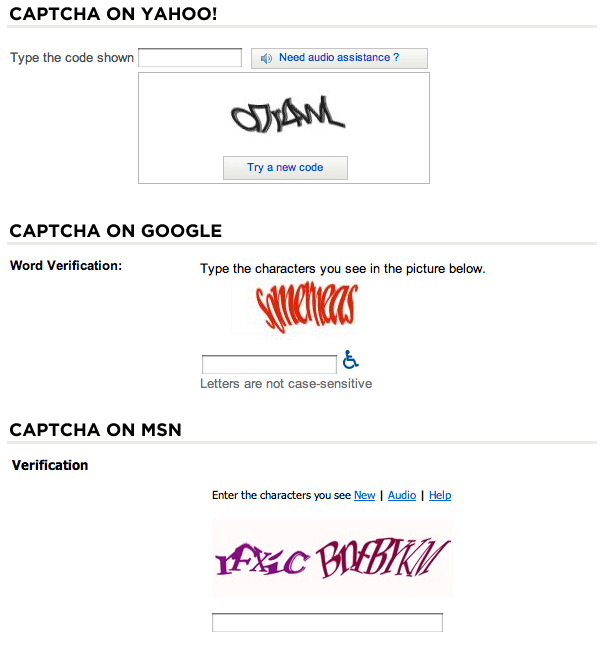
It's no secret that the use of difficult CAPTCHAs (Completely Automated Public Turing test to tell Computers and Humans Apart) in Web forms can confound ordinary people, drop conversion rates, and increase errors in addition to (hopefully!) keeping the bad guys out of your site. As a result, I'm always interested in alternatives to standard CAPTCHA techniques.

CAPTCHAs

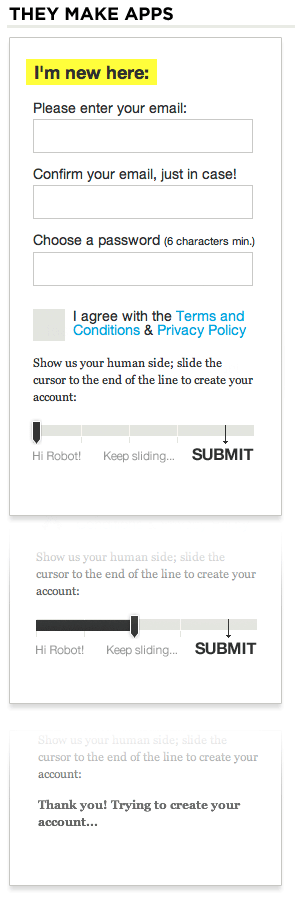
Once such approach brought to my attention recently can be found on They Make Apps. Instead of the distorted text strings that typify most modern CAPTCHAs (above), the sign up form on They Make Apps uses a slider that asks people to: "show us your human side; slide the cursor to the end of the line to create your account." Moving the slider to the right completely submits the form and triggers error validation just like a standard Submit button would.

They Make Apps CAPTCHA Slider

I don't have any data that suggests this implementation impacts conversion rates (up or down). It doesn't seem to cover accessibility issues since it requires a mouse or drag gesture to work (no keyboard support). And at large scale, it won't keep spammers out effectively. CAPTCHA busting farms already employ human labor to crack distorted text CAPTCHAs at incredibly cheap rates (moving a slider would be even faster & easier) and it's likely trivial to develop a script that will adjust the slider automatically to submit the form. But it is still nice to see people exploring different approaches.


Tags: , , , ,


This is meant as an art piece

30 Jun

Sf_drugs_500Indeed, this set of maps produced by Doug Mccune (more here) using publicly available data released by the San Francisco government on its DataSF website is breathtakingly beautiful. Thanks to Rudy R for bringing this to our attention.

***

Hate to spoil the fun but it has to be said that if we apply the Trifecta checkup, these maps fail at the first question: what is the practical issue being addressed?

As Doug noticed, there is a ridge along Mission Street that appears on pretty much every map regardless of the type of crime. The features on various maps are rather consistent as well -- and I can assure you that those features are consistent with population density.

Alas, if you live in San Francisco and care about crime there, Mission Street is not news. We don't need a sophisticated map to tell us that insight. Same with where prostitution is.

What if you are interested in crime in your local neighborhood? Not these maps either because in creating the relief, Doug must make approximations; the higher the peak, the more collateral activity is created around the peak to avoid discontinuities in the surface. This destroys the local details.

***

Still, they are gorgeous to look at, and as Doug alluded to in his disclaimer, we just need to remove our junkcharts glasses to appreciate them.


An Awesomely Bad Sentence

30 Jun

The Bulwer-Lytton award is given annually for the worst first sentence of a novel. Contestants craft deliberately bad opening lines. Molly Ringle took the 2010 prize with this gem:

For the first month of Ricardo and Felicity’s affair, they greeted one another at every stolen rendezvous with a kiss — a lengthy, ravenous kiss, Ricardo lapping and sucking at Felicity’s mouth as if she were a giant cage-mounted water bottle and he were the world’s thirstiest gerbil.


Email this Article Add to digg Add to Reddit Add to Twitter Add to del.icio.us Add to StumbleUpon Add to Facebook

Edward Bulwer-Lytton 1st Baron Lytton - Ricardo and Felicity - Seattle - San Jose State University - Paul Clifford


“First” Picture of Planet Orbiting Sunlike Star Confirmed

30 Jun
A team of astronomers says it holds bragging rights to releasing the first ever direct picture of an alien planet around a sunlike star.

Email this Article Add to del.icio.us Add to digg Add to Facebook Add to StumbleUpon Add to Google Add to Reddit

Extrasolar planet - Astronomy - Solar System - Planet - Gemini Observatory