RSS
 

On S&P, Downgrades, and Idiots

07 Aug
This is not going to be one of those posts that laments S&P’s decision to downgrade the US, but then says that S&P was probably right about our oh-so-dysfunctional political system.

No, S&P was flat-out wrong — no caveats. They are, to put it very bluntly, idiots, and they deserve every bit of opprobrium coming their way. They were embarrassingly wrong on the basic budget numbers, as everyone knows now, so they were forced to remove that section from their report, and change their rationale for the downgrade. (Always a sign that you’re dealing with hacks.)

S&P’s rationale for the downgrade now is based entirely on their subjective political judgement — and their political judgement is wrong. The brilliant political minds over at S&P said that “the downgrade reflects our view that the effectiveness, stability, and predictability of American policymaking and political institutions have weakened at a time of ongoing fiscal and economic challenges.”

That sounds like a Very Serious and Sober assessment, but it’s really not. It’s true that the debt limit debate was ridiculous, and that a large contingent of Tea Party freshmen in the House were threatening to not raise the debt ceiling. But here’s the thing: we still raised the debt ceiling, and in such a way that this Congress won’t have the opportunity to use the debt ceiling as a political bargaining chip again.

S&P’s assessment is only remotely serious if you assume that this particular Congress, with its huge contingent of crazy Tea Partiers, is going to serve in perpetuity. But this Congress isn’t going to serve in perpetuity — there are elections next year, and many of the Tea Party freshmen are likely to lose. They won in 2010 because it was a “wave election” in the middle of a very severe economic slump. But 2012 is a presidential election cycle with an incumbent Democratic president. A lot of these Tea Partiers who won in traditionally Democratic districts (and swing districts) are going to lose. In fact, it’s probably even odds that the Dems take back the House.

The simple fact is that the Tea Partiers are almost certainly at the height of their power in this Congress. And no, the debt ceiling debate doesn’t reflect some sort of secular change in US policymaking — the next time there’s a Republican president, House Republicans will be all about raising the debt ceiling, and Democrats won’t engage in the same kind of political brinksmanship. You’d have to be stunningly naïve not to believe this.

There have also been plenty of political de-escalations over the years — Republicans didn’t shut down the government every year after 1995, for instance. After Tom DeLay won the Medicare Part D vote by holding the vote open for 3 hours, everyone claimed that this would be the new normal on all controversial votes. Didn’t happen. There are plenty of one-off political confrontations. Simply assuming that every political confrontation represents a secular change in US politics and policymaking is ridiculous.

(S&P tries to side-step this obvious weakness in their so-called “argument” by claiming that by the time the 2012 elections roll around, it will be too late. Please. The idea that we have to act in the next 18 months in order to meaningfully affect our long-term solvency is patently absurd.)

Look, I know these S&P guys. Not these particular guys — I don’t know John Chambers or David Beers personally. But I know the rating agencies intimately. Back when I was an in-house lawyer for an investment bank, I had extensive interactions with all three rating agencies. We needed to get a lot of deals rated, and I was almost always involved in that process in the deals I worked on. To say that S&P analysts aren’t the sharpest tools in the drawer is a massive understatement.

Naturally, before meeting with a rating agency, we would plan out our arguments — you want to make sure you’re making your strongest arguments, that everyone is on the same page about the deal’s positive attributes, etc. With S&P, it got to the point where we were constantly saying, “that’s a good point, but is S&P smart enough to understand that argument?” I kid you not, that was a hard-constraint in our game-plan. With Moody’s and Fitch, we at least were able to assume that the analysts on our deals would have a minimum level of financial competence.

I’ve seen S&P make far more basic mistakes than the one they made in miscalculating the US’s debt-to-GDP ratio. I’ve seen an S&P managing director who didn’t know the order of operations, and when we pointed it out to him, stopped taking our calls. Despite impressive-sounding titles, these guys personify “amateur hour.” (And my opinion of S&P isn’t just based on a few deals; it’s based on countless deals, meetings, and phone calls over 20 years. It’s also the opinion of practically everyone else who deals with the rating agencies on a semi-regular basis.)

Treasury has every right to be outraged. S&P mangled the economic argument so badly that they had to abandon it entirely, and then fell back on a political argument which they are in no position to make, and which isn’t even correct.

So to S&P, I say: you should be ashamed of yourselves, and I truly hope this is your downfall.


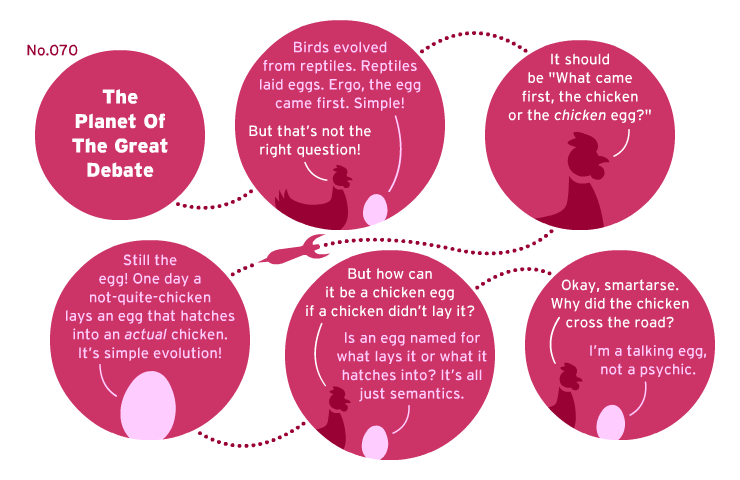
070. Still The Egg

07 Aug

070. Still The Egg

A psychic egg would be way cooler. Although also a lot quieter.


Government logo fail of the day

07 Aug

This is like an Onion parody on steroids. Only it’s 100 percent real.

Inspired by President Obama’s “Sputnik moment” speech back in January, the government-sponsored Smithsonian Institute has launched a new blog called “Department of Innovation”. As they describe it:

Seems a long time ago, but it was only back in January when Barack Obama told us that America had reached a “Sputnik moment.” He was referring to the competition with China to be the Big Dog of the 21st century global economy, but the subtext was that the country needs an attitude adjustment, that we need to start channeling Silicon Valley, a place where people may pledge to “Do no evil” but the true religion is innovation.

It made for one fine sound bite. But it hasn’t exactly inspired a bunch of innovation rallies and bake sales. So in the spirit of banging the drum for new ideas and fresh thinking, this blog will track all things innovative, not just in science and technology, but also in how we live, how we learn, how we entertain ourselves.

Sharp-eyed reader Rob M. certainly found the “Department of Innovation”s logo entertaining. You will, too.

Take a closer look:

As Rob wrote me this morning: “Check out the logo. 3 interlocking gears arranged in this fashion will not move in any direction. They are essentially locked in place. Which when you think about it, is a perfect analogy of today’s government!”

Also a perfect analogy for a hapless administration’s pretense of entrepreneurial expertise: Total non-starter.

And that, my friends, is your government logo fail of the day…

***

Another commenter at the Smithsonian blog also noticed: “I love this feature. I thought, however, that I would comment on the Department of Innovation meshing gears logo. The gears can’t turn. Perhaps that was the intended effect?”

Yeah, that’s the ticket.

Our commenter Cynosura adds: “Not to pick at nits, but the position of the gears (interlocking, thus unable to turn) is not the only problem with the logo. The gear pitch (space between tooth centers) is not consistent. I realize that it’s a logo and not a technical drawing, but it hurts my eyes to look at it. Even if the small gears were separated, the gears would likely jam during the first revolution…”

Snortalicious!


Pursuing Inspiration

07 Aug

via http://www.iobad.com/day/2010/03/15


The Mathematics of Changing Your Mind

06 Aug
The controversial history of the mathematical theorem that tells us when we should change our minds.


World Wide Web turns 20, finally shakes that acne problem

06 Aug
Happy birthday, World Wide Web! Hard to believe you're turning 20 already. It seems like just yesterday we were hearing the pitter patter of little dial-up, delighting at the words "you got mail," and getting frustrated when calling our friends and receiving that dreaded busy signal. You're all grown up now, helping people learn how to farm and become overnight pop sensations. What, we wonder, will the next 20 years bring? At the very least, you'll eventually have to move out of your parents' basement, get a real job, and settle down. It's hard to pay attention to that kind of stuff, though, when you've got another year of sneaking beers ahead of you. So go ahead, World Wide Web, enjoy yourself tonight -- just make sure to be home by midnight.

World Wide Web turns 20, finally shakes that acne problem originally appeared on Engadget on Sat, 06 Aug 2011 11:53:00 EDT. Please see our terms for use of feeds.

Permalink   |  sourceSlate  | Email this | Comments


The Falkirk Wheel

05 Aug
The Falkirk Wheel is a rotating boat lift located in Scotland, UK, connecting the Forth and Clyde Canal with the Union Canal, opened in 2002. It is named after the nearby town of Falkirk which is in central Scotland. The two canals were previously connected by a series of 11 locks, but by the 1930s these had fallen into disuse, were filled in and the land built upon. (Wikipedia)


$300 Million Button: making customers create logins to buy cost etailer $300M/year

05 Aug

"The $300 Million Button," Jared Spool's 2009 article on usability and ecommerce design, is remarkable in that it a) articulates something that anyone who shops widely online already knows; b) is advice that would make a lot of money for sites if they adopted it; c) has been part of the literature for at least two and a half years; d) is roundly ignored.

Spool is recounting the story of an unnamed large ecommerce retailer who had one of those forms that made you register before you could buy anything, and to remember your login and password before you could shop there again. Removing this form, and allowing the option of saving your details with a login and password at the end of the transaction, increased the retailer's sales by $300,000,000 in the first year.

From a commerce perspective, the Internet's glory is reduced search costs for customers. When I was making my office coffee table, I decided I wanted to source some brightly colored anodized aluminum bolts, nuts and washers. I'd never bought these before, but I assumed they existed, and I was right -- a couple searches showed me that they existed and were sold to motorcycle modders. I found a site that supplied them, and ordered sixteen of each, plus some spares. It was the first time in 39-some years I'd needed brightly colored bolts, and it may very well be that long again before I need any more.

So while this specialist bolt retailer is visible to motorcyle hobbyists and can compete for their repeat business with other specialists, they're also tapping into a market to whom they were entirely invisible until the net came along. Periodically, someone like me is going to drop in and spend some money on a one-off basis, and make windfall cash for them. There are a lot of people who, at some time in their lives, want to buy some specialized component or good. Before the Internet came along, we'd likely have just got the non-specialized equivalent. But because of the Internet, businesses all over the world are getting sales from the unlikeliest of corners. And what's more, some of those one-time only customers might discover that they actually really enjoy whatever the specialist thing is, and come back for more. It's win-win.

But the fastest way to alienate those customers and scare away that free money is to make its owner establish a relationship with you before s/he can make a purchase. In the case of the company that sold me my bolts, I was required to create a login and password, and I still get a fortnightly newsletter full of information I don't care to know about bolts (I checked all the opt-out bits, but either I missed one or they just don't pay attention to it).

Spool's research showed that a substantial portion of ecommerce users are even more sick of this stuff than I am -- $300 million/year's worth, in fact. And what's more, of the repeat customers who might have benefited from the faster checkout afforded by creating an account, 45 percent had multiple accounts in the system because they'd forgotten their logins, lost access to the email accounts they'd used, and signed up again with a new address.

Repeat customers weren't any happier. Except for a very few who remembered their login information, most stumbled on the form. They couldn't remember the email address or password they used. Remembering which email address they registered with was problematic - many had multiple email addresses or had changed them over the years.

When a shopper couldn't remember the email address and password, they'd attempt at guessing what it could be multiple times. These guesses rarely succeeded. Some would eventually ask the site to send the password to their email address, which is a problem if you can't remember which email address you initially registered with.

(Later, we did an analysis of the retailer's database, only to discover 45% of all customers had multiple registrations in the system, some as many as 10. We also analyzed how many people requested passwords, to find out it reached about 160,000 per day. 75% of these people never tried to complete the purchase once requested.)

The form, intended to make shopping easier, turned out to only help a small percentage of the customers who encountered it. (Even many of those customers weren't helped, since it took just as much effort to update any incorrect information, such as changed addresses or new credit cards.) Instead, the form just prevented sales - a lot of sales.

The $300 Million Button (via Beth Pratt)


How to Take a Gorgeous Photo Like This on a Perfect Summer Night [How To]

05 Aug
Nothing says summer quite like a field full of fireflies on a starry night. And this beautiful long-exposure shot, which happened quite by accident, is actually pretty easy to replicate. Here's how: More »


Why You’ll Only Have to Wait Half as Long for the Materials of the Future [Government]

05 Aug
Those rechargable batteries in your phone took well over two decades to develop—way too slow in today's global economy. So, the US government has introduced the Materials Genome Initiative and cut the development time of new materials in half. More »