What Do You Think is the Best Online WYSIWYG Editor?
13
Oct
This question was sent in by Edwin.
To clarify, I believe Edwin is asking about these JavaScript scripts you can use on website which turn regular <textarea>s into more robust editing environments. You’ll recognize one in use right here on CSS-Tricks:

I like editors like this, especially in WordPress comment forms. WordPress allows commentors to use HTML tags in their comments, like <strong>, <em>, and <a href=â€"> tags. That’s nice, but not all commentors may feel comfortable using tags like that. Instead users may just select text and press buttons just like they are accustomed to doing in something like Microsoft Word.
I’m using the wmd editor in my comment area on CSS-Tricks, which isn’t exactly a WYSIWYG (What You See Is What You Get) editor, but as they put it, a WYSISYM (What You See Is What You Mean) editor. The difference is that wmd uses the “markdown†language inside the actual text area. Markdown is simple conventions like surrounding a word with asterisks (*) to emphasis it. Behind the scenes, those asterisks are converted into actual <em> tags. There are similar conventions for bold text, links, code samples and quotes. That’s about all I need on CSS-Tricks!
So the reason I chose the wmd-editor is:
- Very easy to install. One line of code to link to self-hosted script and that’s it.
- Very easy to customize. Get rid of those buttons I didn’t need.
- Provides live comment preview, so people can see what their comment will look like before posting.
The wmd-editor isn’t the most popular editor on the block. There are far more robust systems out there you may want to look into if you need more power. Check out tinyMCE and FCKeditor.

Nasa IBEX Probe to Go Where Only Voyager Has Gone Before [IBEX]
13
Oct
 On October 19, NASA will launch the IBEX, or Interstellar Boundary Explorer, into a 130 mile earth orbit to begin mapping the very edge of our solar system. This region of space, also known by the kick ass scientific name "termination shock," is rife with mystery. Only the Voyager 1 and 2 spacecraft have ventured there, but they weren't armed with the right kind of tech to adequately catalog what's going on at the point where our solar system meets outer space. IBEX is, and from its orbit around our planet it will beam back some of the first detailed measurements of the region.
 Unlike Voyager, IBEX's payload includes tech tailor made for measuring solar wind and creating a map of the void.
The satellite's payload will consist of two energetic neutral atom (ENA) imagers, IBEX-Hi and IBEX-Lo. Each of these sensors will consist of a collimator that will limit field of view, a conversion surface to convert neutral hydrogen and oxygen into ions, an electrostatic analyzer to suppress ultraviolet light and select ions of a specific energy range, and a detector to identify particle counts and the identity of each ion. IBEX-Hi will record particle counts at a higher energy band than IBEX-Lo. The payload will also include a Combined Electronics Unit (CEU) that will control the voltages on the collimator and ESA and will read and record data from the particle detectors of each sensor. — Wikipedia

Spacewatch: Milky Way Over Canyonlands
12
Oct
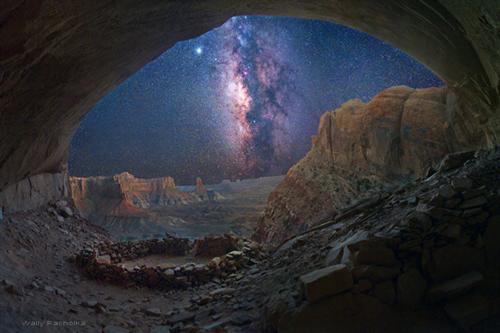
By Evan Ackerman
This picture of the milky way galaxy was taken by amateur astrophotographer Wally Pacholka in Canyonlands National Park in Utah. It’s a panorama of 4 individual pictures stitched together, each one a 25 second exposure on a Canon 5D at 1600 ISO with a 24mm lens. The lighting inside the cave comes from flashlights bouncing soft light off rocks, but the rest of the lightning comes from nothing but a crescent moon and the stars. It took him five 1600 mile trips out to Utah, plus a 2 mile hike in the dark (and he got lost every time) to get this one image. Worth it? Yeah, obviously. You can buy 11 x 14 prints of this picture starting at $55.
[ Wally Pacholka ] VIA [ Digg ]
Black Silicon Discovery Could Change Digital Photography, Night Vision Forever [Black Silicon]
12
Oct
 With the accidental discovery of "black silicon," Harvard physicists may have very well changed the digital photography, solar power and night vision industries forever. What is black silicon, you say? Well, it's just as it sounds. Black silicon. It's what this revolutionary new material does that's important, starting with light sensitivity. Early indications show black silicon is 100 to 500 times more sensitive to light than a traditional silicon wafer.
To create the special silicon, Harvard physicist Eric Mazur shined a super powerful laser onto a silicon wafer. The laser's output briefly matches all the energy produced by the sun falling onto the Earth's entire surface at a given moment in time. To spice the experiment up, he also had researchers apply sulfur hexafluoride, which the semiconductor industry uses to make etchings in silicon for circuitry. Seriously, he did this just for kicks and to secure more funding for an old project.
“I got tired of metals and was worrying that my Army funding would dry up,†he said. “I wrote the new direction into a research proposal without thinking much about it — I just wrote it in; I don’t know why," he said.
The new experiment made the silicon black to the naked eye. Under an electron microscope, however, the dark sheen was revealed to be thousands, if not millions, of tiny spikes. As we said above, those spikes had an amazing effect on the light sensitivity of the wafer. Mazur said the material also absorbs about twice as much visible light as traditional silicon, and can detect infrared light that is invisible to today's silicon detectors.
And there's no change to the manufacturing process, Mazur said, so existing semiconductor facilities can create black silicon without much additional effort or, more importantly, money. [New York Times]
