RSS
 

Sheer Numbers Gave Early Humans Edge Over Neanderthals

29 Jul

By Kate Shaw, Ars Technica

Between 35,000 and 45,000 years ago, Neanderthals in Europe and Asia were replaced by the first modern humans. Why and how this transition occurred remains somewhat controversial. New research from the journal Science suggests that sheer numbers may have played a large role in modern humans’ eventual takeover; archeological data shows that early populations of modern humans may have outnumbered Neanderthals by more than 9 to 1.

Two archaeologists from Cambridge University analyzed data from the Aquitaine region of southern France, which has Europe’s highest density of sites from this era, and one of the most complete archeological records. They used data from three time periods that encompassed the transition between Neanderthals and modern humans: the Mouterian and Chatelperronian eras, during which Neanderthals lived, and the Aurignacian period, which was dominated by modern humans. By examining differences between land use during these time periods, the researchers hoped to determine whether population dynamics played a role in the transition between these two hominins.

Because of the difficulties in estimating long-ago populations, the researchers used a few different proxies for population sizes and densities. They analyzed the number of occupied sites in each era, the size of these sites, and the accumulation rates of stone tools and animal food remains. Through these proxies, the researchers could get good estimates of population dynamics during the transition from Neanderthals to modern humans in Aquitaine.

From the Mouterian to the Chatelperronian era, there was very little increase in the number of rock-shelter sites. There were about 26 sites occupied in the Mouterian era, and 31 in the Chatelperronian period, suggesting that the Neanderthal population was not growing quickly. However, there were about 108 sites occupied by modern humans in the Aurignacian period. The increase is similar for occupied open-air sites. Adjusted for time scales, these figures suggest that, between the last Neanderthal-dominated era and the first era dominated by modern humans, the population numbers and densities increased by a factor of about 2.5.

A similar trend was seen in the sizes of occupied areas, with the Neanderthal sites averaging less than 200 square meters, while several of the modern human sites reached up to 600 square meters. From the size differences of the sites, the researchers estimate population increased up to 3 times as the Neanderthal-dominated era ended and modern humans occupied their sites.

Finally, the accumulation of stone tools and animal remains tells a similar story: modern humans were far more numerous than the Neanderthals they replaced. The densities of stone tools and animal food remains skyrocketed between the Chatelperronian and Aurignacian eras—according to these differences, the modern human population probably outnumbered the Neanderthals by a factor of about 1.8.

Each of these statistics, taken alone, tells only part of the story. Since these archaeological proxies was developed independently, the estimations can be looked at cumulatively to get a better idea of the different population sizes. When evaluated as a whole, these estimations show that the population size and densities of modern humans may have been more than 9 times those of the Neanderthals around the time of the population’s transition. It’s very likely that a numerical advantage that large played a significant role in modern humans’ dominance over their earlier counterparts.

While the study did not directly address the features that gave modern humans a population advantage, the authors suggest that it was probably due to a combination of factors such as improved food storage, an increase in social cohesion, and the potential for trade and the exchange of goods.

Source: Ars Technica

Image: A comparison of Neanderthal and human settlement density and size about 30,000 years ago. (Science)

See Also:

Citation: Science, 2011. DOI: 10.1126/science.1206930


Mild Soap and Water Is Better for Your Wounds than Peroxide or Alcohol [Health]

29 Jul
Most people aren't afraid to use rubbing alcohol or hydrogen peroxide to disinfect a wound when they get a cut. According to WebMD however, using peroxide on a wound can actually harm the tissue around it and delay the healing process. This is just one first aid fallacy they're out to debunk. More »


Graphic of the Day: Who Borrowed? Who Loaned?

28 Jul

A picture says a thousand words. From the NYT today:

20110728_defaultqa_graphic.jpg

In particular, who racked up $6.1 trillion in debt?

For more graphs, see here and here.

Update 9:20am 7/29: Reader CoRev excoriates me for using a graphic along FY lines (well a lot of spending is baked in, so Presidents usually are more responsible for the FYs that the NY Times allocated). Well, since we have a set of magical instruments called the Internet, and Excel, we can easily see that there is little change using quarterly data, and timing the cumulations more tightly.

cumdebt0.png
Figure 0: Cumulative changes in publicly held debt, by Presidential administrations, in millions of $, NSA. Source: Treasury via FREDII (series FYGFDPUN), and directly from Treasury for 2011Q1.

I don't see a drastic revision to the stylized facts. Here is a corresponding graph normalized by GDP, which is more relevant.

cumdebt1.png
Figure 1: Cumulative changes in publicly held debt, by Presidential administrations, in millions of $, NSA, normalized by GDP, in billions of $, SAAR, all through 2011Q1. Source: Treasury via FREDII (series FYGFDPUN), Band directly from Treasury for 2011Q1, BEA 2011Q2 advance release, and author's calculations.

Note that in this last graph, the "Clinton" block is below the zero line because publicly held debt was paid down during the Clinton Administration, in ppts of GDP terms. If we normalized by potential nominal GDP, the Obama block would look smaller. I also find of interest the debt accumulated during Reagan, GHW Bush, and Bush Administrations versus that during Clinton and Obama... (recalling Clinton paid down, as a share of GDP).


Geek Art – Art, Design & Lightsabers

28 Jul

via http://www.geek-art.net/page/2/


Star Wars Pixel Posters on the Behance Network

28 Jul

via http://www.behance.net/gallery/Star-Wars-Pixel-Posters/1341269


Citriodora House by Seeley Architects

28 Jul

Seeley Architects have designed the Citriodora House in the town of Anglesea, Australia.

.

ch_280711_01 ch_280711_01a ch_280711_02 ch_280711_03 ch_280711_04 ch_280711_05 ch_280711_06 ch_280711_07 ch_280711_08 ch_280711_09 ch_280711_10 ch_280711_11 ch_280711_13 ch_280711_14 ch_280711_15 ch_280711_16 ch_280711_17 ch_280711_18

Citriodora House by Seeley Architects

‘Citriodora’ is a holiday retreat set amongst a stand of beautiful Lemon scented gums, near Australia’s famed Great Ocean Road in Anglesea, Victoria. It is one of a number of inspired beach houses that Seeley Architects have designed over the past 10 or so years in this small coastal holiday hamlet.

The name ‘Citriodora’ is derived from the botanical name of the beautiful trees that dominate the northern corner of the property.

Inspired by the affects of the coastal winds, the form of the roof gently rolls, mimicking the shape of the wind pruned coastal vegetation. There is both simplicity and complexity in this building with large negative spaces offering views to the sky, battened screens proving visual privacy to the neighbours and two massive concrete walls forming a prehistoric spine through the middle. A thermal heat soak for the interior that mediates the diurnal temperature variations within the house.

This beautiful dwelling has been designed to maximise the opportunities offered by the site, with a character that respects its locality and environment.

The layout of the house is centred around a raised east facing living platform capturing coastal views and connections into the treetops. It is reminiscent of an adult’s tree house.

The approach to this house is a gentle rise gently from the street. It is sited in the lee of a small hill and nestled closely between two neighbouring houses.

Upon entering the house, you are greeted by massive in-situ concrete walls that form the staircase spine and dominate the entry space. This floor is the teenager’s zone with a swathe of bunks, a TV nook and a pool table for the obligatory holiday competitions.

Rising upward into the kitchen – living area, one’s eye is taken by the breathtaking views along the coastal cliffs and Southern ocean. Separated from the living zone by a protected courtyard deck and a generous internal void, lays the master bedroom, study, bathroom and a guest bedroom. The ceiling that sweeps generous over the entire upper level is gently formed from plywood and is reminiscent of the hull of an upturned yacht.

Wrapping around the exterior of the house is sustainable grown timber boards, fixed with maritime bronze nails, resisting the harsh coastal conditions and gradually weathering to a soft driftwood grey, a reference to the Citriodora tree’s bark.

This elegantly simple house uses a minimal palette with an aesthetic pared back to the essentials. It will gradually develop a patina over time, further blending with the grey-green of the site vegetation and providing a positive response to its impressive loci.

.
Visit the Seeley Architects website – here.

Photography by Zoe Economides, John Walker, and David Seeley

.


Photos of the new Total Recall being filmed in Toronto

27 Jul

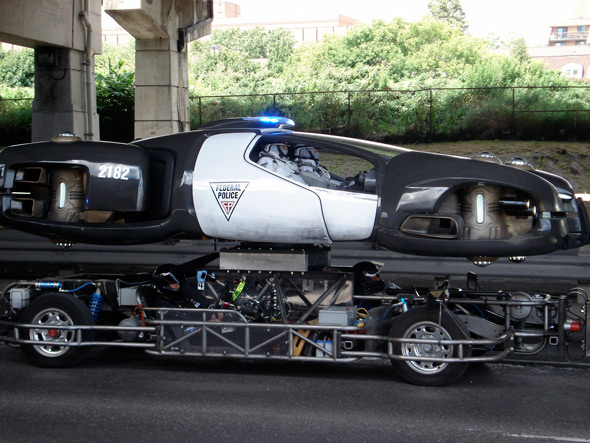
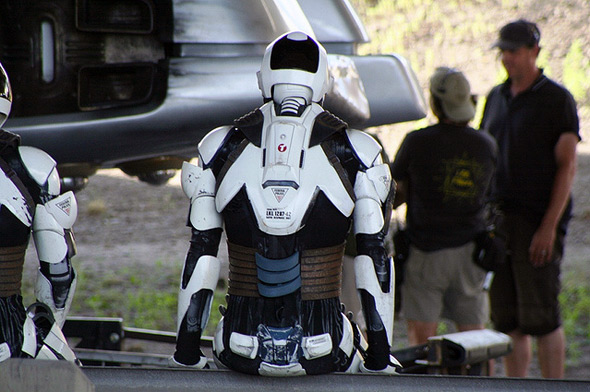
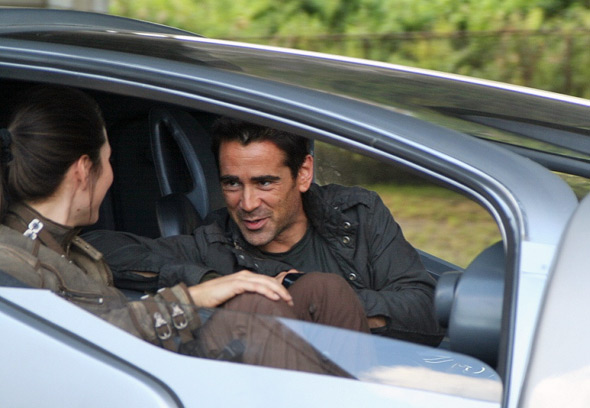
Total Recall Remake TorontoAlthough the new monster-budget remake of 1990's Total Recall has been filming in Toronto for almost two months, thus far the action has been mostly confined to the sound stage at Pinewood Studios on Commissioners Street in the Port Lands. Earlier this week, however, the production got a whole lot more public. With stars Colin Farrell and Jessica Biel in tow, film crews descended on Lake Shore Avenue East to shoot one of what will likely be a number of chase scenes in the $200 million movie, the most expensive to be shot in Toronto to date.

I'm not one to gawk at celebrities, but I've always been fascinated by behind-the-scenes shots of film productions, particularly those which promise to feature gratuitous special effects. While I have little difficulty suspending disbelief in the theatre, it remains intriguing to see what the filmmakers and editors have to work with, even if it's invariably less exciting than the final product.

The stretch of Lake Shore where the filming took place is back open today, but one suspects this isn't the last time that the Total Recall cast and crew make an appearance outside the studio. Check out the photos below, and if you have shots of the production, send them to the blogTO Flickr pool. Lead shot by syfractal.

Total Recall Torontosyfractal

Total Recall FilmingPhoto by dtstuff9

2011727-tr-dt.jpgdtstuff9

Total Recall Remake Torontodtstuff9

2011727-total-recall-to.jpgdtstuff9

Total Recall Remake TorontoPhoto by Max Quijano

Total Recall TorontoMax Quijano


Plutonium Is Hot Suspect in Pioneer Spacecraft Mystery

26 Jul

By Duncan Geere, Wired UK

A 30-year mystery as to why the Pioneer spacecraft have slowly been drifting off course is close to being explained — the latest analysis pins the blame on heat.

The Pioneer 10 and 11 spacecraft, launched in 1972 and 1973 respectively, were designed to fly past the asteroid belt and investigate the Jovian and Saturnian systems. Both are now located in the interstellar medium, and radio contact has been lost, but each is slowing gradually due to the influence of the sun’s gravity.

In 1980, an algorithm to study gravitational effects in the outer solar system was concocted by astronomer John Anderson, but it didn’t quite work. There was a discrepancy — small but noticeable — between the readings predicted by the algorithm and those actually observed from the Pioneer spacecrafts’ radio signal. The phenomenon was named the Pioneer Anomaly.

Physicists struggled to explain the discrepancy, proposing complex theories that even included a suggestion that gravity might behave differently at large distances from the Earth. However, the most recent analysis suggests a rather more mundane explanation — heat from the plutonium inside the spacecrafts’ generators.

If heat is radiating evenly in all directions from the spacecraft, then there will be no effect on its course, but if there’s a difference of as little as five percent between the front and the back then that could explain the difference between the predicted course and the course that’s actually been observed. The smoking gun is that the level of deceleration seems to be decreasing at an exponential rate, which tallies with the radioactive decay of the plutonium-238 that powers the two spacecraft.

It’s not completely out of the question that there might be another culprit, but it’s looking increasingly unlikely. NASA is performing its own investigation to compare to the data, but if that comes out with heat as the cause too, then the 30-year mystery may finally be over.

Image: NASA

Source: Wired.co.uk

Via: Discovery News

See Also:


The Vizosphere

25 Jul

Vizosphere

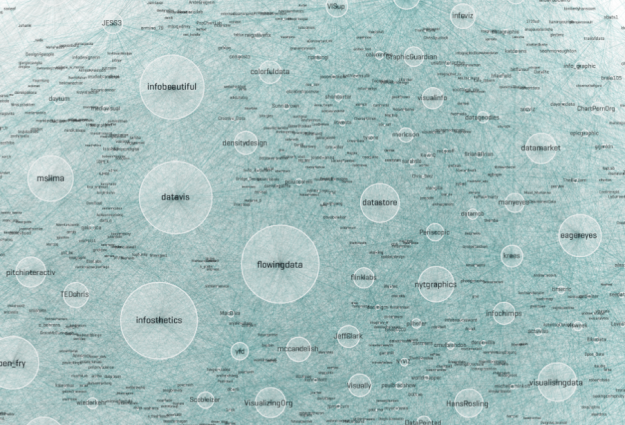
There are lots of people on Twitter who talk visualization. Moritz Stefaner had some fun with Gephi for a view of a whole lot of those people. He calls it the Vizosphere.

This map shows 1645 twitter accounts related to the topic of information visualization. The accounts were determined as follows: For a subjective selection of "seed accounts", the twitter API was queried for followers and friends. In order to be included into the map, a user account needed to have at least 5 links (i.e. follow or being followed) to one of these a
ccounts. The size of the network nodes indicates the number of followers within this network.

Check out the high-res version in the player below.

[VIZoSPHERE]


Cross-Species Gadget Tests Reveal Reason for Dolphin Tools

25 Jul

The dolphins of Australia’s Shark Bay, famed as Earth’s first marine tool-users, likely turned to gadgetry because echolocation couldn’t find the best fish, especially for hurried moms without time to hunt.

It was in 1984 that researchers first observed the dolphins fitting basket sponges over their beaks, then scraping through seafloor mud to disturb hidden fish. Research subsequently showed this behavior to be full-blown tool use, taught by mothers to their daughters and representing a profound difference in lifestyle between them and Shark Bay’s other bottlenoses.

A basic question remained unanswered, however: Though sponges clearly protected sensitive dolphin snouts from jagged pieces of rock and coral, why scrape seafloor at all? Why not rely on echolocation to pinpoint target prey?

In a study published July 20 in Public Library of Science ONE, biologists Eric Patterson and Janet Mann of Georgetown University set out to answer this question by mounting basket sponges on sticks and pushing them through Shark Bay seafloors, just as dolphins do.

Most fish scared from the muck were bottom-dwellers lacking swim bladders, the air-filled organs that help fish control their buoyancy. Compared to fish flesh, which interferes with acoustic signals just slightly more than water, air bladders stand out on sonar. Without them, bottom-dwelling fish are nearly invisible to echolocation. Hence the value of scraping through seafloors manually, and thus the need for a device that protects dolphin noses from scraping.

Hunting with sponges has allowed Shark Bay’s bottlenoses to fill an empty ecological niche, eating fish that other dolphins ignore, wrote Patterson and Mann. The findings also suggest why sponge foraging likely arose among Shark Bay’s females and has remained their province, taught by dolphin mothers to daughters rather than sons.

Whereas dolphin fathers are mostly absent, free to roam and chase prey in the open ocean, dolphin moms spend years with their calves. They need to put food on the figurative table but have little time to do it. Sponge foraging is convenient and nutritious, a family recipe for quick-but-delicious dinners passed on to daughters who will someday need it.

Image: Eric Patterson/PLoS ONE

See Also:

Citation: “The Ecological Conditions That Favor Tool Use and Innovation in Wild Bottlenose Dolphins (Tursiops sp.). By Eric Patterson & Janet Mann. PLoS ONE, July 20, 2011.