RSS
 

Black Hole Holds Universe’s Biggest Water Supply

25 Jul

By Mark Brown, Wired UK

Two teams of astronomers have discovered the largest and farthest reservoir of water ever found in the universe. It’s 12 billion light years away, and holds at least 140 trillion times the amount of water in all the Earth’s oceans combined.

It manifests itself as a colossal mass of water vapor, hidden in the distant APM 08279+5255 quasar. Quasars are bright and violent galactic nuclei fueled by a supermassive black hole at their center.

This quasar holds a black hole that’s 20 billion times more massive than the sun, and after gobbling down dust and gas it belches out as much energy as a thousand trillion suns. The water vapor is spread around the black hole in a gaseous region spanning hundreds of light years.

“The environment around this quasar is unique in that it’s producing this huge mass of water,” says Matt Bradford from NASA’s Jet Propulsion Laboratory in a press release.

“It’s another demonstration that water is pervasive throughout the universe, even at the very earliest times,” adds Bradford in the release. As the light from this watery quasar took 12 billion years to reach Earth, the observations come from a time when the universe was only 1.6 billion years old.

The water reservoir was discovered by astronomers, led by scientists at the California Institute of Technology, and using the Z-Spec instrument at the Caltech Submillimeter Observatory in Hawaii and the Combined Array for Research in Millimeter-Wave Astronomy (CARMA) in the Inyo Mountains of Southern California.

Both instruments observe in the millimeter and submillimeter wavelengths, which lie between infrared and microwave wavelengths. Over the last two to three decades, this technique has allowed astronomers to find trace gases, including water vapor, in the earliest universe.

Astronomers are now building a new telescope that specializes in these wavelengths. The proposed 25-meter telescope is called CCAT (Cornell Caltech Atacama Telescope) and would be plopped on the Cerro Chajnantor lava dome, more than 5,600 meters above sea level.

By measuring the presence of water and other important trace gases, it would allow cosmic researchers to hunt out primordial galaxies and more accurately study their composition. CCAT should start construction in 2013 and be completed in 2017.

Image: ESA/V. Beckmann (NASA-GSFC)

Source: Wired.co.uk

See Also:


Photographers Capture Mysterious, Beautiful Patterns in Sand

25 Jul
<< Previous | Next >>
sandy-chevrons

A single sand grain is a simple thing. But en mass, grains of sand build, slide and settle into beautiful and mysterious patterns we admire, but cannot always understand.

Sand has superhero qualities, as far as geological deposits go. Behaving at times like a solid, at times a liquid and at times a gas, it is a master shape-shifter. Formed by wind and water, sand allows large-scale geography to play out in miniature: settling into ripples, channels, canyons, valleys and deltas.

Sand is born as tiny pieces break away from rock. Young grains have rough edges, which smooth with time. The roundest grains are found in the desert, where the constant shifting winds rub the grains against each other, grinding them to a smooth polish. Because of this, dunes, like those of the Sahara, move in vast waves.

For a geologist, sand is any particle of a certain size. By studying rocks that were made when sand was deposited and compacted over millions of years, geologists can learn about the conditions under which the sand was laid down. And sand can be made of anything — the Huygens probe found “sand,” made of hydrocarbon ice, when it landed on Titan — and comes in many colors.

The enormous golden dunes of the world are made mostly of silicon dioxide, in the form of quartz. Bright white sands are made of limestone or gypsum, in the case of White Sands National Monument, New Mexico. Magnetite or obsidian give sands a black color. Greenish sands hold chlorite-glauconite or olivine, also called peridot, when it is of gem-like quality. Iron-bearing sands are deep yellow, red and orange. Worn coral deposits give some beaches a pink hue.

Sand goes into nearly as many materials as it comes from: glass, bricks, concrete, paint and electronics, to name a few. It is key to the workings of our natural world and a source of endless fascination for arenophiles (sand enthusiasts).

To bring out your inner arenophile, we’ve gathered some of the strangest and most impressive pictures we could find of sand patterns.

Above:

Mysterious Ridges

Martyn Gorman has found these weird and wonderful formations near his home along Scotland’s east coast on two occasions. What is at work in this magical intersection of sand and physics, no one, it seems, knows.

Image: Martyn Gorman

<< Previous | Next >>


Float Coffee Table by Liz Boscacci

24 Jul

American designer Liz Boscacci has created the Float Coffee Table.

.

Description from the designer:

Turned mahogany with glass top
3 feet diameter, 13 inches high

Inspired by bubbles under water floating to the surface, the objective here was to create a table with a distinctly unique base structure.

float_240711_01 float_240711_02

Visit Liz Boscacci’s website – here.

.


Apolo 11 House by Parra + Edwards Architects

23 Jul

Parra + Edwards Architects have designed the Apolo 11 House in La Reina, Santiago, Chile.

.

ap_230711_01 ap_230711_02 ap_230711_03 ap_230711_04 ap_230711_05 ap_230711_07 ap_230711_08 ap_230711_09 ap_230711_10 ap_230711_11 ap_230711_12 ap_230711_13 ap_230711_14 ap_230711_15 ap_230711_16 ap_230711_17 ap_230711_18 ap_230711_19 ap_230711_20 ap_230711_21 ap_230711_22 ap_230711_23 ap_230711_24 ap_230711_25 ap_230711_26 ap_230711_27 ap_230711_28

Apolo 11 House by Parra + Edwards Architects

Apollo 11 is a shop house in the middle of a grove of elms at the foot of the Andes, on the outskirts of the city of Santiago. She was baptized with that name because it is designed like a ship that landed in a forest without touching it at any time and will undertake his departure, leaving the forest intact. “Apollo 11″ also for the laboratory conditions: This house functions as architecture workshop, recording studio and rehearsal room acoustic and electric music. It is a capsule that support in full the life of his crew, a family of architects and musicians.

The program is organized in two levels from a rectangular 6 x 9 mts. in 6 mts. high. The rectangle, for the Japanese is the only element that does not distort the nature, is a clean element that tends to disappear. The simplicity of the box also helps the idea of ??occupying the forest floor minimum while maximizing the heat inside the ship as it landed in a place that is very cold in winter. With two levels of heating is easy and is oriented in their bedrooms to the north with large windows that take the stored heat energy and heat through the glass. In summer the foliage of the elms control acts as natural sunlight.

The box is a simple grid structure coated metal plates on their skin for plywood of 18 mm. glass plates and allowing full and empty that resemble the dark and light fragments produced in the foliage of trees. The skeleton of this structure is always visible, with the metal profiles metaphor from the trunks and branches of this new forest and wood planes of the leaves of the tree. That’s why their facades are indefinite and change in different seasons of the year through mobile web pages are the thermal checked in and out depending on what is happening in the forest itself.

Inside the ship, the inhabitant is a guest, a silent spectator of the nature of the forest in all its dimensions, as a temporary crew capsule observation ephemeral aware of their status in a place that belongs to him, but that is not property.

.
Visit the Parra + Edwards Architects website – here.

Photography by Rodrigo Avilés

.


this isn’t happinessâ„¢

22 Jul

via http://thisisnthappiness.com/page/3


NCOTB: August 2009

21 Jul

via http://72dotsperinch.blogspot.com/2009_08_01_archive.html


NCOTB: June 2009

21 Jul

via http://72dotsperinch.blogspot.com/2009_06_01_archive.html


Goodbye, Space Shuttle: Now the Space Race Can Really Begin

21 Jul

NASA’s 135th space shuttle flight ended this morning when Atlantis touched down at Kennedy Space Center in Cape Canaveral, Florida, marking the close of a 30-year run for NASA’s ambitious, controversial and troubled orbital vehicle.

America’s space programs will continue, but without their flagship space plane — or any manned vehicle, for now. Over the next few years at least, U.S. astronauts will hitch rides to the International Space Station in Russian capsules. Meanwhile, purely robotic systems will take over other space duties.

Listening to some critics, you’d think America had just retreated from space, forever. “We’re basically decimating the NASA human spaceflight program,” former astronaut Jerry Ross told Reuters. “The only thing we’re going to have left in town is the station and it’s a totally different animal from the shuttle.”

Today many observers consider the Shuttle the ultimate expression of American technological prowess, and see its demise as a signal of America’s decline. In one sense, they’re right: With its huge size, distinctive shape and fiery launches, the shuttle has always been an impressive symbol. But as a practical space vehicle, it has long been an overpriced, dangerous compromise.

There’s a reason the Soviets canceled their space shuttle, and that the Chinese have never attempted one. Even without their own shuttles, both nations are now nipping at America’s heels in space. Russia has increasingly reliable rockets and capsules; China began manned spaceflights back in 2003 and is mulling a space station and a moon mission. Both countries are working hard to expand their satellite fleets, though they remain far behind the United States with its roughly 400 spacecraft.

In truth, the shuttle’s retirement could actually make the U.S. space program stronger, by finally allowing the shuttle’s two users — NASA and the Pentagon — to go their separate ways in space, each adopting space vehicles best suited to their respective missions.

“When I hear people say, or listen to media reports, that the final shuttle flight marks the end of U.S. human space flight, I have to say … these folks must be living on another planet,” NASA administrator Charlie Bolden said in a July 1 speech at the National Press Club in Washington.

For NASA, future manned missions will ride in upgraded 1960s-style manned capsules: first Russian models, then potentially American-built ones. Missions that don’t require a human passenger will fall to rockets of various sizes. The military will use many of the same rockets, and could also expand its brand-new fleet of small, robotic space planes.

Together, these vehicles will make space flight cheaper, safer and more flexible than was ever possible with the shuttle.


Monroe or Einstein: Check If You Need Glasses at Your Computer [Health]

20 Jul
You probably know whether or not you're near-sighted, but some people get so used to seeing things a certain way that they ignore a vision problem, squint a lot, and end up with unnecessary eye strain at the computer. The double-image above cuts straight to the point: If you see Albert Einstein while sitting a normal distance from your computer, you're seeing things as you should. If you see Marilyn Monroe, you should probably be wearing glasses or contacts. More »


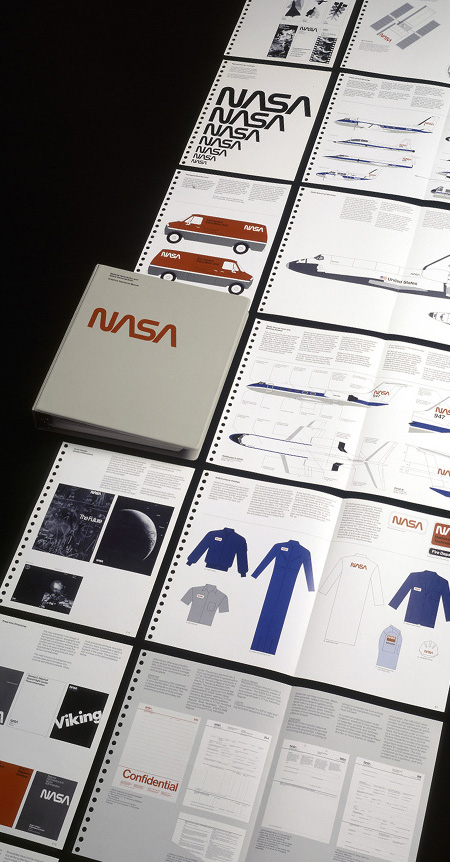
NASA Graphic Standards Manual — 1976

19 Jul

NASA Graphic Standards Manual

As some of you already know, I’m a little obsessed with finding vintage design materials, especially graphics manuals like this one for the 1976 Montreal Olympics. So you can imagine how far my jaw dropped when I saw this 1976 NASA Graphics Standards Manual. Created by design firm Danne & Blackburn in 1975, this manual outlines the proper use of, in my opinion, one of the best brand identities of the last century. One lucky soul has managed to get some hi-res scans of the some of the pages. The hunt has officially begun.