26 Beautiful Web Design Agency Portfolios
06
Apr
Web design is a growing profession popular amongst new-age businesses. This places powerful marketing power into the hands of digital artists and graphic designers for the web. Thus we have seen the development of dozens of design agencies and branding teams. The collection of agency designs below illustrates a bright picture of the current scape [...]
On the Argument That Android Is Taking Over
04
Apr
Nice piece by Jon-Erik Storm on Henry Blodget’s and Fred Wilson’s arguments that Android is the new Windows:
Really? I can come up with three counterexamples. One, gaming consoles. There are three: XBox, Playstation, and Wii. There has almost always been more than one important gaming console. Two, there are several web browsers that people use. If IE were still the only one, standards like HTML5 and CSS wouldn’t matter. Three, is Facebook really the only social platform? What is Twitter then? Maybe iTunes would have been a better example, eh? And as for PCs, Apple seems content with it being the #1 laptop and #2 PC maker with its approximately 8% marketshare, but yet reaping more profits. But the point is these examples are unscientific and don’t explain why technology platforms stabilize that way (if they do) and why that will apply to smartphones.
That’s the question of the decade. Is mobile going to work out like the console market, with a handful of competing and roughly equal major platforms? Or is it going to work out like the PC, where a lower-cost inferior licensed OS grows to an overwhelmingly dominant monopoly position? (And, as Storm points out, Apple’s penalty for “losing†the PC war is that it is now the world’s most profitable PC maker.)
(Also worth noting about the console market: the lead has changed hands several times: Atari, Nintendo, Sony, Nintendo. And second-place has changed numerous times as well. It’s long been a healthy competitive market.)
Update: Another WordPress blog fireballed. Google has it cached.
“Anonymous” attacks Sony to protest PS3 hacker lawsuit
04
Apr

The hacker hordes of Anonymous have transferred their fickle attention to Sony. They are currently attacking the company's online Playstation store in retribution for Sony's lawsuit against PS3 hacker George Hotz (aka "GeoHot"). A denial of service attack has temporarily taken down playstation.com.
In a manifesto announcing the new operation, Anonymous railed against Sony for going after coders who seek to modify hardware that they own. The lawsuits are an "unforgivable offense against free speech and internet freedom, primary sources of free lulz (and you know how we feel about lulz)."
"Your corrupt business practices are indicative of a corporate philosophy that would deny consumers the right to use products they have paid for and rightfully own, in the manner of their choosing," continues the pronouncement. "Perhaps you should alert your customers to the fact that they are apparently only renting your products? In light of this assault on both rights and free expression, Anonymous, the notoriously handsome rulers of the internet, would like to inform you that you have only been 'renting' your web domains. Having trodden upon Anonymous' rights, you must now be trodden on."
Anonymous is rallying participants to voluntarily contribute to the denial of service attack on Sony. That attack is continuing, and it appears to be far more successful than recent hits on Angel Soft toilet paper. In Anonymous chat rooms, participants bash Sony but worry about how their actions will be perceived. "Guys, you need to talk to the gamers and explain to them that this does not affect their gameplay," wrote one.
Some even hope to take credit for a small drop in Sony's stock price: "We're already causing sony stock to drop!!!"
While most Anonymous attacks remain online-only hacks or protests, Operation Sony will feature a real world component. On April 16, Anonymous wants people to gather at their local Sony stores to complain in person—no doubt leading participants to rummage through their closets in order to dig out the old Guy Fawkes mask.
Read the comments on this post
10 ways spam taught us to focus our attention
02
Apr
DIGITAL WILL BE GIVING A PRODUCT PRESENTATION OF THE NEWEST MEMBERS OF THE DECSYSTEM-20 FAMILY; THE DECSYSTEM-2020, 2020T, 2060, AND 2060T. THE DECSYSTEM-20 FAMILY OF COMPUTERS HAS EVOLVED FROM THE TENEX OPERATING SYSTEM AND THE DECSYSTEM-10Â COMPUTER ARCHITECTURE. BOTH THE DECSYSTEM-2060T AND 2020T OFFER FULL ARPANET SUPPORT UNDER THE TOPS-20 OPERATING SYSTEM. THE DECSYSTEM-2060 IS AN UPWARD EXTENSION OF THE CURRENT DECSYSTEM 2040 AND 2050 FAMILY. THE DECSYSTEM-2020 IS A NEW LOW END MEMBER OF THE DECSYSTEM-20 FAMILY AND FULLY SOFTWARE COMPATIBLE WITH ALL OF THE OTHER DECSYSTEM-20 MODELS.
You’ve just read the very first spam message. Sent by Carl Gartley on behalf of Gary Thuerk, this message went to several hundred ARPANET members on May 3, 1978. The message violated the until-then standard practice of e-mailing people individually (ah, those were the days!) and annoyed a whole lot of ARPANET users. It also sold some computers. And thus, the era of spam marketing was born.
It’s customary to curse the name of Thuerk, though Thuerk himself uses fatherespam as his LinkedIn profile URL, and prominently cites his role in creating spam as a professional credential. (Guess he decided to embrace it sometime after this interview.) But I think that Gary Thuerk is owed more than a sarcastic thank you.
After all, spam — now estimated at more than 75% of e-mail traffic — has been one of the major drivers of online innovation. To cope with “Pandora’s Inboxâ€, we’ve had to develop attention and information-management systems that prove crucial for surviving today’s communications-rich environment.
Spam is the vaccine for your attention span. It’s the toxin that has stimulated our immunity system’s defenses. Thanks to spam, we’ve had to find technical, social and personal ways of keeping our eyes on the 22% of e-mail that isn’t pure junk, and to avoid the 78% that is.
Those tools and tactics turn out to serve us very well in the era of social media. Now that people generate content and communications in ways that go well beyond e-mail, we need to focus in ways that go far beyond a spam filter. We can thank Gary Thuerk and the spammers of the universe for helping us develop the following ways to focus our attention:
- Email filtering: Email filters, which were first created to deal with spam, have since turned into powerful tools for managing and organizing incoming email. I’m utterly dependent on Gmail filters in ways that go way beyond spam elimination. Without spam I might have to read and file my e-mails by hand (shudder).
- Attention filtering: Email filters have inspired analogous tools on other platforms. Twitter lists, the Facebook “hide†option and the entire idea of PATH are all about filtering out extraneous content so we can focus our attention on a more limited circle of relationships or a more limited sphere of information.
- Texting and messaging: Spam made us impatient about the process of plowing through our inboxes. Texting, chat and Twitter are all instant communications tools that sidestep the whole inbox nightmare by coming to us in real time. (And better yet, by being incredibly short.) Learning to communicate in very brief increments is one of the legacies of spam, and in a world that connects us to hundreds or thousands of people through a wide range of social networks, we can be grateful that some of those conversations happen briefly.
- Pull: Email did a fantastic job of teaching us about the limits of push: content that gets pushed to you. As a result many of us have shifted much of our attention onto pull: content that we pull to us by choosing what to visit or subscribe to. For instance, instead of subscribing to e-newsletters, we might subscribe to blog RSS feeds. While e-newsletters are still alive and well, the shift to pull is an essential tool for people trying to manage a very high volume of information.
- FOAF: The friend-of-a-friend principle has driven a wide range of social networks in which your interactions are structured around networks of trusted contacts. Relying on networks of trust is a way of getting past the spam problem, by opening communication channels only along lines that mirror pre-existing social relationships. Just think about LinkedIn, which explicitly limits your ability to contact people based on how closely you are connected. That whole model of using social networks to construct boundaries around who gets our attention is in some part thanks to the problem of ungated attention first demonstrated by spam.
- Marketing with value: Spam’s assault on e-mail delivery and opening rates first forced marketers to think about what they could actually offer to make an e-mail worth reading. That consciousness and skill set has served marketers well in the social media era, where the competition for attention is even fiercer. If some online marketing now delivers real value to its targets — think the Dove Campaign for Real Beauty or Dell’s Ideastorm — that’s because marketers have learned that providing tangible value is one way to earn people’s attention.
- Opt in, opt out: To address the spam problem, many countries have laws that require all bulk e-mails to include an opt-out link, and/or to be sent only by people who have explicitly opted into the mailing list. (Of course, these laws are ignored by all kinds of illegitimate operations, which is why spam volumes remain so high.) This has given us the idea that you don’t demand the attention of someone who hasn’t asked for your content, and that losing someone’s attention is a routine and acceptable part of our communications ecosystem. You can see that principle extended into technologies and practices like the ever-evolving policies on what appears in your Facebook news feed, and the ease of unfollowing people on Twitter.
- Ignoring communications: Spam taught us that it was OK to ignore a lot of e-mail. We still have a ways to go in overcoming our notion that all e-mail deserves a reply, but to the extent that we’re asserting some sense of agency over how we allocate our attention, it builds on the foundations established by spam. Once you learn how to ignore offers from Nigerian princes, it gets a lot easier to ignore irrelevant office-wide memos.
- Getting rich quick: In a world that delivers daily messages about how you can get rich quick, it’s understandable that we’d lose our patience for long, slow empire-building. Maybe it’s overreaching to blame (or credit) spam for a generation of social media sites built on the business model of, “let’s build something that we can get Yahoo! or Google to buy.†But some of the startups that found their quick return through early acquisition have included some great tools for managing our information and communications (hello, delicious and Radian6).
- Penis talk: If we weren’t so constantly deluged by spam ads promoting Viagra, Cialis and penis enlargement, we might think that the size and engorgement of one’s genitalia were strictly personal matters. Thanks to spam, we now know how much people like to think and talk about penises, information that has helped to drive some of the Internet’s most successful entertainment sites. Imagine if we’d wasted all that attention on lady parts instead!
Top 5 Facebook Marketing Mistakes Small Businesses Make
02
Apr


This post originally appeared on the American Express OPEN Forum, where Mashable regularly contributes articles about leveraging social media and technology in small business.
While Facebook marketing is on the rise among small businesses, many are still struggling to master the basics.
“Many people have difficulty with just the basic Page set up,†says social media marketing consultant Nicole Krug. “For example, I still see people setting up their business as a profile page instead of a business Page. I have other clients who jumped into Groups when they came out and have divided their fan base.â€
Here are five more common Facebook marketing mistakes to avoid:
1. Broadcasting

Ask any social marketing consultant what the number-one no-no is on Facebook, and he’ll likely tell you it’s “broadcasting†your messages instead of providing fans with relevant content and engaging on an continual basis.
“With Facebook, marketers of any size can do effective, word-of-mouth marketing at scale for the very first time. But Facebook is all about authenticity, so if your company is not being authentic or engaging with customers in a way that feels genuine, the community will see right through it,†says Facebook spokeswoman Annie Ta.
Peter Shankman, social media consultant, entrepreneur and author of “Customer Service: New Rules for a Social Media World,†agrees.
“Your job is to interact, not just to broadcast,†says Shankman. “Fans are looking for a reason to connect with you, and they’re showing you that by clicking ‘Like.’ Your job is to give them a reason to stay.â€
According to Andy Smith, co-author of “The Dragonfly Effect: Quick, Effective and Powerful Ways to Use Social Media to Drive Social Change,†many businesses immediately ask how Facebook is going to make them money and have that be the focus, as opposed to trying to engage customers and provide a meaningful, authentic online experience. “Marketers need to recognize that people go to Facebook to make a connection or feel like part of a community,†says Smith.
2. Not Investing Adequate Time

Another common mistake is underestimating the amount of time a successful Facebook strategy entails. Many social media consultants report seeing a pervasive “set it and forget it†mentality among small businesses.
“Some small business owners are under the impression that if they set up a Page on Facebook, that’s all they have to do. They think people will just naturally come and want to be a fan of their product or service,†says Taylor Pratt of Raven Internet Marketing Tools. “But it takes much more of a commitment than that.â€
It’s not just fan growth that will suffer from this approach — it may also hurt your relationships with existing fans, particularly customers who have come to expect timely responses to their posts and queries.
“Unlike traditional advertising methods such as a radio spot or a Yellow Pages listing, you can’t just create a Facebook Page and just let it run its course,†says Alex Levine, a social media strategist at Paco Communications. “Creating a Facebook Page is the first of many steps, but the Page needs to be updated and monitored constantly.â€
3. Being Boring or Predictable

When they’re thinking about marketing, some business owners forget that Facebook is a social place where people share things they find funny, interesting or useful with their friends. Think about what kind of content your fans would actually want to share when planning your posts.
Shankman also cautions against becoming too predictable. “Status updates by themselves get boring. But then again, so do photos, videos and multimedia as a whole. Your job is to mix it up. The moment you become predictable, boring or annoying, they’ll hide you from their feed. So keep it varied and personal — a video here, a photo here, a tag of one of your fans here.â€
Creating too much “filler†content by auto-publishing content from your blog or Twitter feed can also derail your efforts. Joseph Manna, community manager at Infusionsoft, recommends using Facebook’s native publishing tools to gain the most benefit from Facebook.
“Whatever you do, DON’T automate everything,†says Manna. “It’s nice to ‘set and forget,’ but the risk is two-fold: publishing systems sometimes have issues, and Facebook places low-priority on auto-published content.â€
4. Failing to Learn About Facebook Mechanics and Tools

Since Facebook is a relatively new medium, some businesses have yet to explore all its functionality and they’re missing out on creating an optimal brand experience.
“Many small businesses do not take advantage of the tools to introduce themselves to the Facebook audience,†says Krug. “For example, the ‘Info’ tab is rarely utilized well, and very few small businesses [create] a custom welcome page.â€
Krug also sees frequent mistakes around one of the most basic elements of Facebook presence: the profile image. “Most companies upload a version of their logo, but the resulting thumbnail image that shows up in news feeds often only captures a few letters in the middle of their logo — this partial, meaningless image is then how they’re branded throughout Facebook,†says Krug.
Facebook Insights, Facebook’s built-in analytics system, is also often overlooked, and with it the opportunity to analyze post-performance to see what types of content gets the most engagement.
5. Violating Facebook’s Terms
Not only is it critical to know how Facebook works and what tools are available, it’s also important to know the rules of the road — something that many businesses miss.
“Every day I see organizations endangering the communities they are growing by violating the terms they agreed to when their Facebook presence was created,†says small business marketing consultant Lisa Jenkins.
What are the most common violations? Some build a community on a personal page instead of a proper Facebook Page. Others fail to abide by Facebook’s rules around running contests. And don’t even think about “tagging†people who are in an image without their permission.
“Tagging people to get their attention is not only a violation of Terms but can be reported by those you are tagging as abusive behavior on your part — which brings your violation to Facebook’s attention and opens your Page’s content to review,†warns Jenkins.
To avoid these common mistakes, invest time in learning about the Facebook platform, educate yourself on how to build and sustain an audience, and don’t forget to engage with people like you do in real life.
“What sets small businesses apart from large companies is their ability to make personal connections with customers,†says Ben Nesvig of FuzedMarketing. “They tend to forget this when they join Facebook, yet it’s their biggest strength and asset.â€
More Facebook Resources from Mashable:
- 4 Ways to Set Up a Storefront on Facebook
- HOW TO: Add Social Sharing Buttons to Your Website
- The Future of Social Search
- 5 Creative Facebook Places Marketing Campaigns
- Dog: Man’s Best Facebook Friend, Too? [INFOGRAPHIC]
For more Business & Marketing coverage:
- Follow Mashable Business & Marketing on Twitter
- Become a Fan on Facebook
- Subscribe to the Business & Marketing channel
- Download our free apps for Android, Mac, iPhone and iPad
35 Years & $317 Billion Later, Apple Intends To Dominate a Post-PC World
01
Apr


On April 1, 1976, Steve Jobs, Steve Wozniak and Ronald Wayne established a small company to sell personal computer kits hand-built by Wozniak. That company, as you probably know, was Apple Computer.
Thirty-five years later, Apple is now the most valuable technology company in the world. Its market capitalization exceeds $317 billion, trumping longtime rival Microsoft by more than $100 billion. And Apple’s iconic products sit on the desks and in the pockets of millions of people across the world.
Most people know bits and pieces of the Apple story, but the company has a complicated history. Some of us may not know, for example, that Apple had a third co-founder, Ronald Wayne, who got cold feet and sold his 10% stake in Apple less than two weeks later. Everybody knows Steve Jobs, but they may not know Mike Markkula, one of Apple’s first angel investors and the company’s second CEO.
In the 35 years of Apple’s existence, the company has gone through hell and back. The launch of the Macintosh in 1984 and the coinciding “1984″ Super Bowl commercial remain symbols one of Apple’s highest points, but only a year later, then-CEO John Sculley forced Steve Jobs out of the company. A decade later, in 1996, the company was on the brink of destruction when it acquired NeXT and brought Steve Jobs back. In 1997, Microsoft invested $150 million in Apple to keep it afloat (something it probably now regrets), and soon after came Apple’s golden years with the iPod, iMac, MacBook, iPhone and now the iPad.
We don’t necessarily want to dwell on Apple’s past; you can visit Wikipedia if you want a lesson in Apple Inc.’s history. Instead, let’s focus on what Apple might do in the next 35 years.
What’s In Store For The Next 35 Years?
For the last 35 years, Apple has almost always been the underdog. While it languished, Microsoft flourished. In fact, Apple surpassed Microsoft in market cap for the first time last May.
For the next few decades, however, the technology titan will be incumbent. Apple has a giant target on its back, and it’s not just Microsoft taking aim. Apple also faces challenges from Google, Amazon and a plethora of mobile device manufacturers. While Apple is handily beating its competition today, the status quo could change at any moment.
And while Apple fends off Android, PCs and competing tablets, it has its eye on creating a post-PC world. Rather than compete on hardware specs, it competes on design and user experience. Its a world of mobile devices that Apple intends to dominate for decades to come.

Leading the charge is Steve Jobs, not only the company’s CEO but also its heart and soul. While he’s currently on medical leave, he did show up for the unveiling of the iPad 2, demonstrating things aren’t as dire as previously rumored.
Still, Apple will some day have to continue its quest to redefine technology without its iconic leader, and many question whether anybody can provide the design and product vision Jobs has imparted on the company he founded 35 years ago.
Even if you aren’t a fan of Apple products, it’s tough not to be impressed with what Apple has been able to accomplish since 1976. We wonder what products it will create and challenges it will face in the next 35 years. Right now though, the sun is definitely shining down on Cupertino.
More About: iMac, ipad, iPad 2, iphone, iphone 3g, iphone 3Gs, iphone 4, ipod, mac, macbook, Macbook Pro, macintosh, steve jobs, steve wozniak
For more Tech & Gadgets coverage:
- Follow Mashable Tech & Gadgets on Twitter
- Become a Fan on Facebook
- Subscribe to the Tech & Gadgets channel
- Download our free apps for Android, Mac, iPhone and iPad
I Got .99 Problems, But Pricing Ain’t One.
01
Apr
From research done the Inon Inon Pricing Research Centre, and Leigh Caldwell:
Everyone knows – or thinks they know – that prices such as £1.99, £5.99 or £9.99 are optimal price points for retail goods. Customers read the first digit first, and the last two are ignored – or at least, they have much less cognitive impact. In general, consumers were thought to put a subjective value estimate of about ten per cent less on an item priced at £3.99, than one at £4.00.
This has been a fairly robust result in the past, and is intuitive for a number of reasons, “but WAIT!†say Leigh:
[And] the results were a surprise. At first we thought that the effect we have discovered was just a previously unnoticed artefact, hidden by the fact that no proper experiment has been published before. But after further exploration, we think it is also an effect of changing consumer preferences. As customers become more aware of marketing tactics and more cynical about any communication from companies, their psychology and behaviour inevitably changes.
So, to the results. The summary points are:
- Prices ending in .99 no longer have any advantage in consumer value perception, and do not lead to higher sales.
- The optimal penny value varies by country. In the United States, it is .01. So, instead of $3.99, companies should charge $4.01. In European countries, the optimal price point is different for different product categories, but there is a peak at .04 for many products. So, British or European retailers currently charging, say, £0.99 should increase the price to £1.04.
- By switching in this way to a “dollar-plus†price instead of “dollar-minusâ€, retailers can increase sales volume by an average of 8% and increase profit margins by 1-3% (depending on the exact price point).
- Consumers, when presented with the new price point, report an increased level of trust and affinity with the brands of the retailer and manufacturer. We believe this arises from the “honesty signal†that comes from abandoning a discredited and manipulative sales practice.
This is indeed very interesting, and I eagerly await reading the full study (which Leigh is offering as a pre-print!). Head over to Leigh’s blog for more rather counter-intuitive findings from his new research!
Update: If not a bit late, April fools!
Filed under: Economics, Society


Highest Mountains, Deepest Trenches, and a Doughnut
01
Apr
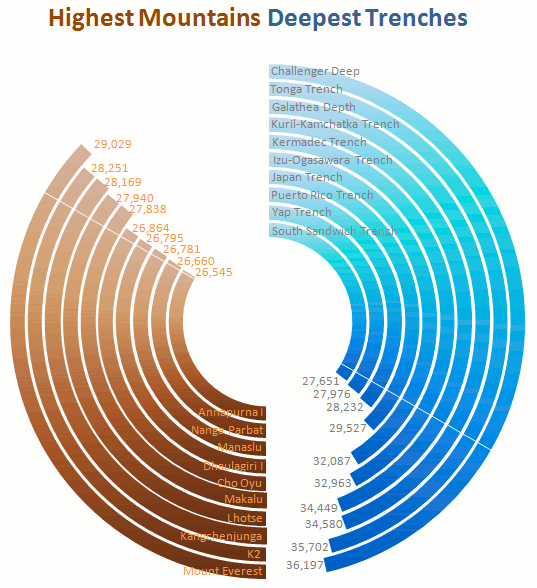
A while ago something broke inside me. My deepest held beliefs were shattered. I started drinking again. Absinthe. I love absinthe. 69% ABV.
It started when I saw it. A glorious pie chart displaying growth rates. Growth! At first, I couldn’t believe it. I took off my glasses. Yes, growth rates. In a pie chart. I had to try it. Unemployment rates. Growth rates above 100%. Apples and oranges. Trends. Pies, pies, pies. And absinthe.
Now I’m playing with doughnuts. Mountains and trenches, from the Wikipedia. I don’t like it. It murmurs. Too much signal. I want pure noise. Maybe a 3D effect can help. I’ll try again.
Bye, Tufte. Bye, Few. Bye, Bertin. I’m almost free.
Oops. April 1 is almost over. Back to business then.
Â
______________________
Want to create better dashboards? Try the Excel Dashboard Tutorial.
Post from: Excel Charts Blog.
Highest Mountains, Deepest Trenches, and a Doughnut

No related posts.
Web browser market share: Modern browser edition
01
Apr

March was a big month for Web browsers, with major new versions of both Internet Explorer and Firefox. Both browsers have been suffering in the browser wars; Internet Explorer has steadily declined from its near-total monopolization of the browser market, and Firefox's growth has faltered, most likely due to strong competition from Google's Chrome.
With Internet Explorer 9 out for just two and a half weeks, and Firefox 4 available for only nine days, however, not much has changed so far. Microsoft's browser continues to shed market share, dropping 0.85 points to 55.92 percent. Firefox is essentially unchanged, at 21.80 percent. These new browsers may yet be influential in encouraging people to switch—but at the moment, it looks like the only people adopting them are users of older versions.

Read the comments on this post