RSS
 

Archive for September, 2008

It's Time for the News Aggregators to Come Clean

09 Sep
Steve Rubel via Micro Persuasion shared by 4 people

A news story from 2002 about United Airlines filing for bankruptcy tripped up investors yesterday when it re-appeared on Google News, Barry Schwartz reports. The Google News team follows with their own explanation. However, the entire issue raises the lack of transparency that permeates the major news aggregation sites. It's time for them all to come clean.

According to Reuters consumers are increasingly turning to news aggregation sites for their info fix because of the growth of the mobile web and an appetite for broad perspectives. These sites, which include Google News, Yahoo News, Topix and Daylife, differ from RSS readers. Feed readers also roll up news but they put the user in complete control of the sources they consume.

News aggregation sites operate without editors. So, they're prone to the occassional glitches like the one that occurred yesterday. The problems are deeper, however. Most of these sites also roll up blog content and they don't tell you that. Yahoo just recently quietly started to links to blogs.

The problem is that these sites don't delineate blogs from news sources. As we all know the quality can range here and that presents a challenge for the reader in determining who to trust.

Although this specific incident with United Airlines did not invovle blogs, it underscores the lack of transparency that permeates these sites. They are doing everyone a disservice by not providing detailed information on who they chose aggregate and why they roll up some sites and ignore others.

 
Comments Off on It's Time for the News Aggregators to Come Clean

Posted in Uncategorized


A friend told me about it.

09 Sep
Jessica Hagy via indexed shared by 4 people

www.indexed.blogspot.com
 
Comments Off on A friend told me about it.

Posted in Uncategorized


True Enough: the science, history and economics of self-deception

09 Sep
Farhad Manjoo's True Enough: Learning to Live in a Post-Fact Society is a breezy-but-engrossing look at the increased polarization of news in the 21st Century. Manjoo convincingly argues that our own capacity for selective perception (show two groups of partisans footage of a political debate and both will swear it was biased for the other side; show the same footage to someone who doesn't care and they won't see bias for either side) combined with the Internet's capacity to network affinity groups and spread fragmented, selective media are a perfect storm, with the truth right in its path.

Manjoo makes a good case. He walks through a number of net-based conspiracy theories on both sides of the political spectrum, speaks with their adherents, the experts who claim it's all bogus, and then to cognitive scientists and other scientists who explain the gigantic gap between what is so obvious to non-partisans and what is blindingly, passionately important to the adherents.

Grounded in history and science, True Enough paints a dismal picture of a species with a limitless capacity for self-deception and selective reasoning. But Manjoo doesn't ascribe the rise of truthiness to fragmented media alone: he calls out PR firms, media outlets and others who have profited from the erosion of the truth.

I'm more-or-less convinced by Manjoo's idea that reality itself has fragmented, that many of us "know" different, mutually exclusive "facts" about the world, but I'm not so sure that this is an outcome of a networked society. For centuries, a large number of people "knew" that Jews used gentile baby-blood in Passover matzoh. They "knew" that phrenology worked. That gypsies stole babies. That the laboring classes lacked the capacity to learn and participate in society. That women had fewer teeth than men.

Our capacity to select the facts that justify our beliefs isn't new, but perhaps it is growing worse. Certainly, the money's better than its ever been. Forewarned is forearmed -- having read True Enough, I feel like I'm more ready to examine my selective perception and cherished illusions. And that's certainly worth the price of admission. True Enough: Learning to Live in a Post-Fact Society

 
Comments Off on True Enough: the science, history and economics of self-deception

Posted in Book


Briton Invented iPod, DRM and On-Line Music in 1979

09 Sep

IXI.jpg

Picture credit: Steve Nicholson

Today Apple is almost certain to announce, at the very least, a new, taller iPod Nano. But amidst the hype surrounding the "Let's Rock" event, it's easy to get so caught up in the iPod's future that we forget where it came from.

The iPod was not invented in 2001 in Cupertino, California. It was invented in England in 1979, by “serial inventor” Kane Kramer.

This is not a story of intellectual property theft, or of big companies putting the screws on the little man. Instead, it is just the retelling of another old story — the story of a lone, visionary inventor and his inability to market a product that appeared way before its time.

Kramer came up with the idea for a pocket-sized, portable solid state music player with a friend, James Campbell. Kramer was 23, Campbell 21. The IXI System had a display screen and buttons for four-way navigation. In a report presented to investors in 1979, the IXI was described as being the size of a cigarette packet. Is this sounding familiar yet?

Back in 1979, a memory chip would store a paltry three and a half minutes of music. Kramer fully expected this to improve, and confidently foresaw a market for reliable, high quality digital music players which would be popular with both consumers and the record labels. It could actually be argued that he was still ahead of Apple after the firat iPod went on sale — that had a hard drive and Kramer had moved onto flash memory years earlier.

Much has been made of Apple somehow “stealing” the technology. But the patent did what all patents do, whether used or not. It lapsed, and whether Apple took the idea from there or from somewhere else, it was all perfectly legitimate. In fact, when Apple was suing (and counter-sued by) Burst.com in 2006 it cited the invention as “prior art” to dispute Burst’s patents. Apple even called Kramer in to give evidence.

But anyone can dream up a magic futuristic gadget. That’s where James Campbell came in. Campbell was an electronics whizz and between them the men came up with four prototypes. According to Kramer’s website, a fifth, pre-production unit actually went on sale at the APRS exhibition at Earls Court, London.


Record-Shop-1982.jpg

But the really surprising part of Kramer’s invention is not the hardware but the infrastructure behind it. It eerily foreshadows the iTunes Store and pretty much any modern online music store.

Content was to be stored on a central server and distributed to music stores vie telephone line (remember — in these days there was no internet and almost no home computers). Customers would take their players into the store and buy music which would be loaded onto the IXI chips inside (the chips were removable, like a tiny cassette). This alone would obviate the need for physical media, but take a look at a few points from Kramer’s investor pitch to see just how close he got to the future:

Immediacy of delivery

No physical inventory and therefore no production costs

Live performances taped and then made immediately available

Entire back catalogs could be put on sale at almost no cost

New, risky artists can be promoted with low cost

Instant micro-billing, handled centrally

Vending machines for self-purchasing — located in bars, filling stations, supermarkets (it seems quaint now that these were to be coin operated)

Uncanny. Kramer also foresaw DRM, or digital rights management, before it even had a name. This is worth transcribing (the original was written on a typewriter):

For every record or tape of conventional format sold, over one copy is made in an illegal form.

Therefore over 100% of the total sale potential is lost.

With IXI, all programme material (recordings) is stored and transmitted on a high security enclosed digital network, all terminals being supplied under license to retailers. Because of the attention to security, it is impossible to break into the system undetected, thus preventing bootlegging of the programme material by fraudulent means.

The first stage at which the digital encoded programme material is converted to analogue (audio) signals, is when the IXI CHIP is played back in the home playback unit.

It can be seen from the above, that the format prevents mass copying of programme material by fraudulent traders and home copying.

Though it is easy to laugh at this optimism, it’s possible that Kramer foresaw the recording industry’s huge reluctance to online delivery and attempted to diffuse it. What is really laughable, though, is that the same recording industry is still thinking in exactly the same way almost thirty years later.

Now Kramer is working on something called the "Bully Button", a wearable recording device which can be discretely activated by kids (or adults) when they are set upon by bullies. It's a laudable idea, but the leap into the future he made with the IXI and it's ecosystem. Back in the 1970s, Kramer was thinking way ahead of his time. Sadly for him, it took the market until now to catch up.

Development of the first MP3 player [Ken Kramer]

IXI Systems Report 1979 [Direct pdf]


Add to Reddit Add to Facebook Add to digg

 
Comments Off on Briton Invented iPod, DRM and On-Line Music in 1979

Posted in Uncategorized


Microsharing becomes the top story

09 Sep
Laura Fitton via Pistachio shared by 5 people

by Mark Dykeman of  Broadcasting Brain

There’s been a lot of speculation this year about when microsharing will finally have its moment in the spotlight and move firmly into the mainstream.  A BusinessWeek Special Report: CEO Guide to  Microblogging may be the sign that early adopters have looked for.

This special report includes several features on the capabilities of tools like Twitter, Pownce, and Jaiku.  The articles cite how well-known companies like JetBlue, Dell, and GM are taking advantage of the power of what we call microsharing.  Whether a company is listening for customer feedback, answering questions, or otherwise helping the customer meet their needs, large companies are finding the customer at point of need.

Here’s a quick guide to the contents of the Special Report:

  • Getting Intimate (With Customers) On Twitter – a look at how companies are conversing and sharing directly with their customers. The customer has the microphone and is in the driver’s seat – companies are getting onboard for the ride… and the conversation.

Just one example from the report is that H&R Block, which helps customers through one of the least sexy tasks ever, is using a tool like Twitter to listen to its customers.  Web 2.0 technologies coupled with a focus on listening, are helping the venerable tax preparation institution to better introduce itself to younger customers. H&R Block is a good example of reaching out to a previously underserved segment of its potential customer base.

The report provides general tips and examples that will be familiar for those who have already adopted 140 character exchanges of links, information, and socialization into their daily routines. What’s significant is that businesses not already visiting these online gathering areas will find it increasingly harder to ignore the unfolding opportunities.  When BusinessWeek targets a special report to the C-suite, the trend is certainly growing, a few more executives will feel the concept “tip” in their minds, and more will start exploring the space.

Is microsharing mainstream yet?  Maybe not.  But it’s a whole lot closer than it was last week.

Reblog this post [with Zemanta]
 
Comments Off on Microsharing becomes the top story

Posted in Uncategorized


Retro Gaming on real backgrounds – Fubizâ„¢

09 Sep

via http://www.fubiz.net/blog/index.php?2008/05/24/1820-retro-gaming-on-real-backgrounds

 
Comments Off on Retro Gaming on real backgrounds – Fubizâ„¢

Posted in Uncategorized


Heinlein’s fan-mail solution

09 Sep
George sez, "Kevin Kelly describes how Robert Heinlein dealt with fan mail before PCs."

Heinlein engineered his own nerdy solution to a problem common to famous authors: how to deal with fan mail. In the days before the internet, Heinlein's solution was fabulous. He created a one page FAQ answer sheet -- minus the questions. Then he, or rather his wife Ginny, checked off the appropriate answer and mailed it back. While getting a form letter back might be thought rude, it was much better than being ignored, and besides, the other questions you did not ask were also answered! Indeed, it is both remarkable and heartwarming that Heinlein replied at all to most mail. Can you imagine other great authors doing the same -- even with a form letter? Heinlein's form is very entertaining to read because you are forced to reconstruct the missing requests.
I love these, especially the slightly grumpy ones about whether authors can be reasonably expected to answer essay questions as part of a student's homework assignment! Oh, and the answer to "I love your work, but your latest story stank," is spot-on perfect. Heinlein's Fan Mail Solution (Thanks, George!)

 
Comments Off on Heinlein’s fan-mail solution

Posted in Book


Cool it on the rocks—literally.

09 Sep
ice_rocks.jpgJust as the devil has the best songs, mother nature has the best gadgets. How about a non-toxic, durable and reusable device that retains cold, and can release it to your drink without diluting it or affecting its flavor? Yep, she's got it covered: "Nordic Rock," which does just that.

I can't find reference to "Nordic Rock" anywhere, but this stuff is probably some kind of calcium carbonate (used in aquariums because it won't poison anything). Pour some acid on it to find out! Mocha sells a set of 10 for £16.

Product Page [Mocha via technabob]


Comments Off on Cool it on the rocks—literally.

Posted in Uncategorized


Retro Gaming on real backgrounds – Fubizâ„¢

09 Sep

via http://www.fubiz.net/blog/index.php?2008/05/24/1820-retro-gaming-on-real-backgrounds

 
Comments Off on Retro Gaming on real backgrounds – Fubizâ„¢

Posted in Uncategorized


Winner of the Personal Visualization Project is…

08 Sep
Nathan via FlowingData shared by 4 people

Last week was the end of our FlowingData personal visualization project. I asked readers to collect data about themselves or their surroundings and then visualize it some way. Thank you to everyone who participated. It put a smile on my face every time I got an email with "summer project" in the subject line :).

The Winner is...

While I enjoyed all the entries (and I hope you all enjoyed making them), there can only be one winner. The winner is Tim Graham who took manual personal data collection to another level. From email spam, to beverage consumption, to aches and pains, Tim embraced the spirit of self-surveillance. He even made his personal data available in the forums. Congratulations, Tim!

Here are Tim's personal data visualization projects along with entries from Brian, John, Kevin C, Kevin M, Lisa, Said, Stacey and Joel, and Tony. Thanks again everyone for participating, and I hope the rest of you will consider getting in on the self-introspection next time.

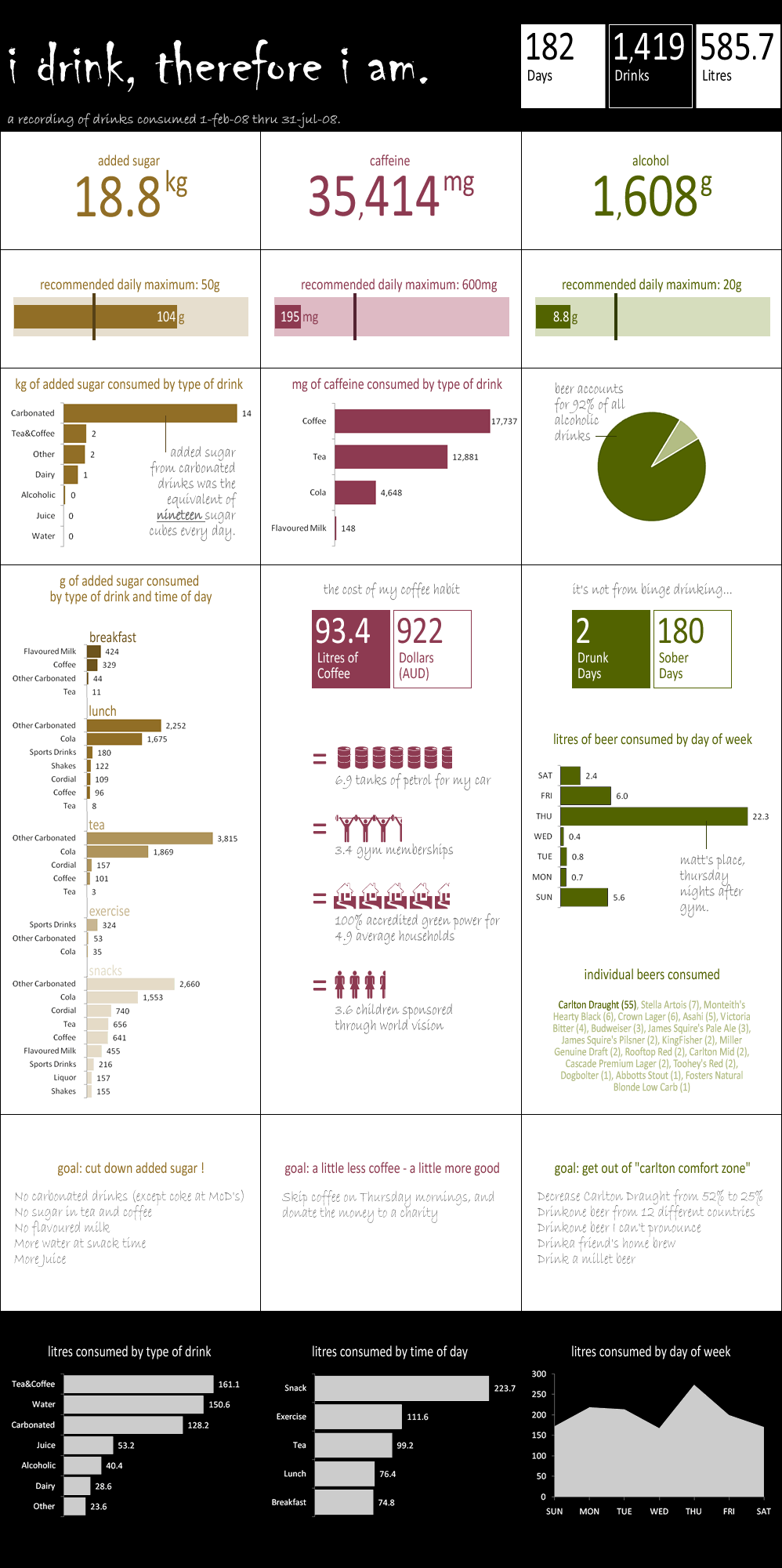
I Drink, Therefore I Am

I originally thought this was all alcoholic beverages. I was going to tell Tim that he might have a problem. Luckily though, it was all beverages he's consumed over the past few months. That's some serious discipline.

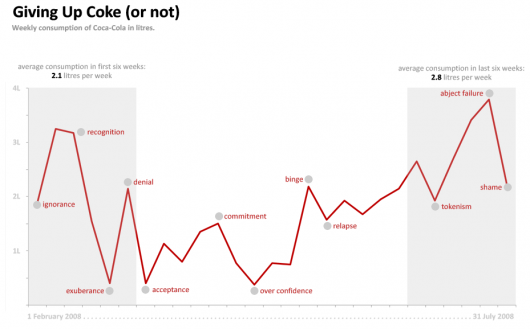
This one focuses on Tim's Coke consumption. It's a short story of a losing battle against his soda addiction.

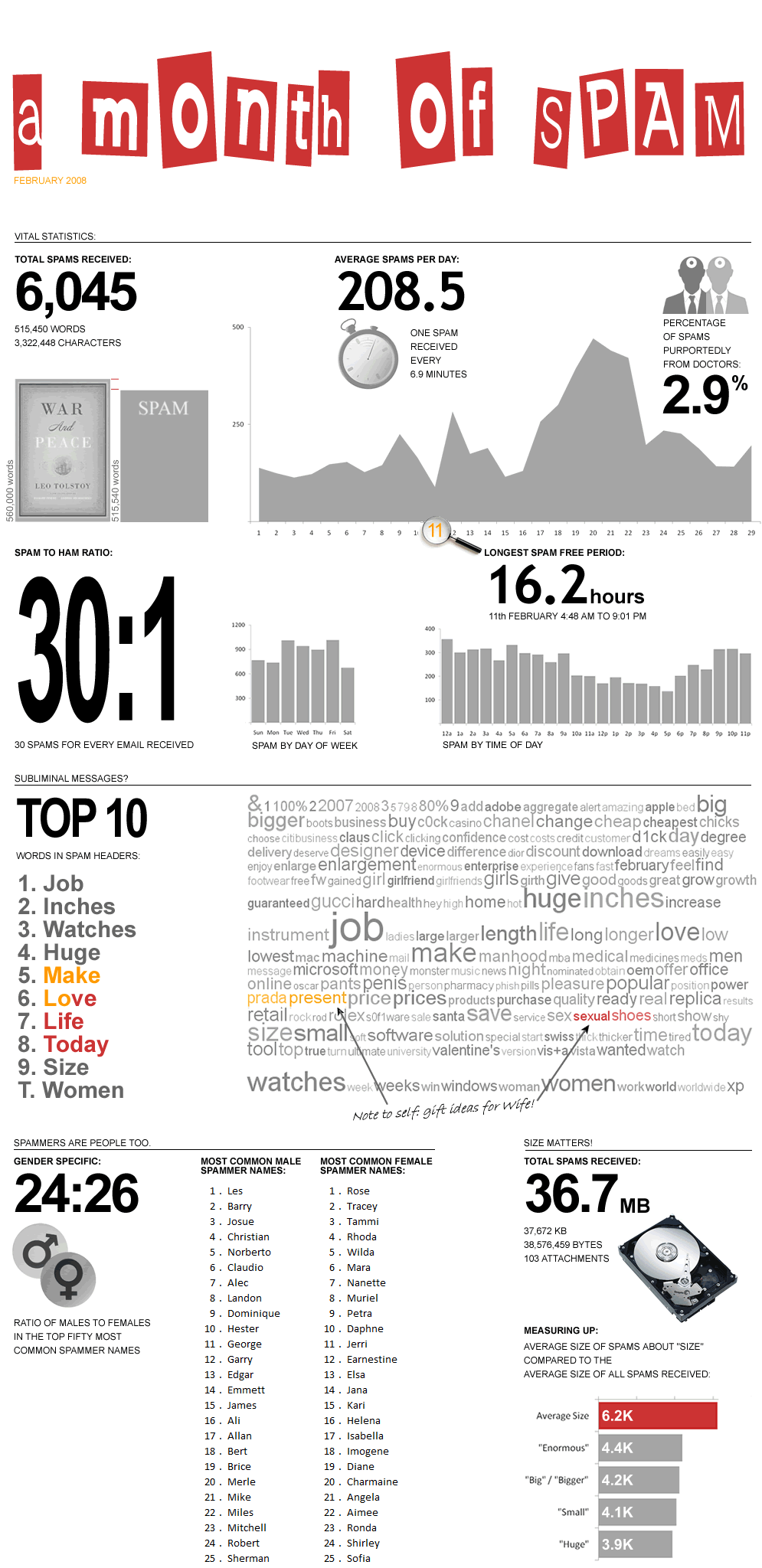
A Month of Email Spam

How about a look at a month of email spam? Almost as many words of spam as in War and Peace.

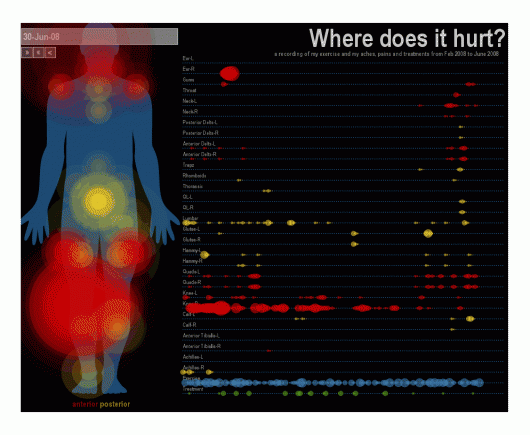
Ouch, My Body Hurts

This is actually an animated aches and pains chart implemented in Processing. Watch as pains fire off on poor Tim's deteriorating body.

An Apple a Day...

A calendar of apples and doctors...

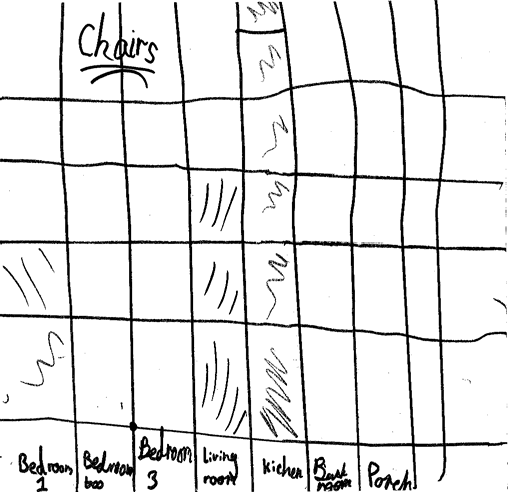
Chairs in the Kitchen

...and even Tim's daughter got in on the action. Here's her very first chart. It shows number of chairs by room. Proud father.

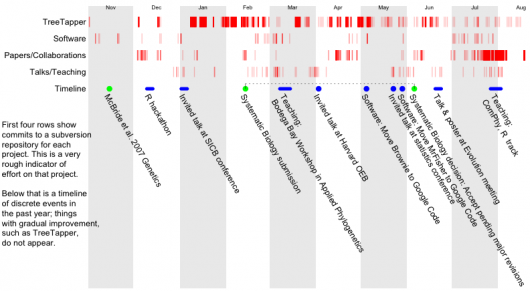
Commits to the SVN Repository

Brian is a postdoc part of an NSF-funded project and displayed commits to subversion, which he used to manage code and documents. He found that there tended me more commits to the repository as deadlines approached.

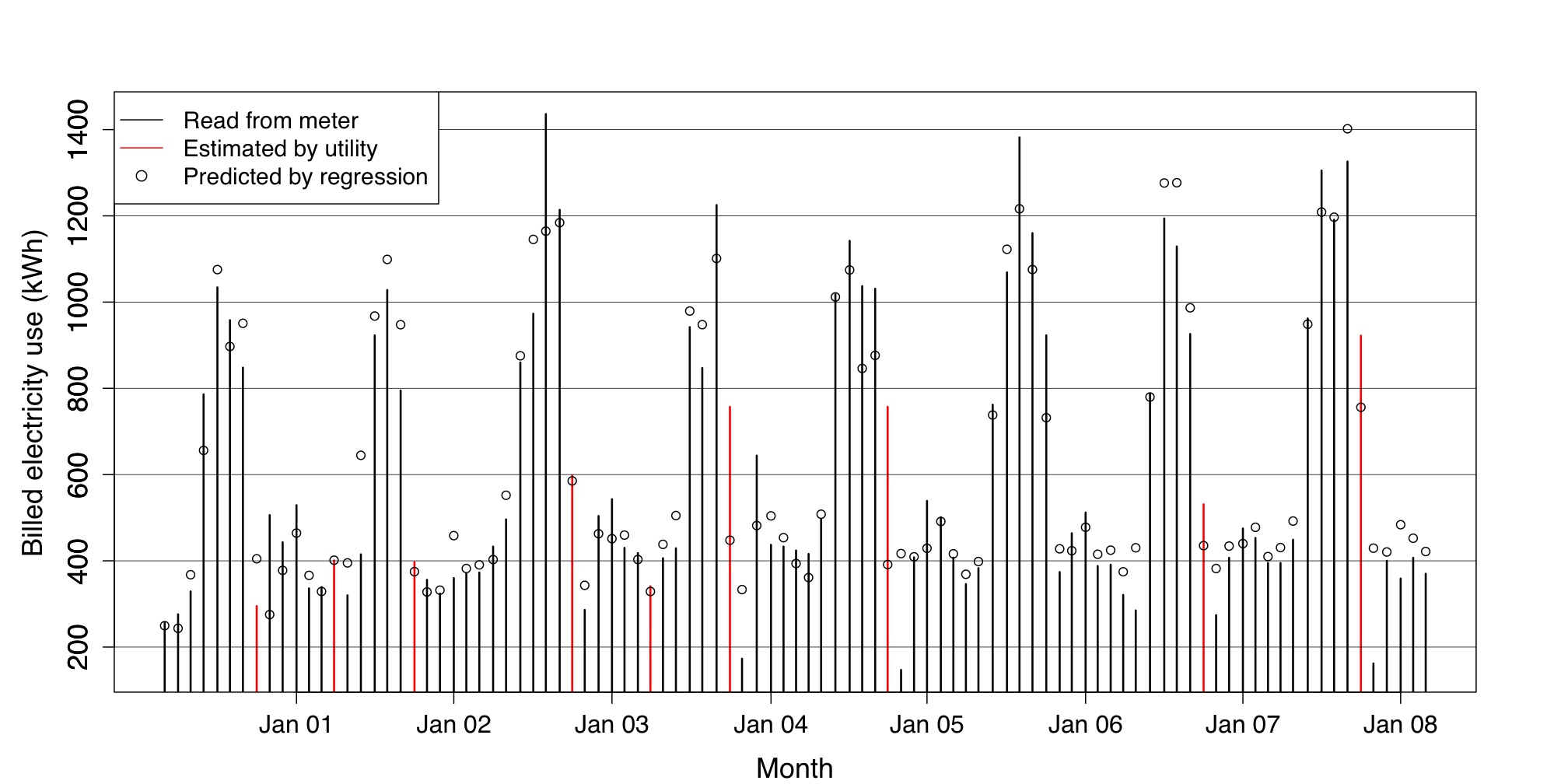
Is the Power Company Ripping Me Off?

Hey look - it's a chart made in R! John bought a new house in 2000 and charted billed electricity use – estimated by the utility company and the regression.

From John, "Every once in a while, the electric company gets lazy and estimates the meter reading, rather than coming to my house to read it. In the attached graphic, I wanted to see those months in particular to determine whether the utility company tends to over-estimate or under-estimate my electricity use in those months, as compared with my own estimation formula."

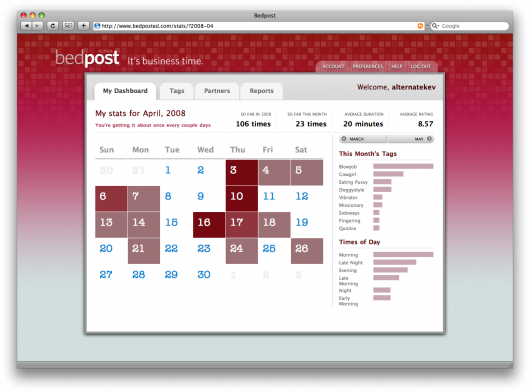
Sex

We saw this one earlier during the summer. Kevin C sent in BedPost, his project currently in private beta to track private time with your nighttime buddy.

Are You Happy Today?

Kevin M has his own application, LifeMetric, which lets you enter how you feel and then compare emotions with other users.

How Do I Spend My Time Every Day?

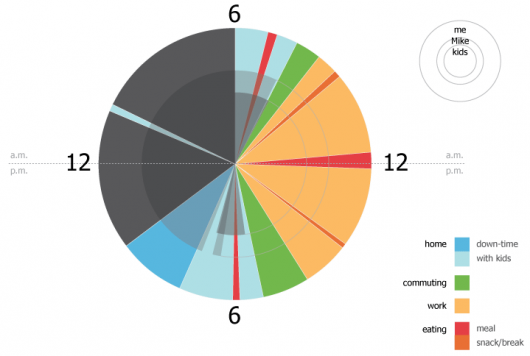
Lisa has been tracking how she (and her family) spends time. Below is one day that shows how she (outside circle) and her husband (middle circle) and her kids spend their day.

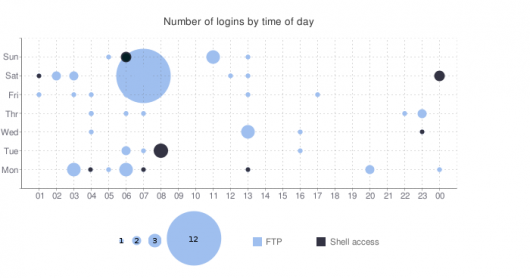
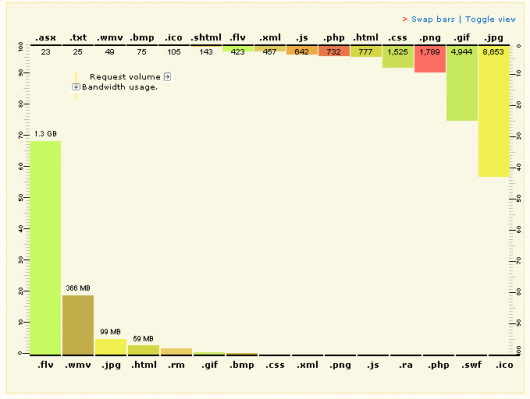
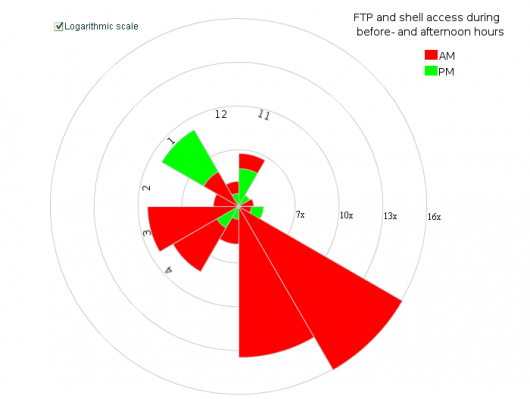
SSH and FTP Logins

Similar in spirit to Brian's visualization, Said put together a series of visualizations of his SSH and FTP logins. It looks like Said is a morning person?

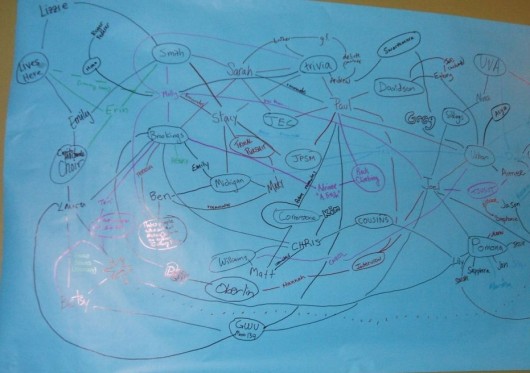
Old School Networks

Stacey and Joel held a PieFest with some friends. While they had everyone together they drew up a network. People wrote their name and drew lines to the people they knew.

Music Interest

Tony put his iTunes library through Wordle. He's a big fan of various artists.

That's All, Folks!

There you have it. The FlowingData personal visualization project. As you can see, there's lots of personal data for you to collect, visualize, and analyze, so go out and have some fun. Can you think of data worth collecting not here? Let us know in the comments.

Again, thank you to everyone who participated. I enjoyed every entry, and I'm sure FlowingData readers do too.

 
Comments Off on Winner of the Personal Visualization Project is…

Posted in Uncategorized