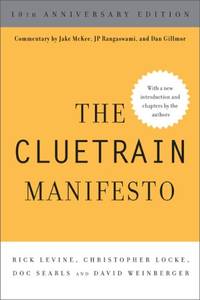
 I read the Cluetrain Manifesto in when it was published in 1999. We had just raised capital for the startup I co-founded, and I was flying back and forth from San Francisco to Toronto to Boston, which left me with a lot of reading time. As someone who was a) ambivalent about the corporate world, b) excited about the net, and c) founding a company, I found in Cluetrain a great deal of comfort, inspiration and fire.
In 1999, Rick Levine, Christopher Locke, Doc Searls and David Weinberger published the Cluetrain Manifesto, a business book that expanded upon 95 theses that they had "nailed to the Web" by posting online, prompting a great deal of furor, discussion, and fooforaw. The first of these theses was Doc Searls's now-famous aphorism that "markets are conversations," and the remaining 94 refined these theses, presenting an indictment of business as-it-was, with special regard for the clueless approach the corporate world took to the net.
Cluetrain influenced an entire generation of net-heads (as generations are reckoned in what we called "Internet time" back in the paleolithic era), for better and for worse. Better: entrepreneurs, social entrepreneurs, and accidental entrepreneurs who discovered that talking with people in the normal, recognizable, human voice was both possible and superior to the old third-person/passive-voice corporatespeak. Worse: the floodtide of marketing jerks who mouthed "Markets are conversations" even as they infiltrated blogs and other social spaces with badly disguised corporate communications beamed in from marcom central.
Now a decade has gone by, an eternity in Internet time, and Basic Books has brought out a "tenth anniversary edition" of the Manifesto, with new chapters by all four original authors, as well as supplementary material by Jake McKee (who manages Lego's social outreach); JP Rangaswami (the maverick Chief Scientist for British Telecom) and Dan Gillmor (net-journalism visionary and author of We the Media, late of the San Jose Mercury News).
First things first: the original, core material stands up remarkably well. Depressingly, the best-weathered stuff is that which describes all the ways that big companies get the net wrong. They're still making the same mistakes. Some of the more optimistic material dated a little faster. There's a lesson in there: it's easier to predict stupidity than cleverness.
The supplementary material is very good as well. The original authors take a very hard look at their original material and do a great job of explaining what went wrong, what went right, and where it's likely to go now. I was especially taken with Chris Locke's "Obedient Poodles for God and Country," a scathing critique of the market itself, asking big questions that the first Manifesto dared not raise -- strangely, I was least taken by Locke's original piece in the Manifesto, which says something about Locke, or me, or both. Searls's new piece has an inspiring -- if utopian -- look at how business might yet reorganize itself on humane principles using the net; and Weinberger's philosophical look at the threats facing the net and analysis of the utopian, realist and distopian views on the net's future play against one another is an instant classic.
The afterwords by the new contributors are likewise extremely engaging stuff, as you might expect. McKee is extremely blunt in recounting the mistakes Lego made with the net early on, and the story of how they turned things around is a true inspiration. Gillmor's ideas on the net and news and media are a neat and concise and compelling version of his extremely important message. Rangaswami's piece is characteristic of his deadpan, mischievous boardroom subversion, and has to be read to be believed.
As updates go, Cluetrain 2.0 is a very fine effort. If you didn't read the first edition, this is your chance. If you did read the first edition, it's time to go back to the source material again. You'll be glad you did.
The Cluetrain Manifesto: 10th Anniversary Edition
(Thanks to Basic Books for sending me a review copy of this book!)
- The Whuffie Factor: applied Cluetrain Manifesto for the twenty ...
- Cluetrain for record execs - Boing Boing
- Doc Searls proposes a barn-raising for civilization - Boing Boing
- Canadian Copyright Consultation submission from Tucows and David ...
- David Weinberger on Digital ID - Boing Boing
- Weinberger: Why the media can't get Wikipedia right - Boing Boing
- Weinberger: Photo-organizing infocalypse looms - Boing Boing
- Interview with David Weinberger, author of Everything is ...
- Weinberger: Delaminate the bastard telcos! - Boing Boing
- Boing Boing: Weinberger talks about Everything is Miscellaneous

 But the legal changes introduced in the years after Fahrenheit 451 did more than just extend terms. Congress eliminated the benign practice of the renewal requirement (which had guaranteed that 85% of works and 93% of books entered the public domain after 28 years because the authors and publishers simply didn't want or need a second copyright term.) And copyright, which had been an opt-in system (you had to comply with some very minor formalities to get a copyright) became an opt out system (you got a copyright automatically when you "fixed" the work in material form, whether you wanted it or not.) Suddenly the entire world of informal and non commercial culture -- from home movies that provide a wonderful lens into the private life of an era, to essays, posters, locally produced teaching materials -- was swept into copyright. And kept there for the life of the author plus 70 years. The effects were culturally catastrophic. Copyright went from covering very little culture, and only covering it for a 28 year period during which it was commercially available, to covering all of culture, regardless of whether it was available -- often for over a century. Unlike Fahrenheit 451, the vast majority of the culture swept into this 20th century black hole was not commercially available and, in most cases, the authors are unknown. The works are locked up -- with no benefit to anyone -- and no one has the key that would unlock them. We have cut ourselves off from our own culture, left it to molder -- and in the case of nitrate film, literally disintegrate -- with no benefit to anyone. The works may not be physically destroyed -- although many of them are; disappearing, disintegrating, or simply getting lost in the vastly long period of copyright to which we have relegated them. But for the vast majority of works and the vast majority of citizens who do not have access to one of our great libraries, they are gone as thoroughly as if we had piled up the culture of the 20th century and simply set fire to it; and all this right at the moment when we could have used the Internet vastly to expand the scope of cultural access.
 WOO:
Rise, and speak wisely, man--but hark; I see thy rug, as woven i'the Orient, A treasure from abroad. I like it not. I'll stain it thus; ever thus to deadbeats.
WOO:
Rise, and speak wisely, man--but hark; I see thy rug, as woven i'the Orient, A treasure from abroad. I like it not. I'll stain it thus; ever thus to deadbeats.
 When
When