
Mobstr just sent over this series of photos. I imagine the buff man has been laughing to himself about all this…






Photos by Mobstr
RJ Rushmore for Vandalog | Permalink | 14 comments
Feed enhanced by Better Feed from Ozh
Mobstr just sent over this series of photos. I imagine the buff man has been laughing to himself about all this…
Photos by Mobstr
RJ Rushmore for Vandalog | Permalink | 14 comments
Feed enhanced by Better Feed from Ozh
 In an article in The Proceedings of the Royal Society, two researchers described how mice in an experiment tended to get greater enjoyment out of rewards that were more labor-intensive:
Mice were trained to push levers to get either of two rewards. Press one lever, out comes a drop of sugar water. Press the other and they get a drop of different tasting sugar water.
Then things got interesting. For one of the treats, scientists gradually increased the amount of effort required for the payoff—from one lever-press to five, then 10, then 15. So by the end of the session, one type of sugar water cost 15 times more effort than the other.
The mice then retired to their home cage where both treats were freely available. And they showed a strong preference for whichever reward they’d worked harder to obtain. Based on how fast the mice sipped, they appeared to find the costlier sugar water more tasty.
Link | Photo by Flickr user Steve Berger Photography used under Creative Commons license
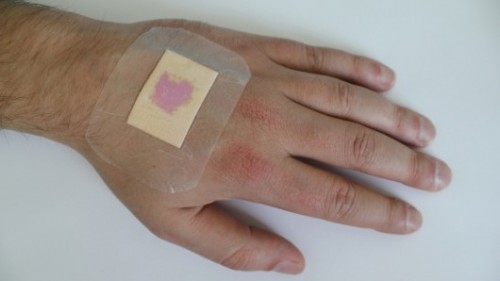
Scientists at the Fraunhofer Research Institution in Munich, Germany, have placed pH sensitive dyes in bandages. These change color when they come into contact with fluids that indicate that a wound is infected:
In creating the color control strip, the researchers had to ensure the dye remained chemically stable when bonded to the fibers of the dressing material or the plaster to ensure it doesn’t get into the wound. They also had to ensure the indicator showed a clear change in color and reacted sensitively in the right pH range.
The researchers have already produced a prototype of the dressing and they say initial tests have proved successful. They are now looking to take the idea further with plans to integrate optical sensor modules into the dressing to measure the pH value and indicate the results on a reader unit. This would allow the pH value to be read off precisely, providing information about how the wound is healing.
Link via Geekosystem | Photo: Fraunhofer EMFT
"Go Daddy is continually looking for ways to provide our customers the best user experience possible. That's the reason we partnered with Google on the 'Make the Web Faster' initiative. Go Daddy engineers are seeing a dramatic decrease in load times of customers' websites using mod_pagespeed and other technologies provided. We hope to provide the technology to our customers soon - not only for their benefit, but for their website visitors as well.â€We’re also working with Cotendo to integrate the core engine of mod_pagespeed as part of their Content Delivery Network (CDN) service.


 Edison Pena, one of the Chilean miners who was trapped underground for 69 days, was known to the media as “the runner†because he ran long distances underground to keep physically fit. On Sunday, he’s going to compete in the New York City Marathon, according to Mary Wittenberg, the President of the New York City Road Runners Club:
Edison Pena, 34, was originally invited by the club, which organizes the annual marathon, to attend the event as a spectator. But Pena insisted on running in the 26.2-mile marathon, Wittenberg said.[...]
“To be out there whether running or walking is such an affirmation of the human spirit,†she said of the marathon.
Wittenberg said Pena will be traveling to New York with his wife.
The 12th miner to be rescued, Pena is a diehard Elvis Presley fan who, despite speaking little English, knows most of the words to Elvis classics and led the trapped miners in sing-alongs during their 69-day ordeal underground.
Link via MArooned | Image: iClipart
 Until very recently, biologists believed that once a virus enters a cell, a person’s immune system cannot combat that virus because antibodies cannot enter cells. But researchers at the Laboratory of Molecular Biology in Cambridge, UK, have uncovered evidence that antibodies can, in fact, enter cells. This opens up the possibility of attaching antiviral components to antibodies that can kill viruses inside cells:
Once inside the cell, the presence of the antibody is recognised by a naturally occurring protein in the cell called TRIM21 which in turn activates a powerful virus-crushing machinery that can eliminate the virus within two hours – long before it has the chance to hijack the cell to start making its own viral proteins. “This is the last opportunity a cell gets because after that it gets infected and there is nothing else the body can do but kill the cell,†Dr James said.
“The antibody is attached to the virus and when the virus gets sucked inside the cell, the antibody stays attached, there is nothing in that process to make the antibody to fall off.
“The great thing about it is that there shouldn’t be anything attached to antibodies in the cell, so that anything that is attached to the antibody is recognised as foreign and destroyed.â€
Leo James, the lead researcher, speculated that this discovery could lead to effective treatments for cold viruses, among others.
Link via DVICE | Image: Clipart.com

Facebook's dataset is fast becoming one of the premiere probes of human behavior. Using the site's statistics, we can double-check our intuitions about how people, in aggregate, behave.
And so it's with great sadness that I inform you that breakup season has begun, according to this graph from David McCandless, scraped from 10,000 status updates on the site. Right at the beginning of November, breakups start climbing, peaking a couple of weeks before Christmas.
Obviously, all sorts of caveats, selection biases, etc. But remember, this is just the beginning. Putting our social lives online means allowing our social lives to be quantified. Just look at all the analysis the dating site OKCupid puts out about our relationship predilections.
Via Gizmodo, Mathias Mikkelsen.


Sophos has today announced the world's first free business-strength anti-virus program for Macs.
In a pretty exciting move, we're making a version of our Mac anti-virus product (used by big companies around the world) available for free download to home consumers.
That means your home Macs can be protected automatically in-the-background with the latest anti-virus protection, checking every program you run, every file you download, every USB stick you insert, completely free. Is there a catch you're wondering? Well, nope! There isn't!

I'm really pleased about this, because I love Macs. Back at Cluley Towers we only use Macs at home - they're great for messing around with family photographs, making movies, storing music, the list goes on..
But just like I make regular backups of my valuable data (some of which is irreplaceable and is priceless in sentimental terms to me and my wife), I also run Sophos Anti-Virus on my Macs.

And it's not just to protect my movies and music collection. I'm also aware that there are a growing number of bad guys out there who might consider Mac users a "soft target" and deliberately set out to infect Apple Macs, in the hope of stealing login details to banks and social networks, comandeer your MacBook to send spam or install irritating pop-ups, or simply commit identity theft.
The cybercriminals aren't kids messing around in back bedrooms any longer, they're organised and professional. And - unfortunately - many Mac users may have been too blasé about securing their computers, making the growing Apple userbase an attractive one to target.
Don't believe me? Well, it's already started. Past threats to Mac users have included:
– Websites that pose as legitimate-looking software vendor's sites, but whose downloads are really Mac malicious code.

– Malware disguised as pirated software available for download from P2P file-sharing networks.

– Sexy online video links that urge you to install a plug-in to view the content, but really infect your computer with a Mac Trojan horse.

– Popular Twitter accounts, such as that belonging to former Apple evangelist Guy Kawasaki, who have tweeted out links to websites designed to infect Mac computers.

(Enjoy these videos? You can check out more on the SophosLabs YouTube channel and subscribe if you like)
– Windows viruses and other malware, which can come in via email, web or USB drive, either being passed on to Windows-using friends or colleagues, or infecting virtual installations of Windows installed on a Mac.

Most people don't know that Apple acknowledged the malware problem by integrating rudimentary protection against a handful of Mac Trojans in Snow Leopard. But 95% of those Mac users we surveyed recently are convinced that more attacks are on the way.

Wise Mac users will secure their computers now, outwitting malware authors – if we make their jobs of infecting Macs damn difficult, they will go elsewhere to make a quick buck.

So, what are you waiting for?
This time you really do have nothing to lose as we've made it free :-) Download Sophos Anti-Virus Home Edition for Mac.
Do you agree that Mac users need to protect their computers? Do you believe that actually they don't need to take any extra precautions to look after their data? Whatever your view, leave a message in the comments below.


