
Author Archive
The bizarre limestone spires of Madagascar [Photography]
23
Aug
Self-dusting solar panels to make life a whole lot easier
22
Aug

It makes perfect sense to build a solar power plant in the middle of the desert - after all, that place gets a whole lot of sun throughout the day (even better if someone could come up with the technology to convert heat into electricity). After all, land is really cheap, but the downside to this would be the insane amounts of dust, dirt and wind which could result in dirty solar panels faster than you can clean them, reducing the efficiency by a pretty large margin. Of course, having someone clean those panels in the sweltering heat is definitely not a job most people would be willing to do, which is why the next best thing would be self-dusting solar panels. These are made possible thanks courtesy of an electric charge that is provided by the solar panels themselves. Who says that space travel to Mars have yielded nothing? Such technology was derived from the self-dusting solar panels used on the rovers which were sent to Mars. It takes just two minutes to remove around 90% of the dust deposited on the panels.
Permalink: Self-dusting solar panels to make life a whole lot easier from Ubergizmo | Hot: iPhone 4 Review, Droid X Review, BlackBerry Torch Review
Beat It + epic Crazy Chinese Omnipotent China red army
21
Aug
Omnipotent China red army rules the world. epic crazy chinese. Beat It
Newly Discovered Chlorophyll Catches Infrared Light
20
Aug

A new kind of chlorophyll that catches sunlight from just beyond the red end of the visible light spectrum has been discovered. The new pigment extends the known range of light that is usable by most photosynthetic organisms. Harnessing this pigment’s power could lead to biofuel-generating algae that are super-efficient, using a greater spread of sunlight than thought possible.
 “This is a very important new development, and is the first new type of chlorophyll discovered in an oxygenic organism in 60 years,†says biological chemist Robert Blankenship of Washington University in St. Louis.
The newfound pigment, dubbed chlorophyll f, absorbs light most efficiently at a wavelength around 706 nanometers, just beyond the red end of the visible spectrum, researchers report online August 19 in Science. This unique absorbance appears to occur thanks to a chemical decoration known as a formyl group on the chlorophyll’s carbon number two. That chemical tweak probably allows the algaelike organism that makes chlorophyll f to conduct photosynthesis while living beneath other photosynthesizers that capture all the other usable light.
“In nature this very small modification of the pigment happens, and then the organism can use this unique light,†says molecular biologist Min Chen of the University of Sydney in Australia. Chen and her colleagues identified the new pigment in extracts from ground-up stromatolites, the knobby chunks of rock and algae that can form in shallow waters. The samples were collected in the Hamelin pool in western Australia’s Shark Bay, the world’s most diverse stromatolite trove.

Previously there were four known chlorophylls made by plants and other photosynthesizing organisms that generate oxygen: a, b, c and d. Chlorophyll a, the standard green type, is found in photosynthesizers from algae to higher plants. It absorbs mostly blue light around 465 nanometers and red light around 665 nanometers (it reflects green light, hence plants look green). Chlorophylls b and c are found in fewer organisms and absorb light in a similar range as chlorophyll a does, but shifted a bit. Chlorophyll d, found in a specific group of cyanobacteria, absorbs the most light at roughly 697 nanometers, a slightly shorter wavelength than the absorption of the new chlorophyll.
While some bacteria make chlorophyll-like pigments that absorb even longer wavelengths of light, these creatures aren’t harnessing light to split water, the step in photosynthesis that generates oxygen. Scientists didn’t think that wavelengths absorbed by chlorophyll f would have enough oomph to split water either, but it turns out they do, says Chen.
“This challenges our conception of the limit of oxygenic photosynthesis,†she says.
The find may also enable scientists to engineer algae that are more efficient producers of oil for biofuels, says algae biologist Krishna Niyogi of the University of California, Berkeley. Microbes bearing the new chlorophyll could soak up rays that most microbes can’t make use of.
There is still much to be learned about the new type of chlorophyll and the organisms that make it, Niyogi says. Chlorophyll f was extracted from the ground-up stromatolites along with a lot of chlorophyll a. It isn’t clear what creature was making chlorophyll f, but evidence points to a filamentous cyanobacterium. This cyanobacterium might use both chlorophylls, or perhaps just f.
Images: 1) Red-shifting cyanobacteria./Science. 2) Shark Bay stromatolites./Wikimedia Commons.
See Also:
- Perforated Blobs May Be Earliest Known Animals
- Green Sea Slug Is Part Animal, Part Plant
- Everywhere in a Flash: The Quantum Physics of Photosynthesis
- Leafy Green Coherence: Quantum Physics Fuels Photosynthesis …
August is always hot, but this heat is unprecedented
20
Aug
It's been so hot this month that ... • The average monthly temperature of 88.3 degrees is eight tenths of a degree warmer than any previous August on Houston record. • This month is on pace to become the warmest...
3500 Year Old Tree The Senator
20
Aug

Imagine a tree, 3500 years old, and the history and knowledge it must possess. The Senator is a species of Bald Cypress situated at Big Tree Park in Longwood, Florida. For year, travelers flocked to the tree, jumping log to log in the swamps, to catch a glimpse of this world wonder.
The Senator Bald Cypress tree measures close 18 feet in diameter and stands 118 feet high. The Senator’s age is estimated between 3,400-3,500 years old, the 5th oldest tree in the world.
From the Upcoming  ueue, submitted by
What’s the point of the semantic web?
20
Aug
 I was scanning journal tables of contents as usual this week and it occurred to me that there must be a better way to find relevant and timely research information that would be of interest to Sciencebase readers…and, of course, out pops the following title:
Technically approaching the semantic web bottleneck
Sounded, perfect…kind of…but what’s the semantic web, why’s there a bottleneck and what can be done to lube the tube?
Tim Berners-Lee’s original vision for the semantic web was that information would be just as readable (and understandable) to a person or to a machine. Digital objects, whether web page, image, video, or some other file, would have embedded within them meta data that would provide context to the content and allow software to extract meaning from the file.
Some software currently has a limited understanding of simple meta data, although any SEO will tell you that Google largely ignores web page meta data these days. That point aside, there is so much
that
might be
done if the
web were
effectively self-awareso much that might be done if the web were effectively self-aware (not talking notions of the singularity here, just making it all more useful and easier to use). So, I asked the paper’s author, Nikolaos Konstantinou, for a few examples of how the semantic web, often referred to as Web 3.0 (although you might call it Web 2.1 or Web 2.0++), might benefit us. The first benefit would be more intelligent searches he told me, either across the web or in large-scale data repositories where intelligence is referred to in contrast to the conventional keyword-based search methods employed by the search engines.
“For instance, performing a search in Google for e.g. ‘renaissance paintings’ you will notice that among the first pages of the results returned, the vast majority contains the keywords ‘renaissance paintings’ in the respective page text (or image HTML image ‘alt’ tag),†he says. “That is because the search engine does not process the content available semantically and therefore, the results although they will be accurate, will be far from being complete. This will cause an arts student, for instance, to spend too much time finding relevant content. She would probably have to visit certain museum pages and collect the results on her own.â€
This is where the semantic web would come into play, Konstantinou adds. “The vision is to get a list of what you asked for even in the case when your keyword does not exist in the web page. In the example above, a page with Leonardo da Vinci’s paintings will not be considered relevant if the words ‘renaissance paintings’ do not exist in the page. In the semantic web world the system would ‘know’ that Leonardo da Vinci is an artist of the Renaissance and therefore his works would be returned to the user performing the query.â€
A second benefit would be knowledge inferred by the existing one. A system built using semantic web technologies, with the support of reasoning procedures could logically deduce informationreasoning procedures could logically deduce information, explains Konstantinou.
“The most classic example about inference is that from the statements ‘all men are mortal’ and ‘Socrates is a man’, we can deduce that ‘socrates is mortal’. This property (transitive property) in combination with a wider set of properties can augment the knowledge inserted in a system, without requiring human insertion of each and every fact, which avoids errors and reduces the workload.â€
Simply, by stating 5 facts to a system, using an ontology (a glossary) and a reasoner, the system will be able to deduce 15 facts by applying logic rules (reasoning). This is in fact what allows the intelligent queries mentioned in the Renaissance example. Such a system, when asked “is socrates mortalâ€? will return a YES, while without reasoning the answer would be NO (or UNKNOWN in other cases). Similarly, socrates would be included in a search like “tell me all the mortals in the systemâ€. “This is, in fact, what is meant by ‘machine understandable’ information, the ability for a machine to process information,†adds Konstantinou.
Now…how do I apply that logic to scanning tables of contents for worthy news items?
 Nikolaos Konstantinou, Dimitrios-Emmanuel Spanos, Periklis Stavrou, & Nikolas Mitrou (2010). Technically approaching the semantic web bottleneck Int. J. Web Engineering and Technology, 6 (1), 83-111
Related Posts:
What’s the point of the semantic web? is a post from: Sciencebase Science Blog
MESSENGER Looks Back at the Earth and Moon
19
Aug
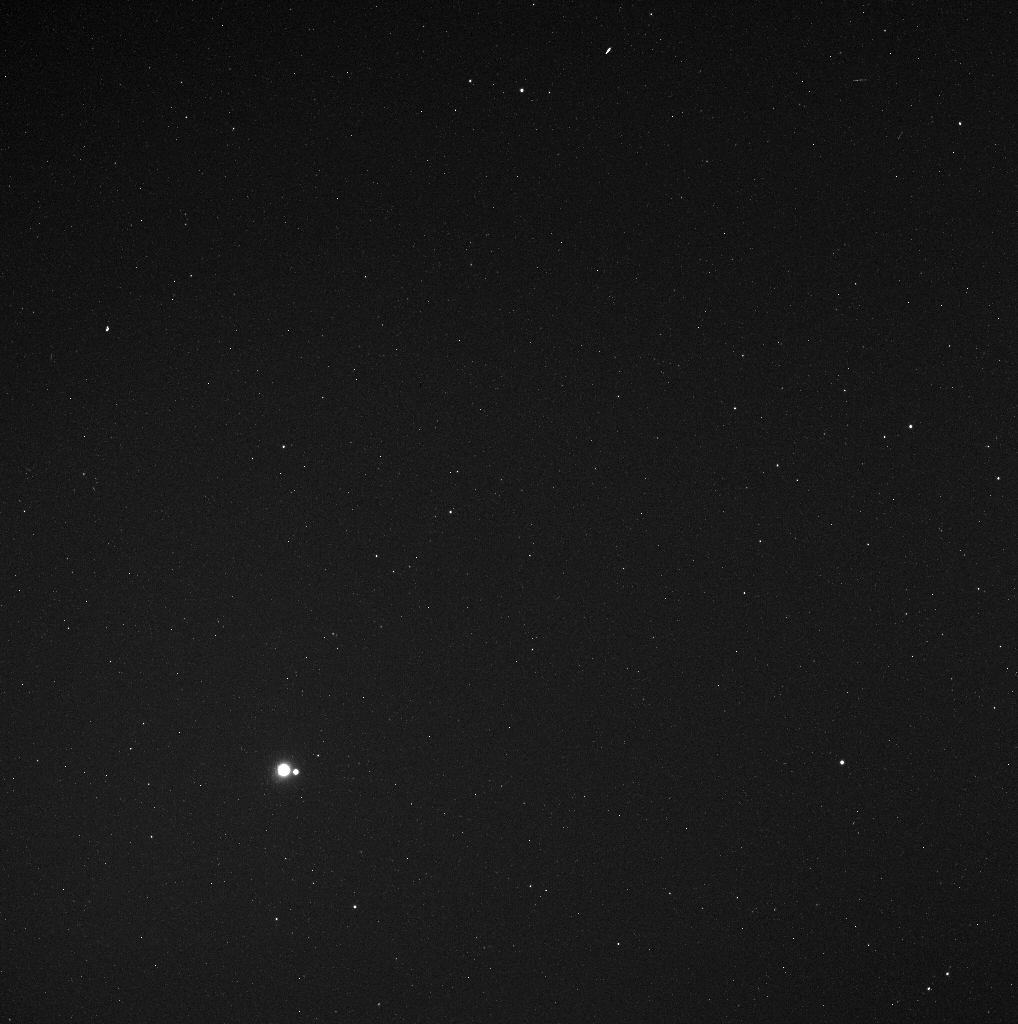
Earth and Moon from 183 Million kilometers. Credit: NASA/Johns Hopkins University Applied Physics Laboratory/Carnegie Institution of Washington
A new image to add to the family photo album! The MESSENGER spacecraft is working its way to enter orbit around Mercury in March of 2011, and while wending its way, took this image of the Earth and Moon, visible in the lower left. When the image was taken in May 2010, MESSENGER was 183 million kilometers (114 million miles) away from Earth. For context, the average separation between the Earth and the Sun is about 150 million kilometers (93 million miles). It’s a thought provoking image (every one of us is in that image!), just like other Earth-Moon photos — Fraser put together a gallery of Earth-Moon images from other worlds, and this one will have to be added. But this image was taken not just for the aesthetics.
(...)
Read the rest of MESSENGER Looks Back at the Earth and Moon (101 words)
© nancy for Universe Today, 2010. | Permalink | 2 comments |
Add to del.icio.us
Post tags: Astrophotos, Earth, Earth Observation, Mercury, MESSENGER, Moon
Feed enhanced by Better Feed from Ozh

