
"Smoke"
Filed under: Estates


Â
Read | Permalink | Email this | Linking Blogs | Comments
 Though it may seem like many of the job opportunities in the United States have dried up as of late, you can find a wealth of job postings on the Web that may be right up your alley. From programmers to promotions, there are many startup companies looking to hire just the right people for the positions they have open. These 18 services represent a mixture of well-known mainstream sites and companies that focus on nothing more than listings in the Web 2.0/startup market.
Have you had success using these sites? Tell us more in the comments.

AOL.CareerBuilder.com - The nice thing about the AOL.CareerBuilder.com site is that you have the salary range listed on the summary page as opposed to having to go into each listing.
Jobster.com - While they have a startups section, finding Microsoft intermixed in their thousands of listings makes you think it’s more a general technology area.
Monster.com - One of the longest running online job sites has numerous job listings for startups that you can search by company, date, job title or relevance.
Yahoo Hot Jobs - Yahoo’s job listings includes numerous listings for jobs at startups, most of them seem to be centered on the technical side.

AsiaWired.com - Looking for startups in Asia? This may be the solution for you.
CoNotes.com - Focusing on nothing but jobs at startups, CoNotes has been around since 2007.
Dice.com - Browse jobs by city or pull up the category that applies to your skill set.
ejob.com - ejob focuses on staffing needs in and around Silicon Valley.
GoBigNetwork.com - A one-stop-shop for startups to form business plans, find funding and locate employees that can fulfill their needs.
HotStartupJobs.com - Aggregates startup listings from a multitude of sites. You can read a lengthier write up of HotStartupJobs by our own Paul Glazowski here on Mashable.
Jobs.Mashable.com - Our very own marketplace features categories for listing jobs and looking for them also.
NeoHire.com - Lets you look up jobs by category, add them to your basket as you find ones that interest you and then apply to all of the ones you’ve saved.
nPost.com - Besides offering numerous job listings at startups, they have 225+ interviews with people from some of the companies explaining what they are about and what they are looking for in an employee.
StartupAgents.com - Both startups and potential employees can set up profiles to try to find the perfect match for each other. The service is completely free to potential employees, but will cost employers to contact potential hires.
StartupJobs.biz - A small jobs board with unique listings that you can search by type of job or occupation.
Startuply.com - Covers various industries related to Web 2.0 and startups, lets you also browse by job type.
StartupZone.com - Allows you to search jobs by occupation, location or even what stage of funding they are in.
VentureLoop.com - Provides internship listings for students at certain schools and has job listings you can search by country or occupation.
Image via CoNotes
---
Related Articles at Mashable - All That's New on the Web:
Steve Jobs Subpoenaed For Backdated Options Case
The Daily Poll: How Did You Follow the Steve Jobs Keynote?
HotStartupJobs Helps You Find Your Next Startup Position
JobThread Launches EasyPost
Ouch: Bloomberg Mistakenly Publishes Steve Jobs’ Obituary
Announcing StartUp Camp: March 7-8th in London
CareerBuilder’s Facebook App Searches Personal Data
 Sure, your car dashboard may have a lot of cool buttons and computer displays, but chances are it lacks something that many classic cars have in abundance. A little something I like to call "style." OObject has put together a list of 17 classic cars (and even one new classic in the Audi TT) that fall into this classy category—cars like the 1906 Stanely Steamer (which looks like a friggin' time machine), the '58 Chevy Impala and the '57 Porsche 356 Speedster. [OObject]
In A Taxonomy of Minds I explore the varieties of intelligence which a greater-than-human intelligence might take. We could meet greater-than-human intelligences in an alien ET, or we can make synthetic ones. The one foundational assumption behind our making new minds ourselves is that we assume our mind is intelligent enough to make a new and different mind. Just because we are conscious does not mean we have the smarts to make consciousness ourselves. Whether (or when) AI is possible will ultimately depend on whether we are smart enough to make something smarter than ourselves. We assume that ants have not achieved this level. We also assume that as smart as chimpanzees are, chimps are not smart enough to make a mind smarter than a chimp, and so have not reached this threshold either. While some people assume humans can create a mind smarter than a human mind, humans may be at a level of intelligence that is below that threshold also. We simply don't know where the threshold of bootstrapping intelligence is, nor where we are on this metric.
We can distinguish several categories of elementary minds in relation to bootstrapping:
1) AÂ mind capable of imagining, or identifying a greater mind.
2) AÂ mind capable of imaging but incapable of designing a greater mind.
3) AÂ mind capable of designing a greater mind.
We fit the first criteria, but it is unclear whether we are of the second or third type of mind. There is also a fourth type, which follows the third:
4) A mind capable of generating a greater mind which in turn itself creates a greater mind, and so on.
This is an cascading, bootstrapping mind. Once a mind reach this level, the recursive mind-enlargement can either keep going ad infinitum, or it might reach some limit. On the other hand, there may be more than one threshold in intelligence. Think of it as quantum levels. A mind may be able to make a mind smarter than itself, but the offspring mind may not be smart enough to make the next leap, and so gets stuck.
If we imagine the levels of intelligence as a ladder with unevenly spaced rungs, there may be jumps that some intelligences are not able to complete, or their derivatives are not able to jump. So a type 3 mind may be able to jump up four levels of bootstrapping intelligence, but not five. Since I don't believe intelligence is linear (that is I believe intelligence grows in many dimensions), a better illustration may be to view the problem of bootstrapping super intelligence as navigating across a rugged evolutionary landscape.
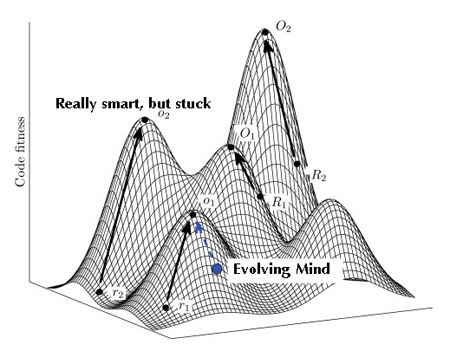
In this type of graph higher means better adapted, more suitable in form. Different hills indicated different varieties of environments, and different types of forms. This particular chart represents the landscape of possible types of intelligences. Here the higher a mind goes on a hill, the more highly it is suited or perfected for that type of intelligence.
In a very rugged fitness landscape, the danger is getting stuck on local optima of form. Your organism perfects a type of mind that is optimal for a local condition, but this very perfection imprisons you locally and prevents you from reaching a greater optimal form elsewhere. In other words, evolving to a higher elevation is not a matter of sheer power of intelligence, but of type. There may be certain kinds of minds that are powerful and optimal for some kinds of thinking, but that are incapable overcoming hurdles to reach a different, higher peak. Certain types of minds may be able to keep getting more powerful in the direction they have been evolving, but incapable of shifting direction in order to reach a new power. In other words, they may be incapable of bootstrapping the next generation. Other kinds of minds may be not as optimal but more nimble.
At the moment we are totally ignorant of what the possibility landscape of intelligence is. We have not yet even mapped out animal intelligences, and we have no real examples of other self-conscious intelligences to map. Navigating through the evolutionary landscape may be very smooth, or it may be very rough and very dependent on the path an evolving mind takes.
Because we have experience with such a small set of mind types, we really have no idea whether there are limits to the varieties and levels of intelligence. While we can calculate the limits of computation (and folks like Seth Lloyd have done just that), I don't think intelligence as we currently understand it is equivalent to computation. The internet as a whole is computationally larger than our brains, but not as intelligent in the way we crave. Some people, like Stephen Wolfram, believe there is only one type of computation, and that there is sort of one universal intelligence. I tend to think there will be millions and billions of types of minds.
Recently, in conversations with George Dyson, I realized there is a fifth type of elementary mind:
5) A mind incapable of designing a greater mind, but capable of creating a platform upon which greater mind emerges.
This type of mind cannot figure out how to birth an intelligence equal to itself, but it does figure out how to set up conditions of evolution so that a new mind emerges from the forces pushing it. Dyson and I believe this is what is happening with the web and Google. An intelligence is forming without an overt top-down designer. Right now that intelligence is rather dimwitted, but it continues to grow. Whether it continues to develop into something near human or greater-than-human remains to be seen. But if this embryonic smartness continued, it would represent a new way of making a mind. And of course, this indirect way of making something smarter than yourself could be used at any point in the evolutionary bootstrapping cycle of a mind. Perhaps the fourth of fifth generation of a mind may be incapable of designing the next generation but capable of designing a system in which it emerges.
We tend to think of intelligence as singular, but biologically this is unlikely. More likely intelligence is multiple, diverse, and fecund. In the long haul, the central question will concern the differences between the evolvability of these various intelligences. Which types are capable of bootstrapping? And are we one of those?
The Google Email Uploader is a desktop utility for Microsoft Windows that uploads email from other desktop email programs (like Microsoft Outlook) into your Google Apps mailbox. More information can be found at http://code.google.com/p/google-email-uploader/.
Download it here or share this link with your users: http://mail.google.com/mail/help/email_uploader.html
 Yesterday Apple introduced HD TV downloads to the iTunes store, meaning you can watch Peter be super emo on Heroes at a crispy 720p resolution. That's a higher resolution than DVD, and technically, yup, that's HD. There's a catch though. Like every other video download service touting HD videos, it's all actually lower quality than DVD.
It's all about bitrate: How much data is packed into a file, described as bits per second. Generally speaking, a higher bitrate translates into higher quality audio and video, though quality can also be affected by codec—the encoding and compression technique that was used to make and read the file—so bitrate is not an absolute mark of quality, but it's still a very good indicator.
You're probably most familiar with this bitrate business when it comes to ripping your CDs. When you shove a CD into your computer, your ripping program will ask what format you want and what bitrate you want. A song ripped at a higher bitrate will sound better, with more presence and detail, but it does take up more space.
The same principle applies with video, though it's actually a bigger deal, because it's easier to see quality differences in video than it is to hear differences in audio. The bits make a huge difference when you get into fast moving stuff like sports or action movies—to be frank, they'll look like splattered, smeared shit in highly compressed low-bitrate vids. This chart below, expertly crafted by George Ou at ZDNet provides a solid starting point for comparison, with average bitrates of most digital video available.
 As you can see, regular DVD runs at about 6-8 megabits per second. High-def iTunes content, despite having a higher resolution, is half that, a mere 4Mbps. Vudu's current HD movies is also about 4Mbps, if you've got the pipes. Xbox Live Marketplace has the highest bitrate—and indeed, often gets props for its quality—at close to 6.8Mbps. On the other hand, standard-def movies on the Netflix Roku box max out at around 2.2Mbps—and are often delivered in lower qualities because of bandwidth constraints. iTunes standard def TV shows run around 1.5Mbps. Now, consider that Blu-ray is a mean 40Mbps and you see that the definition of "HD" is suddenly remarkably vague.
That's a pissload of numbers. What does that mean?
 This comparison test we ran in February pretty much shows you what's wrong: No matter how awesome MPEG-4 compression—or whatever the codec of the month is—gets, it can't work miracles when it's missing bits. It's why Vudu, for instance, is testing out a new closer-to-real-HD service—that they've revealed to us has three times the bitrate of any other download service on the market, meaning it should be close to 20Mbps—that will take hours to deliver to your home. But even then, the notion that it would truly rival Blu-ray is totally laughable.
It's not just download services giving you this watered-down so-called "HD lite", either. Comcast was busted cramming three HD channels into the space of two, resulting in crappy looking HDTV, and the satellite guys adding a million HD channels a year aren't much better.
Now that you understand what makes or breaks an HD picture—the amount of data— it's probably no surprise to you that the major reason everyone is peddling subpar HD is bandwidth. HD content is pipe-bustingly huge—a standard-def Battlestar Galactica file on iTunes is 520MB and takes about 15 minutes to download via a strong cable connection. The 720p HD download is 1.4GB and takes 40 minutes or so for your hard drive to completely swallow. The Blu-ray version of the same ep might be 10 times that—like 14GB. Putting that in more context, a single TV episode would take up twice the space as the average dual-layer DVD movie.
Right now, we don't have the broadband infrastructure to support it, and who knows when we will? Hell, the people with the best chance of giving us that added bandwidth—the major ISPs like Comcast and AT&T—are doing just the opposite: Implementing usage caps that will mean less HD downloading. The sad thing is, they probably won't even use the added bandwidth to make their own HD TV channels look better.
Shared by cephyn
quit worrying about the LHC - this is the real scary stuff.
On March 19, 2008, the Earth was caught full-on in the beam of nature’s deadliest beast, a gamma-ray burst.
 |
| Swift’s view of GRB 080319B. Courtesy Swift team/Penn State University/NASA. |
Lucky for us, the GRB was far away– far, far away: 7.5 billion light years distant, literally more than halfway across the visible Universe.
Had we been much, much closer, like a thousand light years away, the energy from the beam would have torn our atmosphere away, boiled our oceans, and irradiated the planet with a million times the lethal dose of high-energy gamma and X-rays.
Gamma-ray bursts (GRBs) are scary, scary, scary.
But it wasn’t that close; it was a million times farther away than the lethal distance (in fact, all GRBs are really far away, and so pose little real danger to us here on Earth). All we saw was a flash of light — actually, a flash of gamma rays, detected by NASA’s remarkable Swift satellite, designed to do this very task. But what a flash! Even from that terrible distance, the amount of light the GRB gave off made it visible, briefly, to the naked eye!
 |
| Artist’s impression of a GRB. Click for a way cool animation. Courtesy NASA. |
A GRB is born in the fury of an exploding massive star, when its core collapses into a black hole. A vast amount of energy is released, more than the Sun’s entire lifetime’s output. A hellish mix of forces focuses, squeezes this exploding energy and matter into beams, extremely narrow cones of emission, cosmic blowtorches which march across space. If you are too close, and in the path of a beam, well, saying "you’re toast" doesn’t quite cover it. But if the beam misses you, you don’t get the gigantic burst of light; the energy drops of very rapidly if the aim of the GRB is off. Even a miss by a fraction of a degree is enough to change its apparent brightness hugely.
Scientists making models of GRBs had an idea that this narrow, intense beam is inside a wider, mushier beam of energy. It’s easier to get hit by by the wider beam (like you don’t have to aim a shotgun as carefully as you do a rifle), and so the idea is that what we see from almost all detected GRBs is this wide beam. Actually being in the path of the narrow beam would be very rare.
And that’s what makes GRB 080319B (the second GRB seen on March 19, 2008), so remarkable: it was aimed squarely at us, and we were bathed by light from the narrow beam. We were looking right down the monster’s throat. The beam was incredibly tight; only about 0.4 degrees wide (take a look at a protractor to get an idea of how skinny this is). Had the beam been aimed just a scosh off, just a tad, the GRB would have appeared far, far dimmer. We still would have seen it, but it would have looked like just another GRB, and not the single most luminous event ever witnessed by humans.
Probably all GRBs have this narrow beam, but they miss us, so we don’t see them. And because the beam is so narrow, scientists say that this sort of thing would happen once a decade or so. Good thing we had Swift running at the time! Swift was able to detect the burst, then rapidly (within seconds) send the news to observatories all over (and above) the planet, so that they could instantly follow up with their own observations. This allowed astronomers to detect the burst at a wide range of wavelengths (radio, infrared, optical, ultraviolet, X-ray and gamma ray), which is critical: it gives us insight into how the beams are formed. That in turn tells us about how the black hole formed, how the star exploded, what sorts of material were involved, and their physical characteristics.
All of this tells us more about the Universe, which is good.
But it also tells us about gamma-ray bursts. And there is just something about them, something terrifying about the energy, the power, the raw fury of them, that fascinates me. They really aren’t a threat to us — we think they can only come from great distance — but they still represent nature at its fiercest. Sometimes the pursuit of science may seem cold and emotionless, but that is far, far from truth. And like GRBs, the closer you get to the truth, the more powerful, the more energetic, and the more passionate science gets.
And may I add, I have a whole chapter about these beasts in my upcoming book, Death from the Skies!, which is available for pre-order on amazon.com.
 Digg for programming questions? Joel on Software and Jeff Atwood of Coding Horror start letting users into their well built site.
The highly anticipated general release of StackOverflow, the social site for programming questions developed by rock star programmers Joel Spolsky and Jeff Atwood, hasn't happened yet - but the doors are cracked open and many new users are streaming in this morning.
You can get in via this beta URL, using"twitter@twitter.com" as your email and "falkensmaze" as your password. At least you can get in that way for now. Below are screen shots and our first impressions of the new service.
The idea behind StackOverflow is to offer a really well designed site where programmers can find answers to questions that are more obscure than they can get answered elsewhere. Site founders Spolsky and Attwood are software gurus focused on developer relations and user experience. They've got a very capable team with them as well, as is evidenced by the product so far.
The community is for developers working in any programming language and use of the site is completely free. The name StackOverflow refers to an infinite loop or recursion in the programming languages C or C++ and sure enough, a lot of the conversation on the site is self referential so far. The team's got plans for that, though, so we're confident this will be less the case than it is on other sites.
So far, we like it a lot. What does it look like? Check out these screen shots.
The front page.

My Question Got Answered!

I got a good answer to an admittedly simple question, in 2 minutes. Awesome.
Asking a Question.

Pretty smart UI here, quite helpful and fun to use.
A User Profile

Above, the top half of a user profile, below the bottom half. Note that you can see how often a user votes things up or down but you cannot see specific voting history. The user feed is nice.

The UI here has lots of really nice little touches, it's responsive, communicative and relatively clear. We like it a lot and that was one of the site's big goals, to build an effective UI.
Account creation looks very good, it happens automatically via cookie until you register, but OpenID association with your account is not implemented particularly well. Attwood is blaming OpenID providers for that on Twitter, but we're seeing a few too many problems to buy that.
There's already an active community of beta testers on the site and they've developed extensions like a Firefox and IE7 search plugin, a couple of Greasemonkey scripts and a Ubiquity script. That's pretty awesome.
There's a sophisticated credibility system at work here, where users who build up their reputation are given new capabilities. Those capabilities include commenting on questions instead of just answering them and doing some moderation.
The "community mode" is interesting, things are wiki style on the site and once a certain number of edits have occurred the original asker of the question no longer owns it - it becomes a community question, with lower credibility thresh holds required for interaction, etc. The Community User username is tied to these threads and acts as an automated bot repairing things like malformed tags through out the site. That sounds really helpful.
Finally on the positive side, we got some good replies to our questions really quickly and we're already having a lot of fun just browsing the site.
We like StackOverflow a lot so far, but there are some real concerns that deserve to be raised. As the site's owners have voiced throughout its development, the quality of discussions may go down rapidly when they open up to the world at large. We hope that's not the case but we will watch the reputation and bios of the people who answer our questions.
More importantly, perhaps, we're not sure the Digg-style home page is the best way to organize these discussion. Is it on the basis of the newness or hotness of questions that things should be ranked? Or should top answers be highlighted? We know that the site's developers have spent a lot of time wrestling with these questions, so we won't pretend to know better, but we hope the core prioritization principles work out well in this context.
There are some features that we expected to see here but don't. An easy way to mark a thread for reading later would be really helpful, as would a feed for those items in our account. A feed for answers given to our questions would be nice. So would the option to get an email notification when one of our questions is replied to, or another question we're interested in. GetSatisfaction's "I'm interested in this too" feature would make a world of sense - let me know when someone else gets an answer to this question because I'm curious. Finally, a "thanks for this" button like Ma.gonlia would make sense and offer a different kind of feedback.
We've already subscribed to the feeds for several topic tags and we're excited about everything we expect we can learn from the StackOverflow community. General availability of the site is expected sometime this week or next.
Filed under: Cellphones
 The increasingly high cost of text messaging has already caused a bit of a stir in Canada, and it looks like Democratic Senator Herb Kohl of Wisconsin is concerned with the situation in the US as well, with him now opening an inquiry to attempt to get the carriers to explain themselves. Apparently, Kohl is a bit puzzled as to why some customers are now paying 20 cents per message when they paid just 10 cents in 2005, a period that Kohl notes just happens to overlap with some consolidation in the wireless industry, when the number of national carriers shrunk from six to four. Those carriers, as you might expect, aren't saying much just yet, with Sprint only going as far as to say that it looks forward to "responding to the Senator's inquiry about the text messaging options we offer our customers and we will fully cooperate with his request," and the rest saying even less.Read | Permalink | Email this | Comments


