RSS
 

Archive for the ‘Google Reader’ Category

Why Google can’t build Instagram

12 Nov

Tonight I was talking with an exec at Google and I brought up the success of Instagr.am (they’ve gotten more than 500,000 downloads in just a few weeks) and asked him “why can’t Google do that?”

I knew some of the answers. After all, I watched Microsoft get passed by by a whole group of startups (I was working at Microsoft as Flickr got bought by Yahoo, Skype got bought by eBay, etc etc).

I told him a few of my theories, and he told me back what they are seeing internally. Turns out he was talking to me about these items because Google, internally, knows it has an innovation problem (look at Google Wave or Buzz for examples of how it is messed up) and is looking to remake its culture internally to help entrepreneurial projects take hold.

1. Google can’t keep its teams small enough. Instagram was started by two guys who rented a table at DogPatchLabs in Pier 38 (the first time I met the Instagr.am team was when Rocky and I did this video on Dogpatch Labs). The exec I was talking with said Google Wave had more than 30 people on the team. He had done his own startup and knew the man-month myth. For every person you add to a team, he said, iteration speed goes down. He told me a story of how Larry Ellison actually got efficiencies from teams. If a team wasn’t productive, he’d come every couple of weeks and say “let me help you out.” What did he do? He took away another person until the team started shipping and stopped having unproductive meetings.

2. Google can’t reduce scope like Instagram did. Instagram started out as being a far different product than actually shipped (which actually got it in trouble with investor Andreesen Horowitz, according to Techcrunch). It actually started out as a service that did a lot more than just photographs. But, they learned they couldn’t complete such a grand vision and do it well. So they kept throwing out features. Instagram can do that. Google can’t. Imagine you come to Larry Page and say “you know that new social platform we’re building? Let’s throw 90% of it out.” Google has to compete with Facebook. Instagram had to compete with itself. As to Andreesen: this is why lots of my favorite companies like GoPro or SmugMug never took any VC. The pressure to “go for the home run” destroys quite a few companies.

3. At Google, if a product becomes successful, will get tons of resources and people thrown at it. Imagine you’re working at Google and you have 20% time. Will you keep spending that time on a boring project that isn’t very cool? No, you will want to join a cool project like Instagram that’s getting love around the world and getting tons of adoption. If the Instagram team were at Google they’d have to deal with tons of emails and folks hanging outside their cubes just to try to participate. I saw exactly this happen at Microsoft when a small team I was enamored of started getting tons of resources because it was having some success.

4. Google forces its developers to use its infrastructure, which wasn’t developed for small social projects. At Google you can’t use MySQL and Ruby on Rails. You’ve gotta build everything to deploy on its internal database “Big Table,” they call it. That wasn’t designed for small little dinky social projects. Engineers tell me it’s hard to develop for and not as productive as other tools that external developers get to use.

5. Google’s services need to support every platform. In this case, imagine a Google engineer saying “we’re only going to support iPhone with this.” (Instagr.am is only on iPhone right now. They’d get screamed out of the room) and they need to support every community that Google is in world-wide. I remember at Microsoft teams getting slowed down because they’d need to make sure their products tested well in every language around the world. Oh, some screens didn’t work because some languages are read right to left? Too bad, go back and fix it. Instagram doesn’t have those kinds of problems. They can say “we’re English only for now, and heck with everyone else.”

6. Google’s engineers can’t use any Facebook integration or dependencies like Instagram does. That makes it harder to onboard new customers. I’ve downloaded a few iPhone apps this week and signed into them, and added my friends, just by clicking once on my Facebook account. My friends are on Facebook, I don’t have a social graph even close to as good on Google. Instagram gets to use every system it wants. Google has to pay “strategy taxes.” (That’s what we called them at Microsoft).

7. Google can’t iterate in semi-public. Weeks ago Kevin showed me Instagram and loaded it on my phone. He asked me to keep it somewhat quiet, but didn’t ask me to sign an NDA. He also knew it would actually help him if I did leak something about Instagram (I didn’t). What he really needed at that point was passionate users who would try it out and give him feedback about what worked and what didn’t. Bug testing. Now Google will say “we eat our own dogfood” but the reality is that you need to get people outside of your company to invest some time in you. Google can’t do this, because it causes all sorts of political hell. Instagram has no political problems to worry about, so was free to show it to dozens of people (when I got on it there were already hundreds of people who were using Instagram and I had it weeks before its official launch). I saw tons of bugs get fixed because of this feedback and those early users were very vocal believers in the product.

8. Google can’t use Eric Ries-style tricks. Eric’s “lean startup” methodology advocates making sure that customers want something, before going on and building infrastructure that scales. Google, on the other hand, has to make sure that its services scale to hundreds of millions of people before it ships a single thing. Google Wave failed, in part, because it couldn’t keep up with the first wave of users and got horridly slow (and that was even with an invite system that kept growth down to a reasonable rate).

So, how does a big company innovate? Well, for one, Google can innovate by buying companies like Instagram. For two, Google can use its strength in places where small companies can’t dare to go. For instance, building autonomous cars (I have a video with Stanford’s Center for Automotive Research that shows how these cars work and you can see that building stuff like that takes teams bigger than two people. Although to demonstrate that Google gets the power of small teams, Google’s car’s algorithms were mostly approved by just one person, I’ve learned).

Another way? How about open source? Build a system so anyone can code and add value without sitting in meetings and things seem to take off. At Rackspace (the web hosting company I work for) we’re noticing that with OpenStack, which is already seeing some pretty cool new innovations (coming soon) added by people who aren’t even working at Rackspace. As I look around the coolest companies in the valley, like Cloudera, I see the same mentality in place: they know they’ll get slower as they get bigger, so they are trying to build systems that let innovative, entrepreneurial, developers add value without getting caught in the politics of a bigger company. Take it outside of tech, look at TEDx. There they’ve enabled thousands of conferences around the world to use the TED name, but in a way that doesn’t require a lot of approvals from the mother ship. That keeps them innovative, even if they stop innovating at their core (everyone outside continues the innovation).

Sachin Agarwal, one of the founders of Posterous, echoes these comments in a post about what he learned working at Apple (Small teams rule).

Some of these lessons sure seem counter intuitive. Remove people from a team if you want to make it more productive? But I have heard this over and over again in my journey through the world’s best tech companies.

So, how about you? Are you seeing the same problems at your work? When I do I point them out and we try to fix them.

By the way, you can see my Instagram photos done with my iPhone on Tumblr and I’m “Scobleizer” on that service, if you want to follow me.


Facebook’s Gmail Killer, Project Titan, Is Coming On Monday

12 Nov

Back in February we wrote about Facebook’s secret Project Titan — a web-based email client that we hear is unofficially referred to internally as its “Gmail killer”. Now we’ve heard from sources that this is indeed what’s coming on Monday during Facebook’s special event, alongside personal @facebook.com email addresses for users.

This isn’t a big surprise — the event invites Facebook sent out hinted strongly that the news would have something to do with its Inbox, sparking plenty of speculation that the event could be related to Titan. Our understanding is that this is more than just a UI refresh for Facebook’s existing messaging service with POP access tacked on. Rather, Facebook is building a full-fledged webmail client, and while it may only be in early stages come its launch Monday, there’s a huge amount of potential here.

Facebook has the world’s most popular photos product, the most popular events product, and soon will have a very popular local deals product as well.  It can tweak the design of its webmail client to display content from each of these in a seamless fashion (and don’t forget messages from games, or payments via Facebook Credits). And there’s also the social element: Facebook knows who your friends are and how closely you’re connected to them; it can probably do a pretty good job figuring out which personal emails you want to read most and prioritize them accordingly.

Oh, and assuming our sources prove accurate, this explains the timing of the Google/Facebook slap fight over contact information.

We’ll keep digging for more details and will have full coverage on Monday.

Image by Spencereholtaway


before & after: elizabeth’s + rebecca’s mirrors

11 Nov


This window-makeover project makes me want to run to the store immediately and grab some mirrored glass spray. And we all know how I feel about fireplaces (I want one!). So it’s safe to say that I’m in love with the way Elizabeth has repurposed this ornate window into a stunning statement piece to hang over her mantle. Luckily, Elizabeth has provided full instructions on her site for how to recreate this project, including tips on how to use her three-hook hanging system, which I must say, looks lovely. Thanks for sharing, Elizabeth! — Kate

Have a Before & After you’d like to share? Shoot me an email with your images right here! (Low res, under 500k per image, please!)


You can’t take one step in my local garden center without bumping into something that looks identical to this metal sun piece, which is why I usually try to avoid going there. Don’t get me wrong, I appreciate the occasional curated collection of purely decorative objects in a garden, but they can be a bit irritating en masse. Rebecca was able to spot the beauty within this beast, and for that I applaud her. With a simple paint job and a change of face (literally), this sad sun — well maybe not sad, but definitely cross-eyed — is now a retro starburst-style mirror. Not only does it look expensive, but it’s versatile, chic and useful as well. Great work, Rebecca!


before & after: dining room + play kitchen

11 Nov


I love to see people using rooms for things other than their customary purpose. Corissa and Kris needed a place to dine, and since they have no space for a table in their kitchen, they decided to turn a spare bedroom into a dining room. For a “formal” dining room, this has a great casual style. I’ve been a little timid about painting my walls a dark color, but this is another example of how successful it can be. Great work, Corissa! — Kate

Have a Before & After you’d like to share? Shoot me an email with your images right here! (Low res, under 500k per image, please.)


When I was little, I was obsessed with fake food. In one of our family albums, we have a photograph of me at age three, dancing with glee behind a small shopping cart of plastic food wares. I would be lying if I said that I’d completely outgrown this childhood love, and when I saw this adorable play kitchen from Amy, I had a very strong desire to break out my old shopping cart and regress for a few hours. Click here to read more about how Amy’s parents turned this old TV table into a lovely repurposed play kitchen for their granddaughter and Amy’s daughter, Milla. Thanks for sharing this with us, Amy!


Quick Tutorial: Create a Reusable Retro Type Treatment

11 Nov

Retro Type Illustrator Tutorial

In this tutorial I will show you how to create a simple retro type treatment. Even though its simple, it uses some powerful Illustrator features. If you have read my tutorials before, you know this means the Appearance panel! Along with the Appearance panel, we will be using some texture effects, Warp effects, and some simple layering.

Final Image

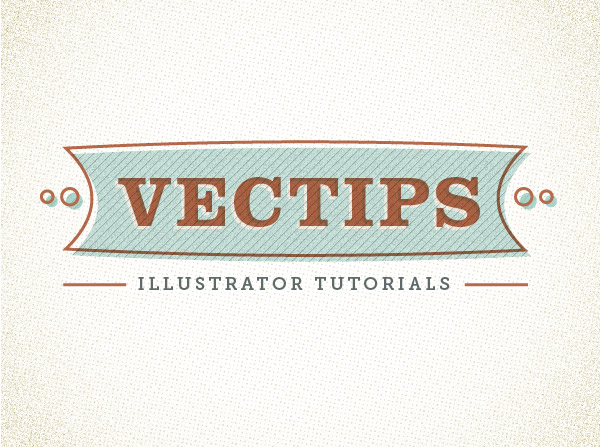
Below is the final type treatment we will be working towards.

Final Image

Tutorial Details

  • Program: Adobe Illustrator CS5 (You should be able to create this tutorial in CS4 and CS3 but some of the tutorial images might look different.)
  • Difficulty: Beginner / Intermediate
  • Topics Covered: Appearance Panel, Effects
  • Estimated Completion Time: 15-20 minutes

Step 1

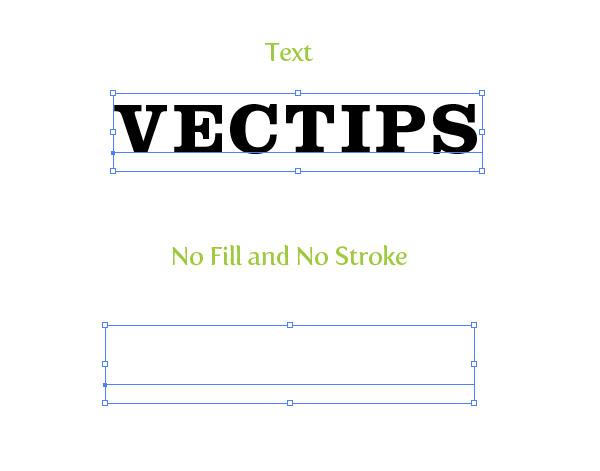
Create a new document and type out some text with the Text tool (T). I used Clarendon Bold at 48 pt. Take off any stroke and fill on the text.

Step 1

Step 2

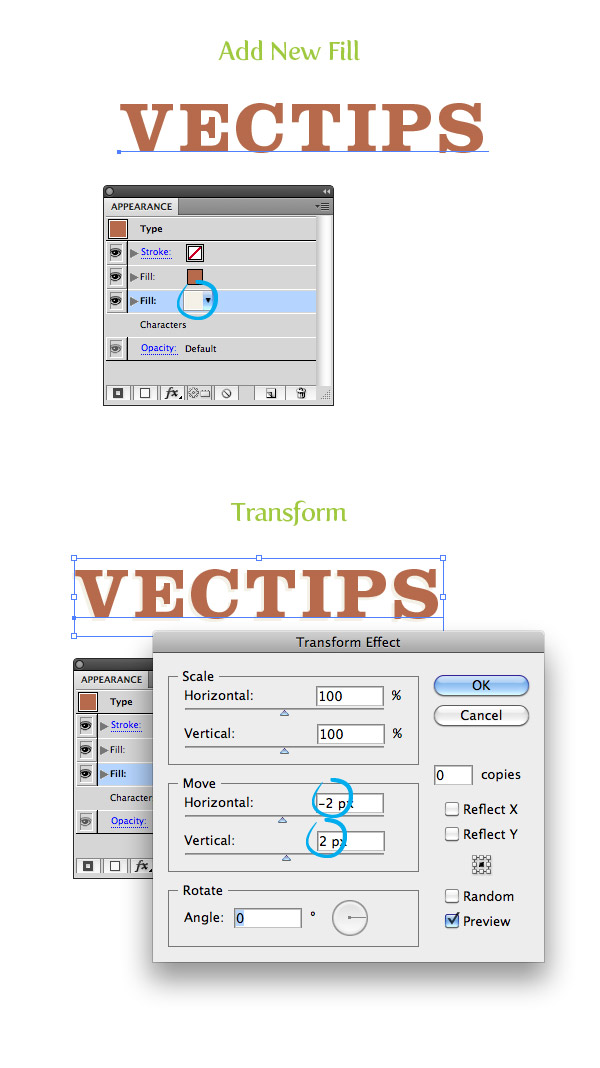
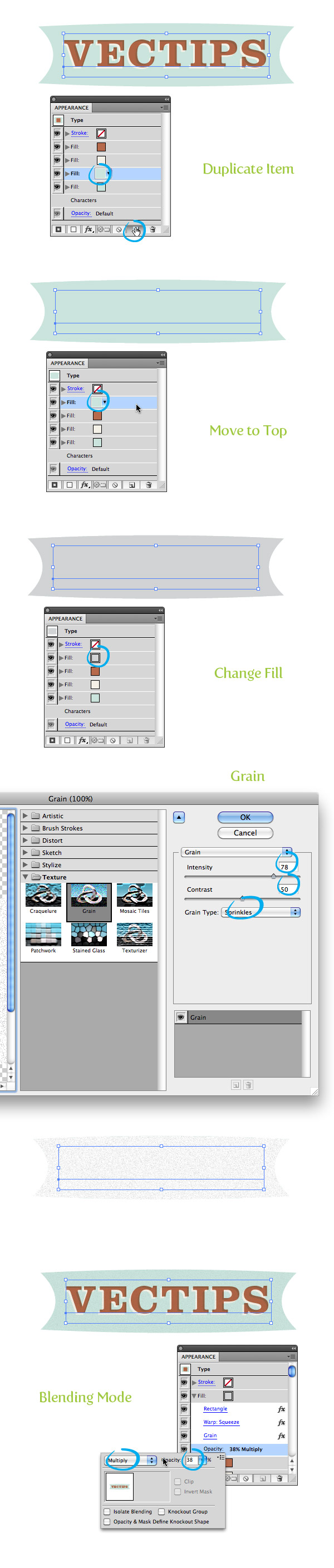
With the text still selected, choose Add New Fill from the pop-up menu of the Appearance panel. Fill the new fill with a reddish orange color. In the Appearance panel, press the drop-down arrow for the new fill to reveal its attributes. Press the Opacity link and change the Blending Mode to Multiply.

Step 2

Step 3

Create another new fill in the Appearance panel, select the bottom fill item, and fill it with a light yellow color. With the light yellow fill item selected in the Appearance panel, go Effect > Distort & Transform > Transform. In the Transform dialog, change the Horizontal Move to -2 px and the Vertical Move to 2 px.

Step 3

Step 4

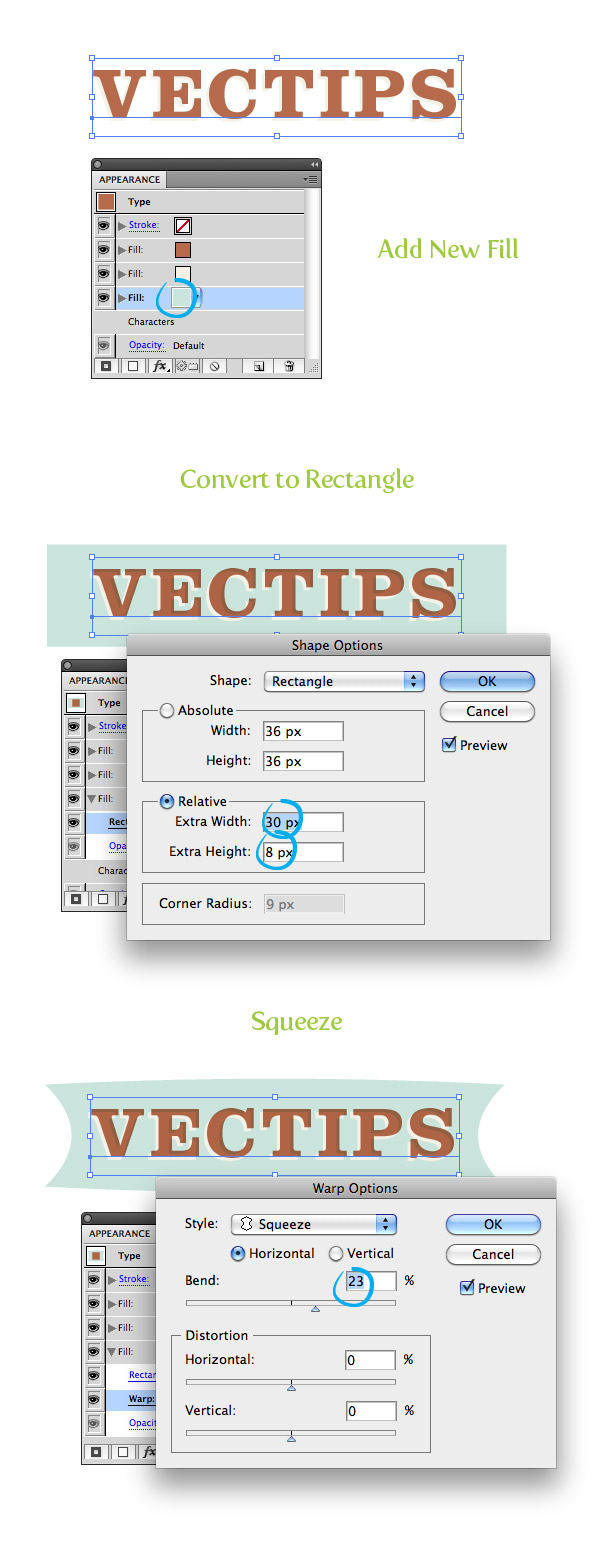
Create another new fill, select the bottom fill item, and fill it with a light aqua color. With the aqua color fill item selected, go Effects > Convert to Shape > Rectangle. In the Rectangle dialog, select the Relative radial button, change the Extra Width value to 30 px and the Extra Height to 8 px. With the aqua fill item still selected, go Effects > Warp > Squeeze. In the Warp Options dialog, select the Horizontal radial button and change the Bend to 23.

Step 4

Step 5

With the aqua item selected, press the Duplicate Selected Item button at the bottom of the Appearance panel. In the Appearance panel drag one of the aqua copies above the first reddish fill item. Change the fill of the top item to a light gray. With the item still selected, go Effects > Texture > Grain. In the Grain dialog, change the Intensity to 78, the Contrast to 50, and the Grain Type to Sprinkles. Change the Blending Mode of the gray fill to Multiply and change the Opacity to 38.

Step 5

Step 6

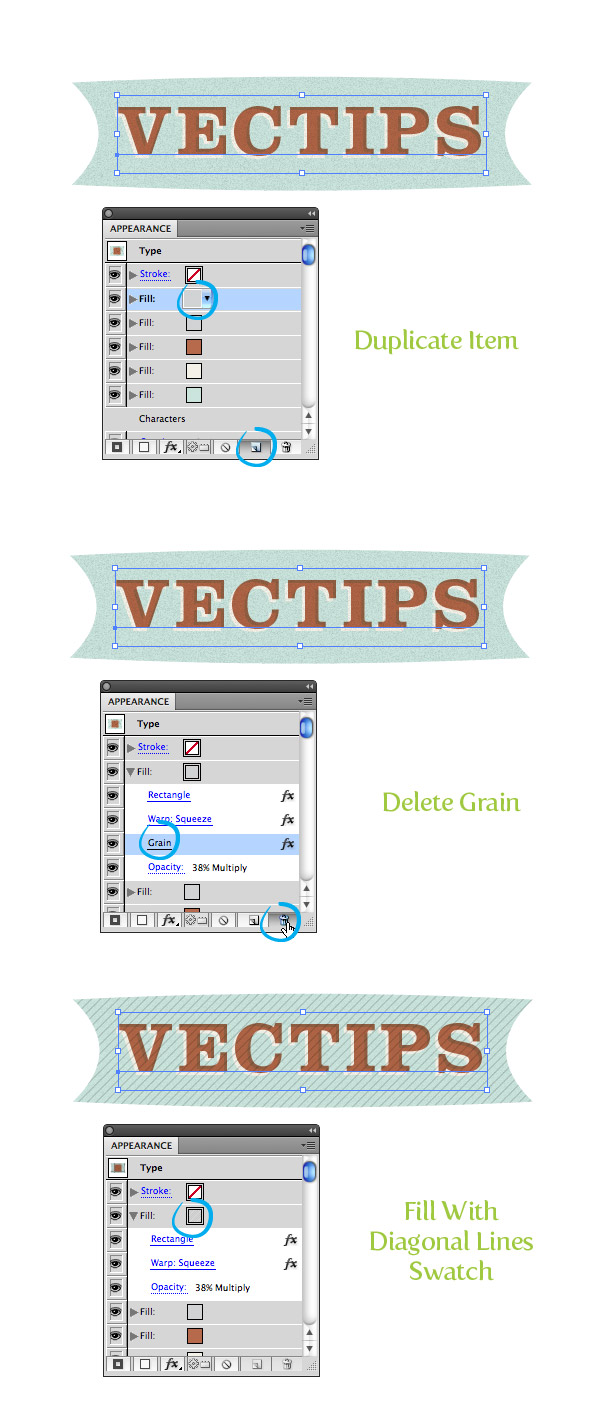
Duplicate the grain fill item, select the top copy, and expand the attributes. Select the Grain attribute and press the trash icon at the bottom of the Appearance panel. Fill the selected item with a Diagonal Line swatch (this can be found by pressing the bottom left Swatch Libraries icon in the Swatches panel then navigating Patterns > Basic Graphics > Basic Graphics_Textures).

Step 6

Step 7

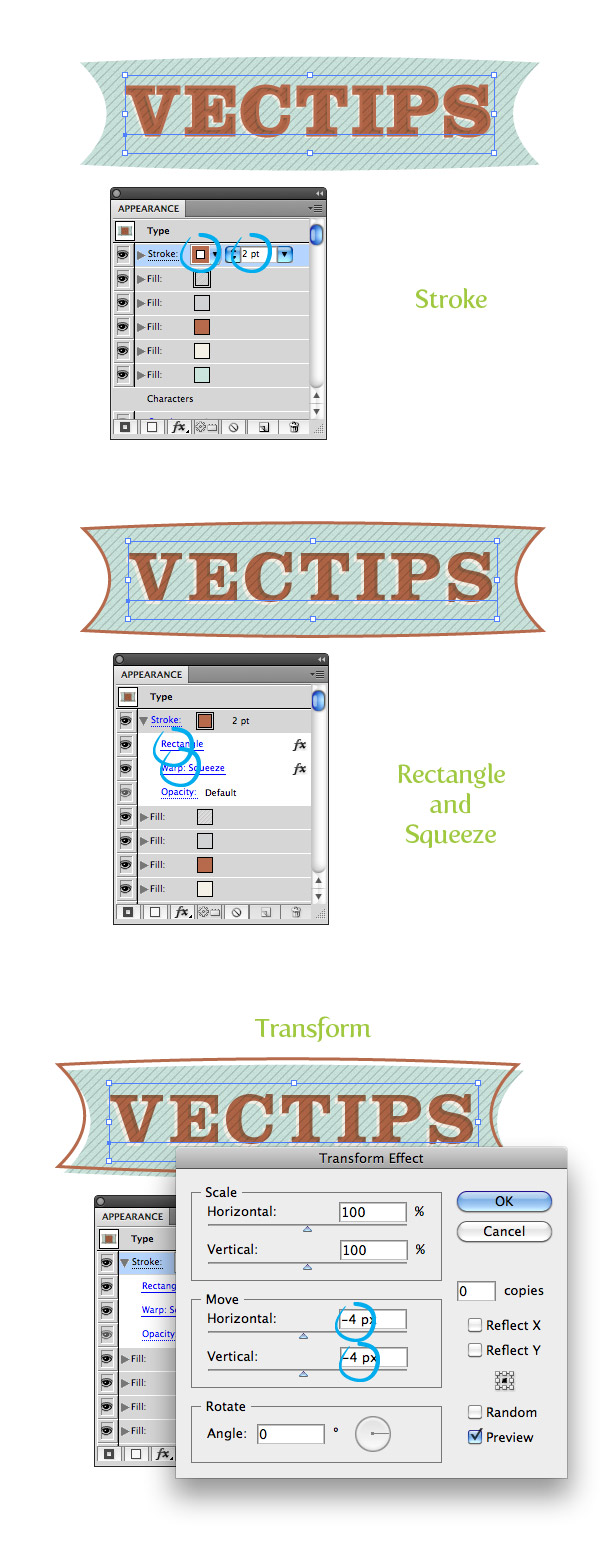
Select the empty stroke item at the top of the Appearance panel, (if your empty stroke item is not at the top, drag it up to the top) fill the stroke with your reddish color, and change the weight to 2 pt. Change the stroke to have the same rectangle and squeeze settings as the previous fill items and set the Blending Mode to Multiply. With the stroke still selected, go Effect > Distort & Transform > Transform and in the Transform dialog, change the Horizontal Move to -4 px and the Vertical Move to -4 px.

Step 7

Step 8

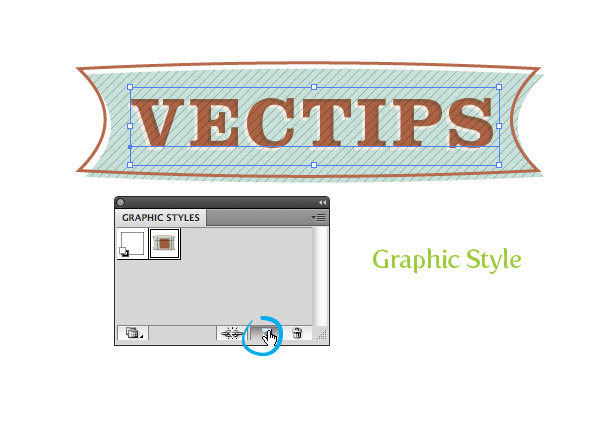
That’s pretty much it for the text treatment! I like to save it as a Graphic Style so I can apply it to other artwork. To create a Graphic Style, select the text and the press the New Graphic Style Button in the Graphic Styles panel. Now you can add the effect to other elements like in the final preview image.

Step 8

Final Image

Again, here is the final image!

Final Image


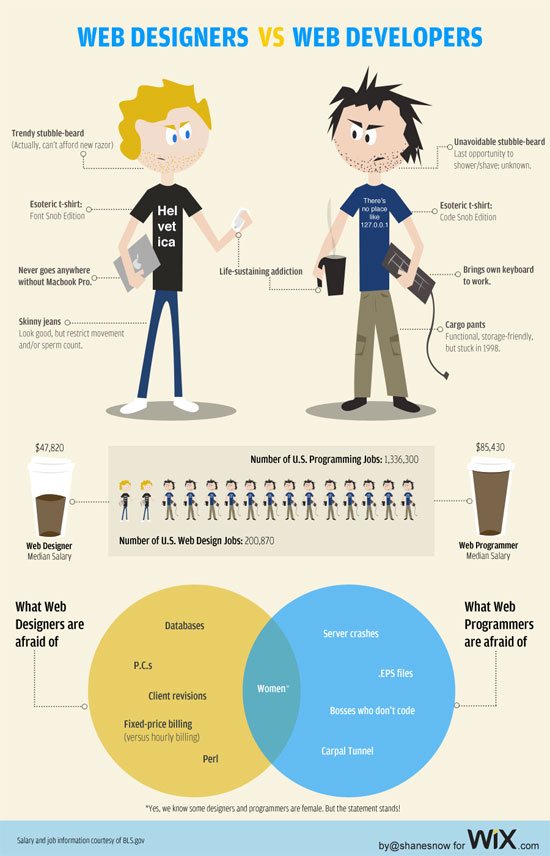
Web Designers vs. Web Developers (Infographic)

11 Nov

Let’s be honest. Being a web developer or a web designer doesn’t exactly give you an edge with the pretty girls (or guys) at your local pickup bar. If you were a part-time firefighter or investment banker, maybe. Nevertheless, the feud continues between web designers and web developers over which profession is the true calling. Like the yin and yang, these two are in constant battle to prove their dominance over the other, even when they work closely together.

Here is an infographic of the differences between web designers and web developers.

Click to enlarge.

Web Designers vs. Web Developers (Infographic)

Infographic by: Shane Snow. Shane Snow is an entrepreneur, writer, and recent Columbia MS/Digital Media graduate. Visit his personal site and follow him on Twitter @shanesnow.

Related Content

About the Author

Wix is a free website builder tool for quick and easy creation of quality Flash websites. Follow them via Twitter as @wix, and subscribe to their blog where they post useful articles for website owners.


Glenn Beck’s Great Awakening

10 Nov

On Saturday, August 28, Glenn Beck brought tens of thousands of people to Washington, D.C., for his “Restoring Honor” rally. The aim of the event, the lachrymose radio and TV host explained, was to “come celebrate America by honoring our heroes, our heritage, and our future.” I covered the event for reason.tv, and I found the rally interesting, strange, and powerful.

Beck is channeling a very strong American tradition with regard to religion and the public square. One of the main themes of the rally was that it was America’s “turning away” from God that led to our present problems. The solution offered by Beck, other speakers, and most of the people I encountered, was “embracing” God and putting him back in the center of our lives, both private and public.

The problems themselves were never fully articulated, but they are palpably related to the recession, which undergirds a huge amount of free-floating anxiety. For much of the new century, and indisputably for the past three years, uncertainty has infected both the economic and the political arena. The people I met at the Beck rally said that they felt like cogs in a machine whose shape and size they didn’t even understand. They were not rabid xenophobes or racists or even haters in general, but they were pissed off that their individual actions did not seem to mean much. They were not conspiracy freaks, but they felt frustrated and cheated that their individual lives seemed to be controlled by larger forces and institutions over which they had little or no control. To the extent that they talked about government, the focus was generally on government spending that they felt threatened to destroy the future.

(Article continues after the video, "What We Saw at the Glenn Beck Rally in DC.")

Historically, such a mind-set has led to two sorts of broader crusades. It can create a populist movement, which might seek to tame the power elite, demonize foreigners, turn the government over to a new crew, or otherwise intervene in the political realm. Or it can inspire a self-improvement movement that has political import but is not fundamentally political: America’s various Great Awakenings, for example, or the self-help gospels of Norman Vincent Peale.

The rally was an interesting mix of both strands. In his day job, Beck rarely misses an opportunity to rail against politicians he deems socialistic. But at this event the accent was on the self-help dimension: the idea that self-transformation was the key to a larger group transformation. A lot of that seems to stem from Beck’s facility with and embrace of 12-step rhetoric. In a sense—and I don’t mean this snarkily—the rally was a giant Alcoholics Anonymous meeting, flush with the notion that whatever else is going on in the world, you can control some portion of your own life.

The attendees saw a continuity between George W. Bush and Barack Obama, between spendthrift and ineffectual Republicans and Democrats. To me, this was the most interesting aspect of the crowd. As one person told me, “It all started under Bush, but now it’s really going to hell.” There were definitely more Republicans than Democrats, if indeed there were any Democrats there at all, but virtually everyone we talked with identified more enthusiastically as an independent. They were fed up with the past decade in toto, not just a year and a half of Obama.

The other thing that struck me about the crowd was how much it reminded me not of a stereotypical church congregation in its Sunday best, but of Walmart. I live part-time in small-town Ohio where the local Walmart Supercenter is an important third place, the sociologist Ray Oldenburg’s term for spaces outside the home and workplace that facilitate interaction and community. And over the past few years, contrary to its wholesome image, the chain has gone seriously goth. If you check out the T-shirts you can buy there, you’ll find that virtually every other one has skulls and crosses on it. And if something doesn’t have stylized chains and blood on it, then it’s in Day-Glo colors.

The Restoring Honor crowd reflected that, with more piercings than I’ve seen at some rock shows, ZZ Top beards galore, a biker look on many men and women. A noticeable percentage of the crowd was wearing inexpensive Faded Glory (Walmart’s house brand) American flag T-shirts. This is America.

The organizers and attendees of this rally were not really part of the Leave Us Alone coalition, Grover Norquist’s famous phrase to describe people who resent government intrusion into various parts of their lives. Yet in some ways, they were proto-
libertarian: They want the government to spend less money, and they seemed wary of interventions into basic economic exchange. (Nobody seemed to dig ObamaCare or the auto and bank bailouts.) But they also want the government to be super-effective in securing the borders, they worry about an undocumented decline in morals, and they are emphatic that genuine religiosity should be a feature of the public square. Which is to say that, like most American voters, they may well want from government precisely the things that it really can’t deliver. 

Nick Gillespie (gillespie@reason.com) is editor in chief of reason.com and reason.tv.


Why do morphine-blocking drugs make you lose weight?

10 Nov
Naloxone (IV) and naltrexone (oral) are drugs that block the action of morphine.

If you were an inner city heroine addict and got knifed during a drug deal, you'd be dragged into the local emergency room. You're high, irrational, and combative. The ER staff restrain you, inject you with naloxone and you are instantly not high. Or, if you overdosed on morphine and stopped breathing, an injection of naloxone would reverse the effect immediately, making you sit bolt upright and wondering what the heck was going on.

So what do morphine-blocking drugs have to do with weight loss?

An odd series of clinical studies conducted over the past 40 years has demonstrated that foods can have opiate-like properties. Opiate blockers, like naloxone, can thereby block appetite. One such study demonstrated 28% reduction in caloric intake after naloxone administration. But opiate blocking drugs don't block desire for all foods, just some.

What food is known to be broken down into opiate-like polypeptides?

Wheat. On digestion in the gastrointestinal tract, wheat gluten is broken down into a collection of polypeptides that are released into the bloodstream. These gluten-derived polypeptides are able to cross the blood-brain barrier and enter the brain. Their binding to brain cells can be blocked by naloxone or naltrexone administration. These polypeptides have been named exorphins, since they exert morphine-like activity on the brain. While you may not be "high," many people experience a subtle reward, a low-grade pleasure or euphoria.

For the same reasons, 30% of people who stop consuming wheat experience withdrawal, i.e., sadness, mental fog, and fatigue.

Wouldn't you know that the pharmaceutical industry would eventually catch on? Drug company startup, Orexigen, will be making FDA application for its drug, Contrave, a combination of naltrexone and the antidepressant, buproprion. It is billed as a blocker of the "mesolimbic reward system" that enhances weight loss.

Step back a moment and think about this: We are urged by the USDA and other "official" sources of nutritional advice to eat more "healthy whole grains." Such advice creates a nation of obese Americans, many the unwitting victims of the new generation of exorphin-generating, high-yield dwarf mutant wheat. A desperate, obese public now turns to the drug industry to provide drugs that can turn off the addictive behavior of the USDA-endorsed food.

There is no question that wheat has addictive properties. You will soon be able to take a drug to block its effects. That way, the food industry profits, the drug industry profits, and you pay for it all.


Republicans Are Really Weird, Chapter CCVII

09 Nov

Ben Armbruster:

In 2008, Bush Said He ‘Probably Won’t Vote For’ McCain: With stories about President Bush’s new memoir dominating the headlines this week, Financial Times Westminster correspondent Alex Barker reports on his “favourite Bush anecdote,” which he writes, “for various reasons we couldn’t publish at the time. Some of the witnesses still dine out on it“:

The venue was the Oval Office. A group of British dignitaries, including Gordon Brown, were paying a visit. It was at the height of the 2008 presidential election campaign, not long after Bush publicly endorsed John McCain as his successor.

Naturally the election came up in conversation. Trying to be even-handed and polite, the Brits said something diplomatic about McCain’s campaign, expecting Bush to express some warm words of support for the Republican candidate.

Not a chance. “I probably won’t even vote for the guy,” Bush told the group, according to two people present.“I had to endorse him. But I’d have endorsed Obama if they’d asked me.”

Barker said that British officials looked “dumbfounded” and that Brown’s “poker face gave way to a flash of astonishment.”


Feds admit to storing tens of thousands of images from naked scanners – unknown number leaked back to manufacturer

09 Nov
You know those naked scanners that we're seeing at the airport that use backscatter radiation to show snoopy security staff high-resolution detailed images of your genitals, breasts, etc? The ones that aren't supposed to be storing those images from your personal involuntary porn shoot?

Well, the US Marshals have just copped to storing over 35,000 of these personal, private images taken from a single courthouse scanner in Florida.

What's more, another machine used in a DC courthouse was returned to the manufacturer with an unspecified number of naked images on its hard drive.

A 70-page document (PDF) showing the TSA's procurement specifications, classified as "sensitive security information," says that in some modes the scanner must "allow exporting of image data in real time" and provide a mechanism for "high-speed transfer of image data" over the network. (It also says that image filters will "protect the identity, modesty, and privacy of the passenger.")

"TSA is not being straightforward with the public about the capabilities of these devices," Rotenberg said. "This is the Department of Homeland Security subjecting every U.S. traveler to an intrusive search that can be recorded without any suspicion--I think it's outrageous." EPIC's lawsuit says that the TSA should have announced formal regulations, and argues that the body scanners violate the Fourth Amendment, which prohibits "unreasonable" searches.

Feds admit storing checkpoint body scan images (Thanks, Master Pokes!)