RSS
 

Facebook Pages Getting New Design and Checkins [SCREENSHOTS]

05 Dec


Facebook appears to be on the verge of launching a new design of its Fan Pages.

This change seems to include the site’s location-based Places checkin functionality, enabling “likers” of the page to check in to it.

Although Facebook founder Mark Zuckerberg is said to be giving a sneak peak at the new Profile Pages design on 60 Minutes tonight, it seems that more change is in store; you can already see the new Pages design in action on select pages, such as Ellen DeGeneres’s Fan Page. On Ellen’s page, you will notice a count for the number of checkins the Page has. According to Facebook spokesperson Meredith Chin, the Ellen Page is a merged page that includes the functionality for checkins available shortly after the feature launched a few months ago. Basically, your brand page will then take on the Places page designs, which appears to be the inspiration for the new profile pages that are to be released as well.

“As long as the address of the official page and the place page match, it should show you a prompt and ask you if you want to merge them,” Chin said.

You can see screenshots of the new design below.


Current Pages Design


The current Pages design, similar to Profile Pages, has the Page navigation tabs (Wall, Questions, Photos) at the top.


The New Pages With Checkins


The new Pages design includes checkins, profile information (which includes some basic information about the page and the Wall postings below it), a narrower left column and more.


New Tabs


The new Pages also feature the navigation tabs on the left-hand side.


Reviews: Facebook, pages

More About: facebook, facebook pages, Facebook Places, mark zuckerberg, social networking

For more Social Media coverage:


Google spends a few more million, picks up Widevine DRM software firm

05 Dec
Two acquisitions in as many days? Say it ain't so! Prior to even unboxing Phonetic Arts, Google has now snapped up Seattle-based Widevine. Truth be told, you're probably taking advantage of the company's technology without even being aware of it -- it's used in over 250 million web connected HDTVs and streamers around the globe, and it's primarily designed to thwart piracy attempts while enabling consumers to enjoy content on a wider array of devices. As these things tend to do, neither outfit is talking prices, but it's fairly obvious why El Goog would want a firm like this in its portfolio. Moreover, it's borderline comical that Viacom's pushing an appeal in order to pit Google as an anti-studio, pro-piracy monster while it's spending hard-earned cash on a DRM layer. At any rate, Google's not getting into specific plans just yet, only stating its intentions to maintain Widevine's agreements, provide support for existing and future clients as well as "building upon [the technology] to enhance both Widevine's products and its own."

Google spends a few more million, picks up Widevine DRM software firm originally appeared on Engadget on Sun, 05 Dec 2010 13:20:00 EDT. Please see our terms for use of feeds.

Permalink Download Squad  |  sourceThe Official Google Blog, Widevine  | Email this | Comments


When’s the Best Time to Publish Blog Posts?

05 Dec

This guest post is by HubSpot’s social media scientist, Dan Zarrella.

Of all the data analysis that I’ve done, day-of-week and time-of-day data has been consistently the most popular. So in preparation for my upcoming webinar, titled Science of Blogging, I decided to combine all of my existing data on timing with my new research into one master post on the subject.

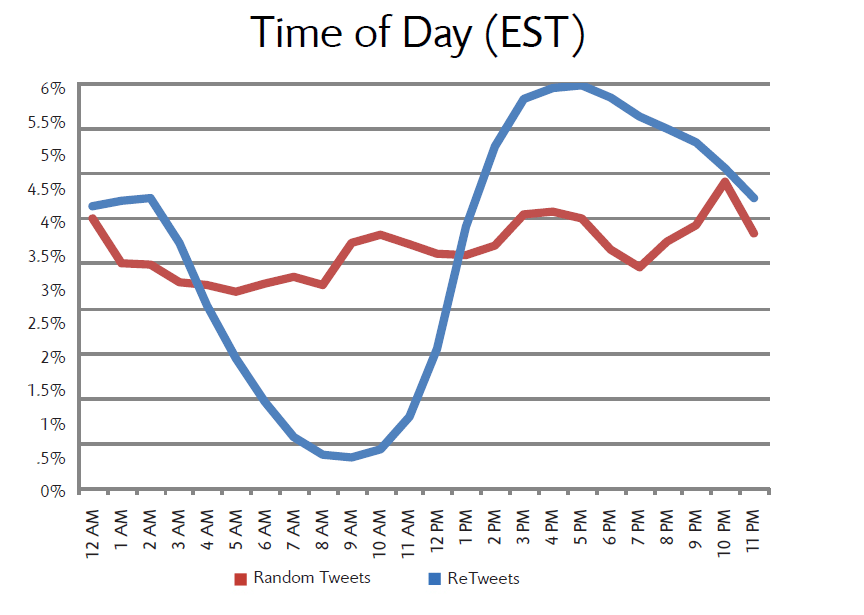
The first time I looked at blog post timing was when I was analyzing retweets. I found that retweets exhibit a strong diurnal pattern, in that they’re more common during the day and less so at night. I noticed that retweet activity tended to peak around 4pm EST, suggesting that this might be the best time to tweet a blog post for maximum potential retweet reach.

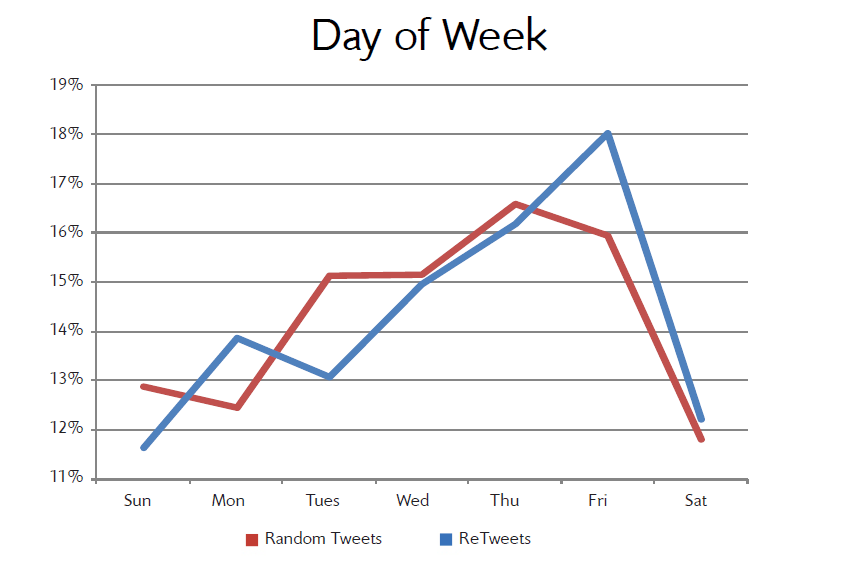
When I looked at retweet activity over the days of the week, I saw that they peaked later in the work week, specifically on Friday.

Since I first published this graph, the most frequently cited piece of this research has been the idea that Friday at 4pm is the most retweetable time of the week. While your niche maybe different, this data was based on analysis of nearly 100 million retweets, so in aggregate, Friday at 4pm is indeed the most retweetable time of the week.

Moving on from retweets, I started studying Facebook sharing and discovered some things that surprised me about timing there, too.

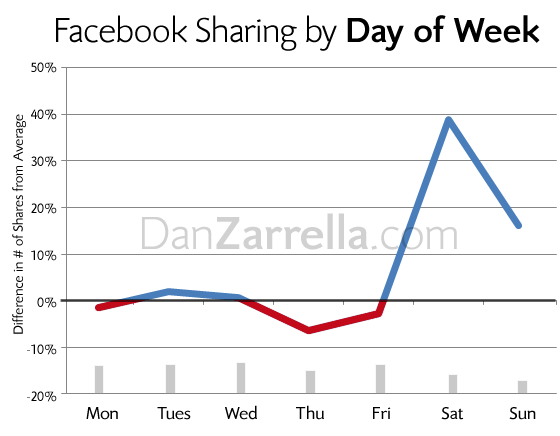
First, while major news sites and blogs publish articles during the work week, articles that are published on Saturday and Sunday tend to be shared on Facebook more than those published during the week. Perhaps one reason for this is that (as Wired reported), more than 50% of American companies block Facebook at work.

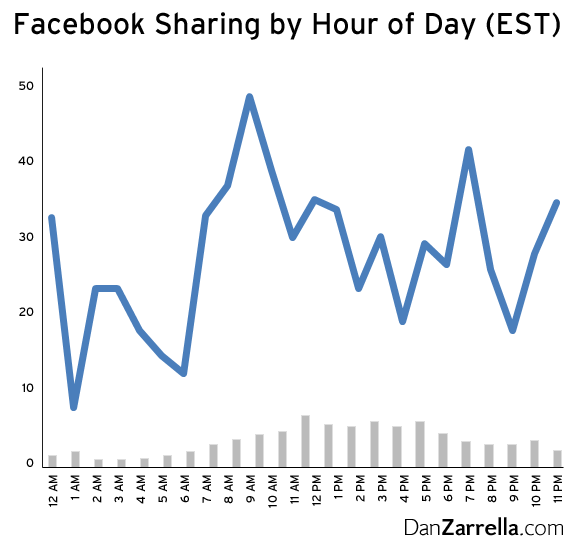
Next, I looked at the effect that the time articles were published had on the number of times they were shared on Facebook. I found that while there is a fair amount of variation, articles published in the morning, around 9a.m. EST, tended to be shared more on Facebook than articles published at other times of the day.

Looking back at these four data points, it may seem that they’re contradictory, but thinking through them a bit more, we can see that they is not necessarily so. Both day-of-week charts tell us that we should experiment with publishing articles later in the week—on Friday and Saturday specifically.

And by publishing posts early in the day, but tweeting them later in the afternoon, we can stimulate both Facebook shares and retweets.

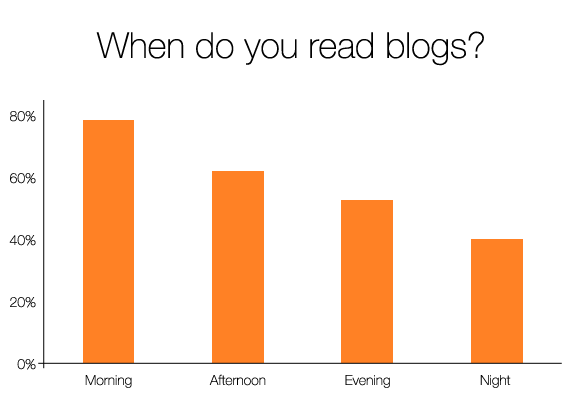
I recently did a survey of over 1,400 blog readers and I asked them what time-of-day they read blogs. Morning was the most popular, followed in decreasing popularity by the rest of the day. Most respondents reported reading blogs at more than one time, so this piece of data reinforces my suggestion to publish early in the morning.

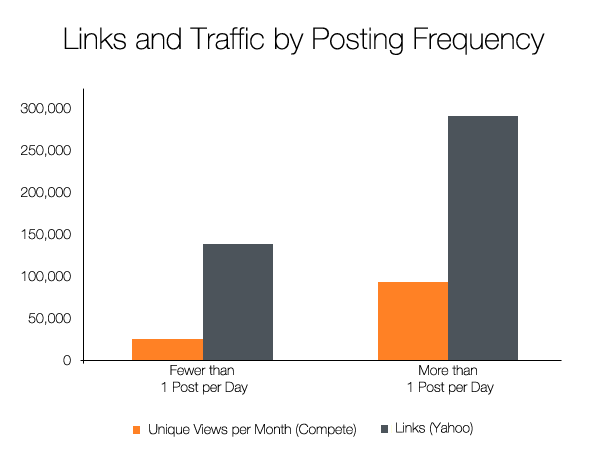
The best timing advice, however, may actually be around frequency. Last week, I analyzed 1000 of the most popular blogs on the web, according to Technorati. I compared their posting frequency with the number of incoming links and visitors they had attracted (according to Yahoo and Compete).

I found that among very popular blogs, publishing multiple times per day led to a huge increase in a blog’s success. This tells us that rather than focusing one perfect day or time, we should aim to publish at many times, and on many days.

Have you experimented with post timing and tweeting? What has your experience shown about the best times of day or week to reach your readers?

Dan Zarrella is HubSpot’s social media scientist. This post contains data from his upcoming webinar The Science of Blogging, taking place on December 9th.

Post from: ProBlogger Blog Tips

-1.gif

When’s the Best Time to Publish Blog Posts?


Bacteria evolve a way to share electrons

04 Dec

Life is powered by the shuffling of electrons. When organisms break down a food source like a sugar, they're really extracting high-energy electrons, which they shuffle down through intermediate proteins before they end up in a final electron acceptor. For most of the life we're familiar with, that acceptor is oxygen. But for various microbes that thrive in the absence of oxygen, a variety of other chemicals are used.

A few bacteria don't even use a chemical receptor at all, instead transferring their excess electrons to metals in their environment (these can form the basis of microbial fuel cells). Now, researchers have witnessed the evolution of a bacteria that transfers its electrons to another bacteria, which goes on to put them to further use.

There are a number of symbiotic relationships like this among the microbes, some of which can metabolize an organic molecule, while others can transfer them to a low-energy chemical. Typically, the bugs exchange an organic chemical or hydrogen to a symbiotic bacteria that extracts further energy from it.

In the current paper, the authors forced two different species of bacteria to live in an anaerobic environment, and provided them with ethanol as food. Initially, they grew very poorly. After several transfers, however, the rate of growth improved, and small, colored nodules began to appear in the culture, which contained a mix of the two types of bacteria. The authors checked a number of the chemicals that are typically used to transfer electrons in these symbiotic cultures, but saw no evidence of their being used.

To figure out what was going on, they did whole-genome sequencing, and found only one change: a single base missing in the gene for a protein that regulates RNA production. Making a similar mutation in another strain also allowed those bacteria to form quick-growing nodules. The mutation appears to cause proteins involved in electron transfer to be expressed at increased levels. These proteins end up on pilli, arm-like structures that extend out from the bacteria.

As a result, the authors conclude that one of the two species of bacteria has evolved the ability to transfer electrons directly to their neighboring species, allowing both to get more energy out of the limited food available.

Science, 2010. DOI: 10.1126/science.1196526  (About DOIs).

Read the comments on this post


This Lady Made A DIY TSA-Like Body Scanner [Video]

04 Dec
Jeri Ellsworth probably saw all the fun the TSA was having with their scanners and decided, 'hey, maybe I can build my own'. And by hacking a satellite dish to act as her backscatter and centimeter wave scanner, she did. More »


Tooth decay to be a thing of the past? Enzyme responsible for dental plaque sticking to teeth deciphered

04 Dec
Scientists have deciphered the structure and functional mechanism of the glucansucrase enzyme that is responsible for dental plaque sticking to teeth. This knowledge will stimulate the identification of substances that inhibit the enzyme. Just add that substance to toothpaste, or even sweets, and caries could be a thing of the past.


What the average American thinks we spend on foreign aid

04 Dec

27% of the federal budget

vs what they think we ought to be spending (=13%)

and what we’re actually spending (=0.6%)

[source]


The Indicator: 101 Things I Didn’t Learn in Architecture School

03 Dec

This article is co-authored by Sherin Wing

1] Even if your boss is your friend he may have to axe you to save his business.

2] Read the book, On Bullshit, by Harry G. Frankfurt. Carry it with you. It’s pocket-sized.

3] Do not drink at work and especially do not get toasted around your colleagues under any circumstances.

4] No matter how highly you may think of yourself you may still be a minion in the eyes of others who hold more power than you.

5] Once you leave architecture school not everybody cares about architecture or wants to talk about it.

6] All eating habits and diets acquired during school should be jettisoned.

7] The hygiene habits you kept in architecture school are inappropriate for real life; bathe regularly and change your underwear.

8] The rush and exhilaration you experience in studio may be inversely proportional to how much you will enjoy working for a firm.

9] It’s architecture, not medicine. You can take a break and no one will die.

10] Significant others are more important than architecture; they are the ones who will pull you through in the end. See 49.

Keep reading after the break.

11] Being smart and having advanced degrees can make you a better designer.

12] The industry underpays. Push for what you are worth.

13] Mind your internet traffic at work unless you are certain your office does not have someone monitoring. Of course you should be working every minute, so this goes without saying.

14] Go home to your family.

15] Call your loved one’s frequently.

16] If you are working overtime, the firm buys dinner.*
*Contingent on office policies, of course.

17] Don’t keep a mayline screwed to your desk. They are not cool and they date you. The same goes for colored pencils.

18] Get the biggest monitor you can.

19] Do not, however, ask for two monitors. Even though it makes you look like a bad-ass you will be expected to do twice the amount of work.

20] Make sure team roles are clearly defined.

21] Know what your role is.

22] Be careful with emails. If in doubt, don’t send.

23] At times respect and civility seem to be scarce commodities in architecture.

24] Be cautious of “opportunities” that do not pay.

25] Sometimes the most critical person on your jury might actually be right.

26] Understand how your office is run as a business and how they go after projects.

27] It is best to keep your outside activities quiet.

28] Your boss reads your blog.

29] Pyromania, car soccer, and other antics you made up to amuse yourself at 3 am are not actually normal. See 49.

30] There are no architectural emergencies that should make you completely give up your life on the outside. That may have been the ethos in studio, but don’t carry it into the office.

31] Be suspicious if your firm expects you to work long hours of overtime for no compensation. Be doubly suspicious if they justify it by saying things like, “It’s just part of the learning curve” or “We had to go through this, too.”

32] If a police officer pulls you over on the freeway for doing 90 mph on a Sunday morning while heading into the office, it’s time to re-evaluate your priorities.

33] Know who the decision-makers are.

34] Don’t dress like an intern. See 72.

35] Read Dana Cuff’s Architecture: The Story of Practice.

36] Expect to be regarded with suspicion if your undergraduate degree is not in architecture.

37] Don’t be seduced by mere appearances.

38] If your firm is outsourcing work to save money, be concerned.

39] Architecture firms can have multiple glass ceilings. Be aware of them all.

40] If a principal of a firm sees making coffee or moving boxes as beneath him/her, consider looking for another office.

41] If a principal doesn’t say good morning when you say good morning to him/her, consider looking for another office.

42] When firms advertise themselves as think tanks or research labs, ask them specifically what it is that they do. And most importantly, make sure they pay. Well.

43] If you are invited to be on a jury, don’t trash the student just to make yourself look good or to contradict a rival on the jury. Be constructive and try to help the student. This is the point.

44] Subvert the signature of the software, unless you consciously want the architecture to convey this signature.

45] Architects are in a service industry. They provide services to clients.

46] In proportion to their pay, architects require the most education, most training, and the most exams to become licensed professionals.

47] Don’t be a Typhoid Mary. When sick, stay home.

48] Embrace the business-side of architecture.

49] If you are an architect you should automatically qualify for psychotherapy and medication.

50] Most architects believe they were destined to become architects because of their early childhood experiences. They showed signs of architectural greatness at a very young age. This is a myth that reinforces an unhealthy hero complex. See 49.

51] Architecture in the academy is completely removed from the profession. Likewise, the values within the academy are radically different from the values within a firm.

52] Be cautious about applying theory to space.

53] Do not take design strategies or operations learned in studio too seriously.

54] Know the difference between architectural celebrity and actual worth.

55] Read books with words, not just pictures.

56] All firms are different. Shop.

57] To save time, assume your wife is right.

58] Do not date an architect unless you are certain he/she is able to maintain a healthy life outside of architecture. See 49.

59] Architects should not intermarry. Inbreeding is not good for the gene pool. See 49.

60] If you are married when you go to architecture school, studio ends at 7:00.

61] Do not buy into the fashion of the moment and simply dismiss certain architects without examining them for yourself.

62] Architects who do not build things also have important things to say and should be listened to.

63] If your studio instructor is a recent graduate, be alarmed.

64] Do not obsess about sustainability to the exclusion of other factors.

65] Renderings done in China are so last year.

66] If you start a think tank make sure you have some thoughts to put in it.

67] Read Rem Koolhaas, but do not obsess and fantasize about being him. Delirious New York is still relevant.

68] Archi-babble does not make you sound cool.

69] Keep in touch with everyone you know, especially if they aren’t in architecture.

70] In fact, make friends who are not architects.

71] Do not wear the same shoes every day, They will start to smell.

72] Make sure your jeans are up-to-date. No acid-wash. No baggy.

73] The economically distressed urban zones you can afford while in school are not gentrified just because you and your friends have moved in.

74] If you must read Italo Calvino, read more than just Invisible Cities.

75] Expect a period of post-traumatic stress disorder after you graduate. Do not make any important decisions during this time.

76] Don’t get a dog just because you are lonely.

77] Architecture is fueled by fetishes—rectilinear designer eyewear, for instance.

78] When trying to decide if a theory book is good, check the bibliography first.

79] Listen to your elders. They are wise.

80] FAIA can mean different things to different people.

81] If you already have a B.Arch, consider further education in a different field. Your M.Arch. can’t make a real contribution to the field if you’re just showing off software skills.

82] Always back up your hard drive.

83] Embrace social media, but don’t be its bitch. Only tweet/post when you have something important to say.

84] Architecture firms should consider forming economic alliances similar to OPEC.

85] Even if you don’t like the look of someone’s architecture they may have something valuable to teach you.

86] Great architecture, like great art, tends to arise from deep psychological issues. See 49.

87] The eighties and postmodernism were not all bad.

88] Being avant-garde is a choice that should be evaluated.

89] Architect’s web pages are often out of control and take too long to load.

90] In one’s life there are a finite number of all-nighters one can pull. You probably used them all up in school.

91] Understand the contexts from which modernism arose.

92] When the economy is good architects can rely on experience to run firms, but when the economy is bad they need advanced business skills they may not possess.

93] Architecture is dependent on boom and bust cycles.

94] Good design is not necessarily the most important factor in running a successful architecture firm.

95] Branding is important.

96] In a corporate firm, those at the top are not necessarily the best but they may have been there the longest.

97] Being good at software does not make you a good architect.

98] Architecture is cliquish.

99] Many architects do not live in houses designed by themselves or other architects.

100] Architecture office parking lots communicate success. There should be at least a couple high-end luxury cars. If there are a lot of beaters, be wary. If all cars are beaters, don’t go in.

101] Be concerned when you are too idle at work.


, a weekly column focusing on the culture, business and economics of architecture, is written by Guy Horton. The opinions expressed in are Guy Horton’s alone and do not represent those of ArchDaily and it’s affiliates. Based in Los Angeles, he is a frequent contributor to Architectural Record, The Architect’s Newspaper and other publications. He also writes on architecture for The Huffington Post. Follow Guy on Twitter.


Holiday Giveaway #8: Triple Aught Design

03 Dec

tadmain.jpg It’s holiday season here at NOTCOT, and we’re doing our annual Gift Guides, Coupons and Giveaways! Just our little way of giving a big hug to awesome brands and readers as we close out 2010!

NOTCOT Holiday Giveaway #8 is here ~ and today our friends from Triple Aught Design are giving 2 lucky readers: the set of an Artemis Hoodie (ladies), a Fast Pack Lite Speed Backpack and a Special Service Sweater (men)!

You probably remember Triple Aught Design as TAD Gear from the super awesome Patrick Ma of Rocketworld - with the bad ass Insurgent Wilderness Gruppo creatures in vinyl and more! They have taken on this incredible understated hyperfunctional chic style that is worn by everyone from special ops teams to… well, designers like us? The quality of materials and attention to detail in the design and build of their products is absolutely incredible! So, i’m really excited to be sharing these brand new products with you! The Fast Pack Lite Speed Backpack JUST launched today! Check out all the details and close ups on the next page!

For a chance to win, leave a comment by midnight on Dec 7th (PST) ~ sharing your awesomest 2010 adventure!

TO PAGE 2 of "Holiday Giveaway #8: Triple Aught Design"! ----->

(Want more visual goodness? See NOTCOT.com + NOTCOT.org)


Nazi Scientists Proposed Creating a Giant Space Mirror to Burn Enemy Nations

03 Dec

An issue of Life magazine published on July 23, 1945 includes an article about a secret weapon proposed by some Nazi scientists toward the end of World War II. It was a huge mirror that, if placed in orbit, would focus sunlight on enemy nations and burn them:

Plausible schemes to build a station in space were engineered on paper long before the war. European rocket enthusiasts, including Dr. Hermann Oberth, who may have been the designer of the V-2, had planned to use the space station not as a weapon but as a refueling point for rockets starting off on journeys into space. … The only major obstacle: constructing a rocket powerful enough to reach a point where a space station could be built. If the modern German scientists had been able to make such a rocket, they might have ben able to set up their sun gun. Whether the sun gun would have accomplished what they expected, however, is another matter.”

The German idea of using the sun as a military weapon is not new. There is an ancient legend that Archimedes designed great burning mirrors which set the Roman fleet afire during the siege of Syracuse, in which Archimedes later died. This legend, and the German plan for building may be proved physically impossible by a simple axiom of optics. This is that light cannot be brought to a sharp, pointed focus with lenses or mirrors unless it comes from a sharp, pointed source. Since the sun appears in the sky as a disk and not as a point, the best any optical system can produce is an image of this disk. At very short focal lengths, the image is small and hot but as the focal length is increased the image becomes progressively bigger and cooler. At the distance the Germans proposed to set up their mirror (3,100 miles) the image of the sun cast on the earth would be about 40 miles in diameter and not hot enough to do any damage.

Link via blastr | Image: Life