RSS
 

Feds admit to storing tens of thousands of images from naked scanners – unknown number leaked back to manufacturer

09 Nov
You know those naked scanners that we're seeing at the airport that use backscatter radiation to show snoopy security staff high-resolution detailed images of your genitals, breasts, etc? The ones that aren't supposed to be storing those images from your personal involuntary porn shoot?

Well, the US Marshals have just copped to storing over 35,000 of these personal, private images taken from a single courthouse scanner in Florida.

What's more, another machine used in a DC courthouse was returned to the manufacturer with an unspecified number of naked images on its hard drive.

A 70-page document (PDF) showing the TSA's procurement specifications, classified as "sensitive security information," says that in some modes the scanner must "allow exporting of image data in real time" and provide a mechanism for "high-speed transfer of image data" over the network. (It also says that image filters will "protect the identity, modesty, and privacy of the passenger.")

"TSA is not being straightforward with the public about the capabilities of these devices," Rotenberg said. "This is the Department of Homeland Security subjecting every U.S. traveler to an intrusive search that can be recorded without any suspicion--I think it's outrageous." EPIC's lawsuit says that the TSA should have announced formal regulations, and argues that the body scanners violate the Fourth Amendment, which prohibits "unreasonable" searches.

Feds admit storing checkpoint body scan images (Thanks, Master Pokes!)


We’re Running Out of Chocolate [Chocolate]

09 Nov
At the rate we're going, chocolate is going to be a rare—and extremely pricey—commodity within the next twenty years. Somebody needs to light a fire under those Oompa-Loompas, stat. More »


Why Richard Feynman can’t tell you how magnets work

08 Nov

But seriously, f*ckin' magnets, how do they work?

It's a very good question, but the truth, according to none other than Richard Feynman, is that it's also a very hard question to give non-scientists an answer on. The trouble: Magnetism is one of those things that's just damn difficult to understand in terms of analogy to stuff the average person already knows. The only way to answer this kind of reductive "why" question, Feynman says, is to put the questioner through an elaborate education in physics, at which point they will emerge—like a hobbled butterfly—equally unable to answer the question in a simple way.

Basically, ICP is doomed to receive nothing but unsatisfying answers on this topic until they enroll themselves in an evil clown Ph.D. program.

Submitterated by millrick, from a post at The Atlantic.


The high school with seven Nobel prize winners

08 Nov
Inside the Bronx high school that produced seven Nobel-winning physicists—despite having sub-standard physics education while most of them were in school. According to this article, what the Bronx High School of Science lacked in specific-subject resources, it made up by creating an engaging environment that got kids excited about science, in general, both in and out of the classroom.


Nicaraguan Invasion? Blame Google Maps

08 Nov

An embarrassing error on Google Maps has been blamed for Nicaragua’s accidental invasion of Costa Rica. Last week, Nicaraguan troops crossed the border, took down a Costa Rican flag and defiantly raised their own flag on Costa Rican turf.

But the troops’ commander, Eden Pastora, told a Costa Rican newspaper, La Nacion, that his invasion was not his fault, because Google Maps mistakenly said the territory belonged to Nicaragua. Government officials in Nicaragua have also blamed a “bug in Google” for the error.

Now, the Organization of American States and UN Security Council are being called in to mediate the dispute, and find a solution to the problem caused by Google. “Costa Rica is seeing its dignity smeared and there is a sense of great national urgency,” said Costa Rica’s excellently-named President Laura Chinchilla.

The search giant has owned up and admitted to its mistake, saying that an error, by up to 2.7 kilometers, arose in the compilation of the border source data with the US Department of State. It has now received correct and accurate data, and is working on updating the map.

“Cartography is a complex undertaking, and borders are always changing” said Charlie Hale, geopolicy analyst at Google. Indeed, this particular border is a hotly contested issue, with dispute over who owns land around the San Juan River dating back to the mid-19th century.

It’s not the first time that Google’s messed up its maps. Earlier this year, Cambodia hit out against Google’s representation of the Thai-Cambodia border. And in September, Google completely misplaced the Florida town of Sunrise, frustrating local businesses and council officials.

Perhaps the most embarrassing thing for Google, though, is that competitor Microsoft has the border definition right on its maps. If Nicaraguan commander Pastora had used Bing Maps, the entire red-faced incident might never have happened.

Illo: Google

See Also:


Cut-up artist alphabetizes the newspaper

08 Nov

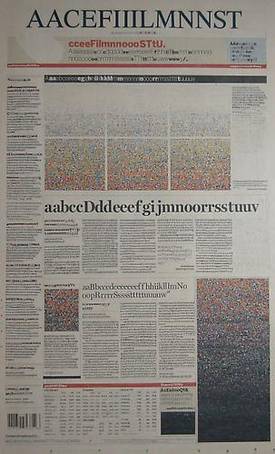
Kim Rugg is a Canadian visual artist with a very sharp knife and a lot of patience and glue: she newspapers, stamps and other paper ephemera up, letter by letter, and makes does delightful and demented art like newspapers in which all the type has been rearranged in alphabetical order. The work is a beautiful and provocative commentary on the form and content of print media.

Kim Rugg - A London artist's knife skills and knack for precision

Kim Rugg, Mark Moore Gallery


Matthew Lyons’ Inspiration Tumblr

06 Nov

via http://matthewlyons.tumblr.com/


Lincolnbot Mark I

05 Nov

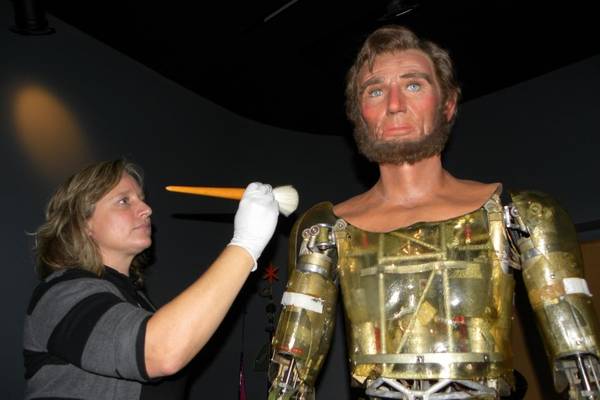
Disney's put the original Abe Lincolnbot Mark I from the 1964 New York World's Fair on display at the gallery at Disney Hollywood Studios in Walt Disney World.

Walt Disney: One Man's Dream Reopens With New Magic, Fond Memories at Disney's Hollywood Studios


Crutchfield Dermatology of Minneapolis claims copyright in everything you write, forever, to keep you from posting complaints on the net

05 Nov
An anonymous reader writes,
Crutchfield Dermatology, in the Minneapolis area, requires its patients to give them the copyright for everything they write on the Internet, in exchange for service. The provision is in an agreement called: "No Show and Cancellation Policy, Patient Satisfaction Agreement, Privacy Protection and Assignment of Copyright Policy." Basically, the company doesn't want its patients saying bad things about it on the Internet. So it demands:

"In consideration for your medical care and the additional patient protection, described above, by signing this document you or your legal ward agree to refrain from direct or indirect publication or airing of commentary about Crutchfield Dermatology and Dr. Crutchfield's practice, expertise or treatment except in the manner provided in the preceeding Patient Satisfaction Agreement Procedures. You recognize that Crutchfield Dermatology has made significant investments to develop Crutchfield Dermatology's practice and reputation for outstanding care, and that published comments on the internet or through mass correspondence may severely damage Crutchfield Dermatology's practice. By this agreement, you grant all copyright ownership in any and all published statements, comments, blog postings, and any other communication made by you outside of the Patient Satisfaction Agreement Procedures. You further agree that Cruthfield Dermatology is entitled to equitable relief to prevent the initiation or continuation of publishing or airing of such commentary regarding Crutchfield Dermatology's practice, expertise, or treatment."

Giving them copyright over things I write about them is bad enough; giving them copyright over everything I write turns me into an indentured servant. And, of course:

"Crutchfield Dermatology reserves the right to modify any policies without notice."

Crutchfield Dermatology


Everyone hates the KFC "Double Down"

05 Nov
Why are we humans so gullible as to believe in things that are obviously not true, like astrology, homeopathy, and stuff Joe Morgan says?

One argument is that it's a question of being numerate and understanding the scientific method. If people who believe in homeopathy truly understood that there isn't even one molecule of active ingredient of their "medicines," they might be swayed. And if only Joe Morgan learned a bit about how the Runs Created formula actually works, he'd understand why we've reached the conclusions we have and come over to our side. It's just a matter of education.


Well, I'm not so sure that's true. Case in point: the reaction to KFC's "Double Down" sandwich.


The "sandwich" consists of two breaded, boneless chicken breasts, with bacon and cheese and sauce in between. There's no bun. (If you've never seen one before, here's a picture.)

The Double Down has been available in the US for a few months now, but it just came to Canada about a month ago, and all the usual nutrition and obesity spokespeople are flipping out. Google "double down Canada," and see for yourself:


-- "KFC's Double Down hits Canada; nutritionists worried - CTV News"

-- "Double Down, Canada: We gobble artery-clogging fat fare from KFC in record numbers"


-- "KFC’s Double Down raises eyebrows among Canadian nutrition experts."

There's lots more than that. For instance, my local paper, the Ottawa Citizen, had TWO editorial cartoons about the Double Down in the last couple of weeks. (Here's one of them.)


So what's the big problem? I don't see it. The Double Down isn't really any worse than other fast food items. It has 540 calories (including 30g of fat) and 1,740 mg of sodium. The Big Mac, which nutritionists don't seem to be pooping themselves over, has the same 540 calories (28g fat) and 1,020 mg of sodium. And the double Wendy's Baconator has 980 calories (63g fat) and 1,830 mg of sodium. (Let's not even talk about the triple.)


So the Double Down doesn't seem like that big a deal. Yes, it's got a little more sodium per calorie than the other two items, but, really, not that much more. And it's not like KFC is any worse than chicken anywhere else.

A KFC breaded boneless chicken breast has 560 mg of sodium. I went down to my kitchen and pulled out a box of President's Choice frozen breaded chicken breasts. Each one has ... exactly the same, 560 mg of sodium. I checked the "blue menu" variation of those chicken breasts, the ones with less fat and fewer calories: 450 mg. And, finally, I checked non-breaded honey-lemon chicken breasts: each breast had 460 mg of sodium. Those are the healthiest, least-fatty ones, at only 150 calories each.


So, again, what's the big deal? It looks to me like seasoned chicken breasts routinely have salt added to make them taste good.

So why blame KFC?
Is it because of innumeracy? Do the nutritionists and the journalists simply not understand what the numbers mean? No, it's not. It's the opposite, in fact. Every article I've seen points out that other fast food products aren't much better, and they all print the numbers for calories and sodium. But, somehow, it goes in one sentence and out the other.

Why is the Double Down singled out for so much opprobrium?
Because it has no bun. I think it's a status thing. Having no bun -- or rather, having a bun made out of meat -- is weird, and weird in a lower-class non-gourmet way. It looks like gluttony -- chicken and more chicken, stacked so high it's hard to bite into. It's something that truckers might eat, but cultured nutritionists, and educated people who care about obesity of the lower classes -- well, when they want to eat chicken, they use a knife and fork ... or, at least, put it in a bun like civilized people.

Furthermore, the existence of the Double Down feels like a personal attack on nutritionists. Because it has no bun, it's kind of fun, with overtones of gluttony. People who take nutrition seriously *hate* that. Food isn't supposed to be fun. It's supposed to be serious. Nutritionists have spent years and years getting degrees and becoming experts on what's good to eat and what's not ... and now what happens? KFC tries something completely different, appealing to people's appetites in a whole new way, *without even consulting the nutritionists*!

Without the absence of the bun, none of this happens, because there's really intrinsically nothing special about the product. Think about it:


1. The Double Down is made of two breaded boneless chicken breasts. But KFC has had those same boneless chicken breasts around for some time now. They actually offered them in a meal, but flat on a plate, with a knife and fork, and two side dishes. Nobody complained, and nobody took notice.


If I were to order that, and take the tray to my table, and eat it, nobody would look twice. But if I took those two patties, stacked them up on top of each other, and spread the the honey mustard sauce between them, and then I picked up my newly-constructed double-decker greasy chicken thingy in my two hands, and ate them that way ... well, people would stare, and some of them would be grossed out.
Even though it's the same meal, they'd think I was a disgusting pig, and wonder why I'm not ill and obese.

Same product, different presentation, completely different reactions. It's the shape of the Double Down, not the content. To some, stacked chicken patties with sauce in the middle is disgusting. But "that's disgusting" won't get them taken seriously, so they have to complain about the nutritional content.


2. McDonald's has a breaded chicken sandwich. They'll let you make it a double for an additional charge, and they'll be happy to add cheese and bacon. Nobody complains. Why? Because it's got a bun. Take away the bun, and what have you got? The McDonald's version of a Double Down.

3. There's a well-regarded product that are almost exactly the equivalent of the Double Down, and nobody complains. It's Chicken McNuggets. Well, it's not exactly the same, because there's no cheese or bacon. But a 10-piece McNuggets, with two sauces, otherwise has almost exactly the same profile as the Double Down: 610 calories (35g fat), and 1560 mg sodium.

But McNuggets are bite sized. You eat them individually and daintily. You don't stack them all up and ooze the sauce in between them.

4. Okay, here's an established main course that really IS almost exactly a Double Down: Chicken Cordon Bleu. It's a breaded chicken breast, and when you cut it open, there's cheese and butter and ham inside. (Yes, it's ham instead of bacon, but close enough.) If you look up nutrition information for Chicken Cordon Bleu, it's pretty close. It has to be -- the ingredients are almost the same.

Chicken cordon bleu is classy, classy enough to serve at weddings. Foodies don't mind it, and nobody campaigns against it. But if KFC sold it, and made you eat it with your hands? Yuck!
It's gross, and the multinational corporate megagiant doesn't care about the health of its customers!

-----


We humans have a "blink" mentality -- we see a situation and come to a conclusion in an instant. Often, those conclusions are wrong, fed by our prejudices.
Overcoming those prejudices does indeed take numeracy and intelligence.

But the most important thing it takes is a willingness to think about the issue with an open mind.

No matter how smart you are, and no matter how many math courses you've taken, you still have to be able to put aside your instinctive first impression and take a fair look at the issue and the evidence.
Of all the people who'd be able to evaluate a foodstuff with a clear eye, you'd think nutritionists and health experts would be at the top of the list. But despite all their expertise -- or perhaps because of it -- they're among the worst offenders.

(In fairness, it could be selective sampling; the nutritionists who don't have a problem with it wouldn't be out for media attention. But you'd think if they were that common, some reporter would have found a few to present a countering view.)

In Ontario, the minister in charge of health promotion even started talking about *banning* the Double Down. She was quickly shot down by the Premier. But still -- the public official in charge of public health, the one who you'd think would have the most responsibility to see both sides and evaluate the situation, had the most extreme, prejudiced reaction. It's as if the head of the American Bar Association suddenly called for an impromptu lynching, with a thousand lawyers lining up behind her.


The solution is not just to teach more math. The solution is to make it socially unacceptable to accept silly, unjustified arguments. There are some places where we've been partially successful. We're able to do that, at least a little bit, in academia, where peer review at least calls out the cranks. We're able to do that in the justice system -- I'd bet that few judges would give credence to the argument that the Double Down is significantly worse than the Baconator just because you consume it more lustily.

We just have to promote that way of thinking in everyday life -- which is difficult, and perhaps impossible. But in my utopia, when nutritionist Joe Morgans say that Chicken Cordon Bleu is worse for you when you use your hands instead of a plate, we stop quoting them in approving newspaper articles, and laugh at them instead.