
via http://www.fubiz.net/blog/index.php?2008/05/24/1820-retro-gaming-on-real-backgrounds
Last week was the end of our FlowingData personal visualization project. I asked readers to collect data about themselves or their surroundings and then visualize it some way. Thank you to everyone who participated. It put a smile on my face every time I got an email with "summer project" in the subject line :).
While I enjoyed all the entries (and I hope you all enjoyed making them), there can only be one winner. The winner is Tim Graham who took manual personal data collection to another level. From email spam, to beverage consumption, to aches and pains, Tim embraced the spirit of self-surveillance. He even made his personal data available in the forums. Congratulations, Tim!
Here are Tim's personal data visualization projects along with entries from Brian, John, Kevin C, Kevin M, Lisa, Said, Stacey and Joel, and Tony. Thanks again everyone for participating, and I hope the rest of you will consider getting in on the self-introspection next time.
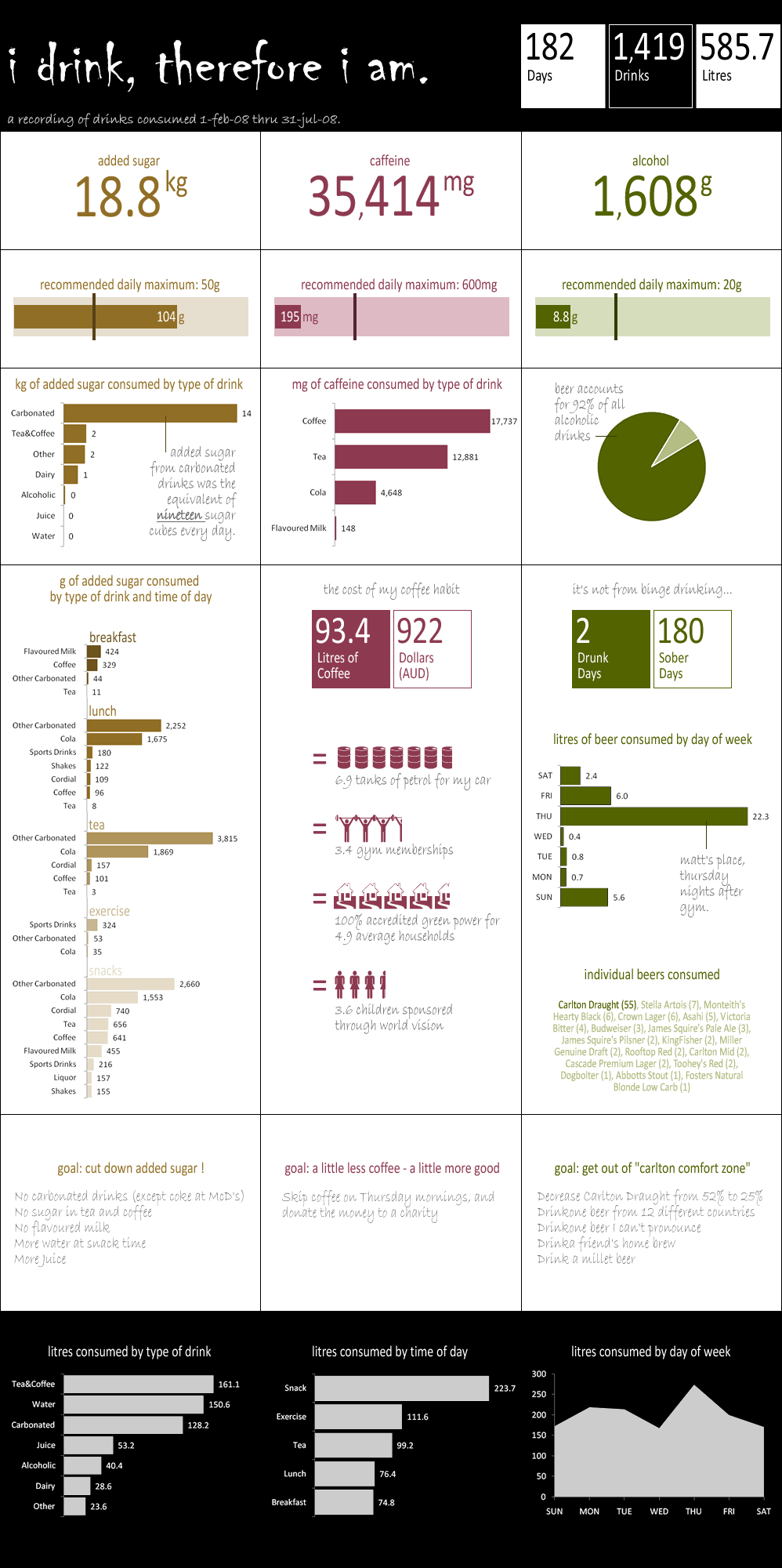
I originally thought this was all alcoholic beverages. I was going to tell Tim that he might have a problem. Luckily though, it was all beverages he's consumed over the past few months. That's some serious discipline.
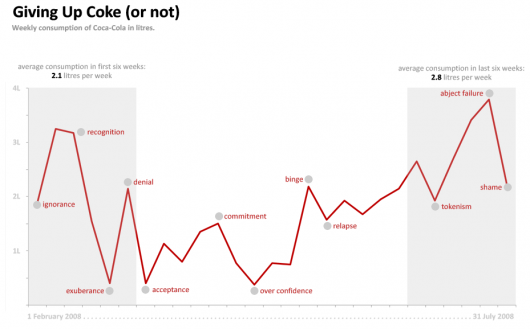
This one focuses on Tim's Coke consumption. It's a short story of a losing battle against his soda addiction.
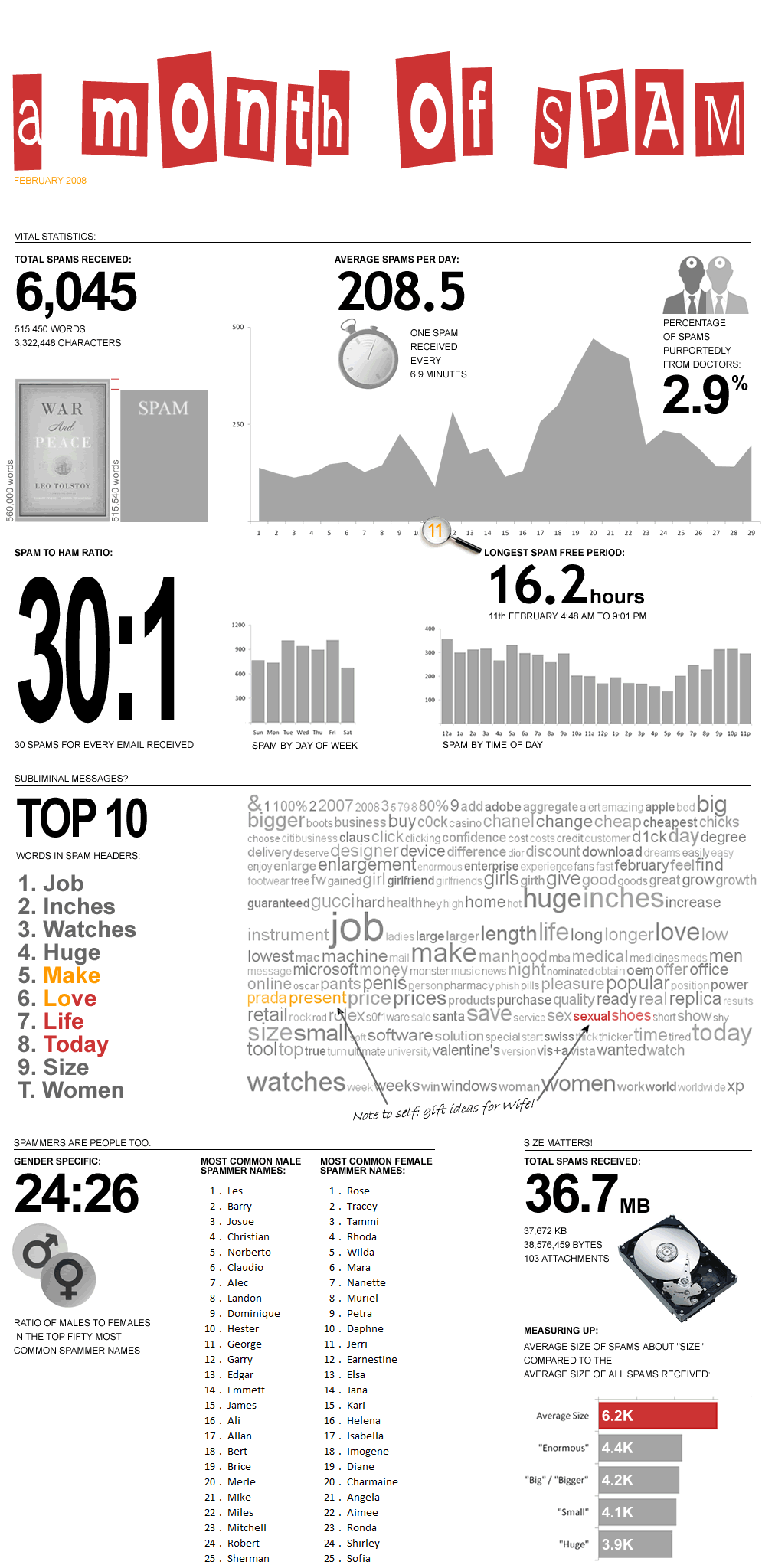
How about a look at a month of email spam? Almost as many words of spam as in War and Peace.
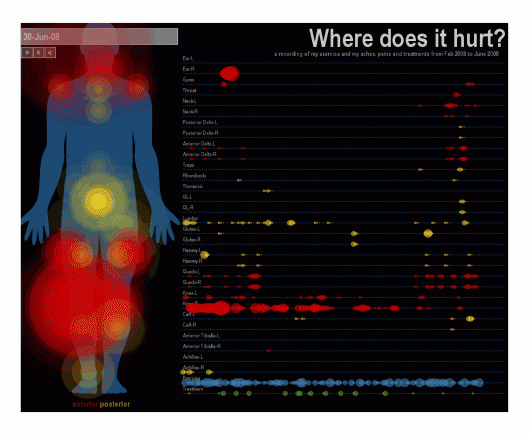
This is actually an animated aches and pains chart implemented in Processing. Watch as pains fire off on poor Tim's deteriorating body.
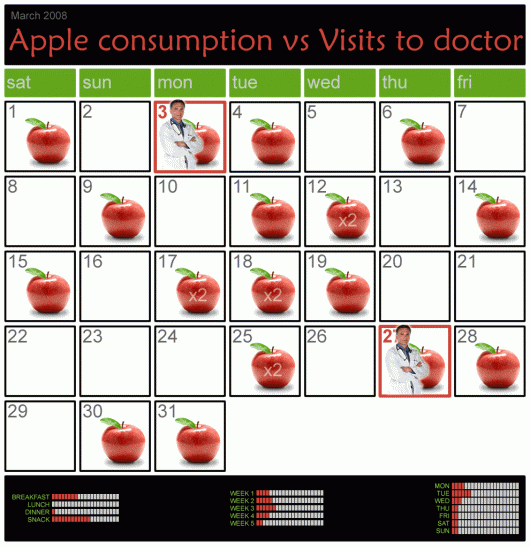
A calendar of apples and doctors...
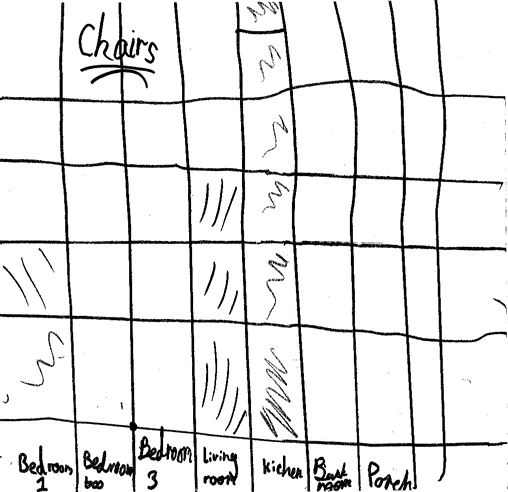
...and even Tim's daughter got in on the action. Here's her very first chart. It shows number of chairs by room. Proud father.
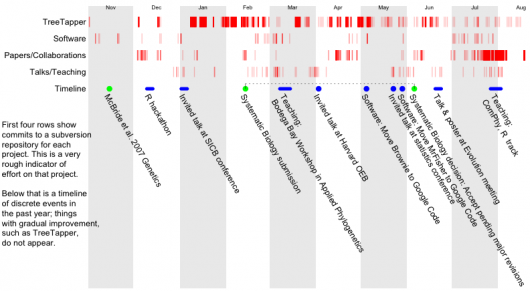
Brian is a postdoc part of an NSF-funded project and displayed commits to subversion, which he used to manage code and documents. He found that there tended me more commits to the repository as deadlines approached.
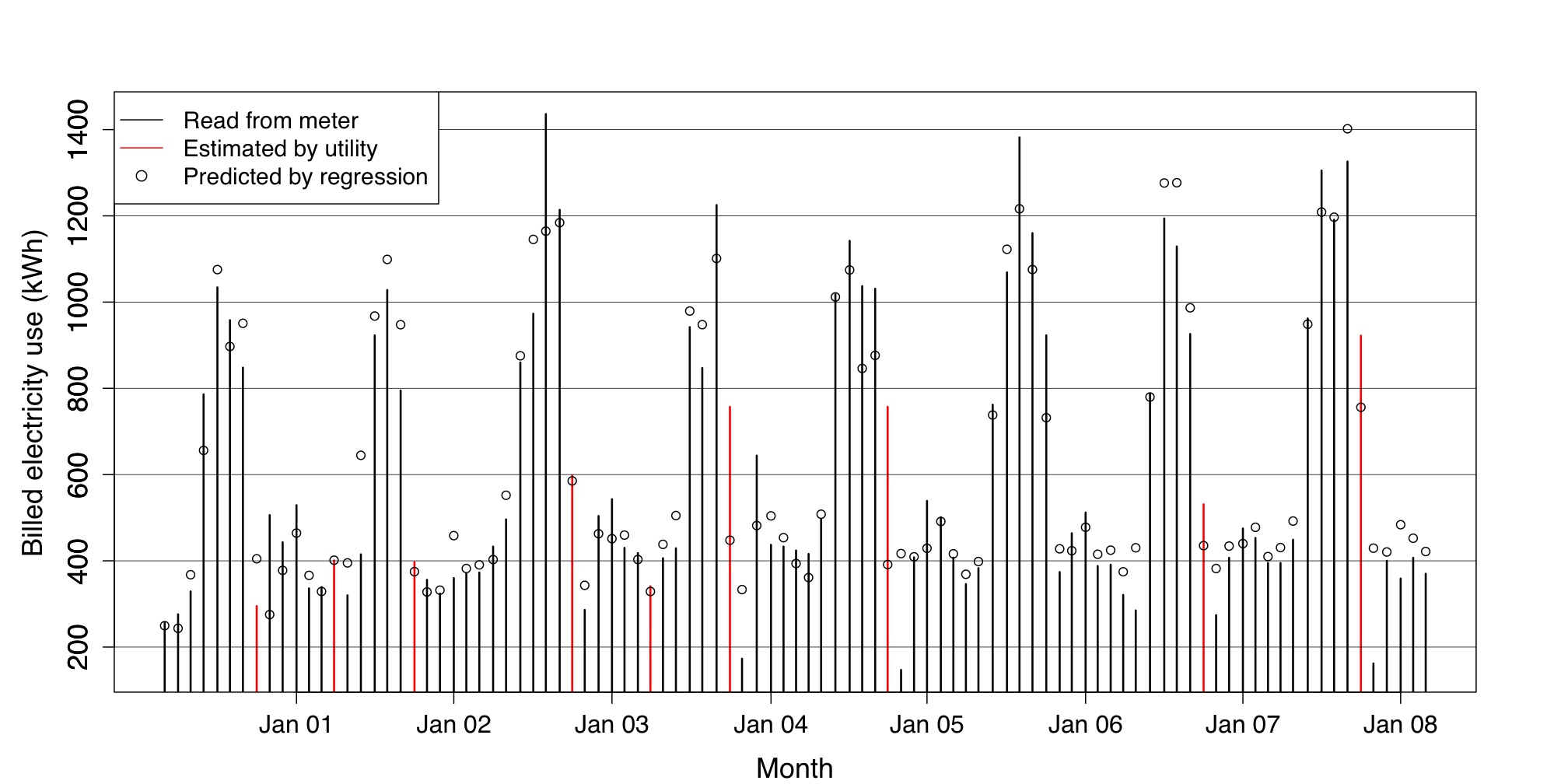
Hey look - it's a chart made in R! John bought a new house in 2000 and charted billed electricity use – estimated by the utility company and the regression.
From John, "Every once in a while, the electric company gets lazy and estimates the meter reading, rather than coming to my house to read it. In the attached graphic, I wanted to see those months in particular to determine whether the utility company tends to over-estimate or under-estimate my electricity use in those months, as compared with my own estimation formula."
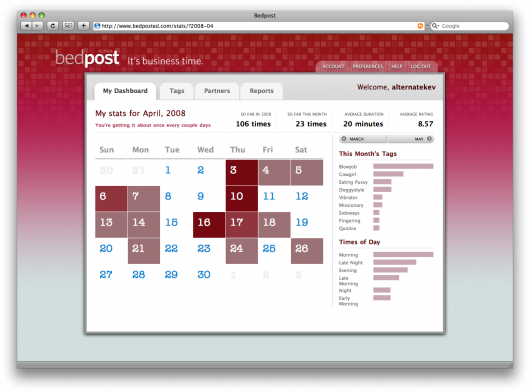
We saw this one earlier during the summer. Kevin C sent in BedPost, his project currently in private beta to track private time with your nighttime buddy.
Kevin M has his own application, LifeMetric, which lets you enter how you feel and then compare emotions with other users.
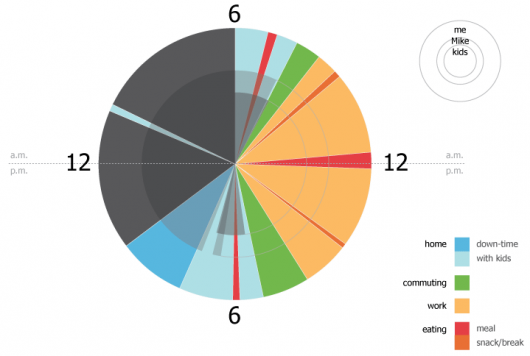
Lisa has been tracking how she (and her family) spends time. Below is one day that shows how she (outside circle) and her husband (middle circle) and her kids spend their day.
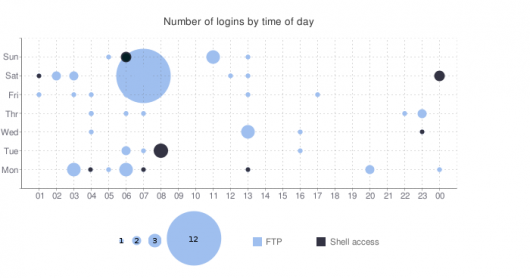
Similar in spirit to Brian's visualization, Said put together a series of visualizations of his SSH and FTP logins. It looks like Said is a morning person?
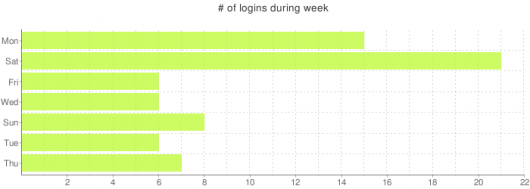
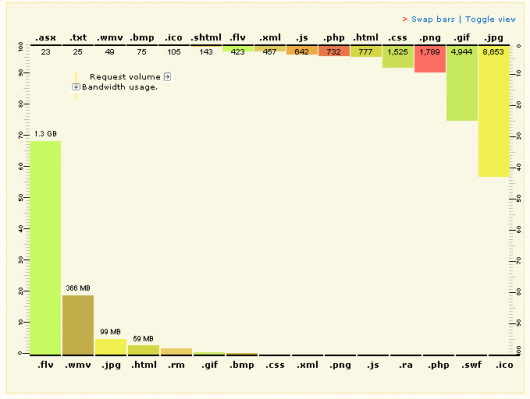
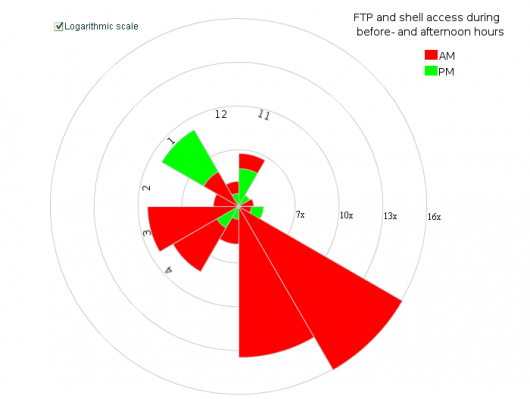
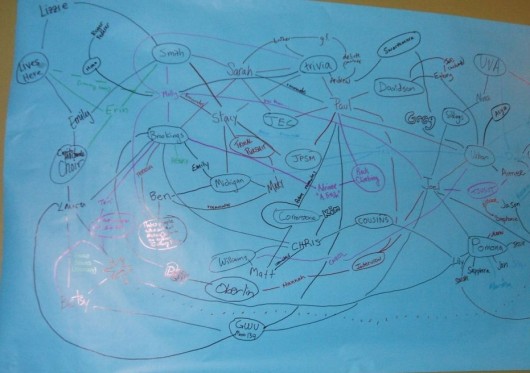
Stacey and Joel held a PieFest with some friends. While they had everyone together they drew up a network. People wrote their name and drew lines to the people they knew.
Tony put his iTunes library through Wordle. He's a big fan of various artists.
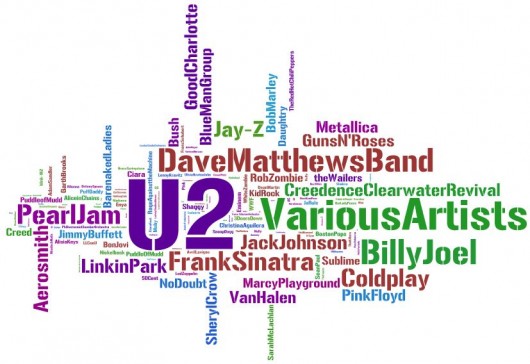
There you have it. The FlowingData personal visualization project. As you can see, there's lots of personal data for you to collect, visualize, and analyze, so go out and have some fun. Can you think of data worth collecting not here? Let us know in the comments.
Again, thank you to everyone who participated. I enjoyed every entry, and I'm sure FlowingData readers do too.
 In a long-ranging discussion today at TechCrunch50, investor Peter Thiel (PayPal, Facebook, Slide) gave his thoughts on what is the best predictor of startup success. At the Founder’s Fund, one of the most important factors he likes to look at before deciding to invest in a startup is how much the CEO is paying himself. (This is also a factor that one of his investments, YouNoodle, looks at to value private startups). Says Thiel:
The lower the CEO salary, the more likely it is to succeed.
The CEO’s salary sets a cap for everyone else. If it is set at a high level, you end up burning a whole lot more money. It aligns his interest with the equity holders. But [beyond that], it goes to whether the mission of the company is to build something new or just collect paychecks.
In practice we have found that if you only ask one question, ask that.
In Startupland, everybody should be working towards the same goal: that big juicy exit. That’s the only payday any CEO should be worried about (even though more than half of them will never get it).
Crunch Network: CrunchGear drool over the sexiest new gadgets and hardware.
 Cerego introduced iKnow at DEMOfall 08 today as “The first intelligent social learning platform.†Basically, iKnow! enables people to learn faster and improve memory retention through patented learning algorithms that generate personalized learning schedules. Each person’s training schedule is unique because it is customized according to their optimum periods of time for studying and learning. This process is based on research conducted on optimum learning patterns in the fields of cognitive science and neuroscience.
Big in Japan
The url for the iKnow website currently uses the Japanese domain extension because it has been in beta in Japan for the past ten months. There are currently over 250,000 registered Japanese users studying English. Cerego plans to provide support for many other languages and even an open API for developers, which will mean many new applications based on their system.
World-wide brainshare
iKnow wants to become not only a tool to help users learn but also an intelligent social network where they can share and collaborate with other users. The goal is to get members to help each other grow and learn within their online system. Ultimately, users from all over the globe will be able to remix content and share them with others within the learning community.

Crash Course of Classes
The real proof in the pudding is actually taking a few courses to see how well iKnow worked. So I went to their English courses page which only has a few listings at this point in time but many more are sure to come. Right now there are some courses for vocabulary and SAT preparations.
The first thing you notice in any of the courses is the abundance of audio assistance on every page. This is especially useful in courses where you learn languages or need to hear how words sound such as in the vocabulary courses that I took. You can click the play button as often as you need to hear the word or sentence.
The other interesting thing you notice is how many ways different ways they ask the same questions which is an effective method of training. For example, instead of just asking a multiple choice question, you will need to actually spell out words as well as fill in the blanks of sentences. It forces you to learn the concepts even when you guess something correctly it will test you again in another manner almost as if to verify whether or not you were lucky or really knew the answer.
Making Learning More More
I was impressed with the amount of things I learned in a relatively short period of time. It was also kind of enjoyable and not painful at all. In addition to the regular courses, iKnow also has a game-like study course called BrainSpeed that’s fun and fast-paced. It’s timer based and conducts itself much like a gameshow.
It even maintains a top players ranking list and allows you to invite others to join the fun and learning.

Final Thoughts
It makes sense to combine the power of computer technology and the many benefits of social networking with this new learning platform from iKnow. Making the process a global experience where users can actually interact and assist one another is an excellent idea. If things go as well for iKnow then we could very well be looking at the future model of online training and educational systems that are effective and fun.
Shared by Sean
I also saw tweets about the audio/visual failing.
 TechCrunch50 has been plagued by a lack of internet connectivity, according to emails we’ve received and other reports online.
As well as affecting people on the floor, the biggest losers from the WiFi problems are the 100 companies in the demo pit, who from one account I have are furious, particularly given that unlike the presenting companies, they had to pay to be at the conference.
Mixed reports on EVDO and 3G access. Some demo pit companies do have cards, but coverage isn’t great. The issue being that when you’re demonstrating a web startup, having access to the internet to demonstrate your product is a necessity.
Here’s some of the feedback via Twitter
“Demoing Powerset at TC50, in between Zivity (good location) and Wixi. But still no WiFi? Wishin’ I were at DEMO.†Mark Johnson on a stall in the demo pit.
“tc50 demopit is just a pit right now. No wifi, no demo.†matteofabiano
A wry observation: “Funny. There are more tweets about the broken WiFi at TC50 than about the actual event… †schillmoeller
There does appear to be some good news for companies in the demo pit though:
“There’s good news & bad news. Since the wifi at #TC50 was down most of today, today’s Demo Pitters are invited back tomorrow. Yay!/Ugh! “ J-Strizzle
Even Scoble couldn’t stay on message
“I hear that at Demo the wifi works. Not here at TC50.â€
As one email to me put it: “I know the attention this amateur hour gets is frustrating the hell out of them.â€
If you have any thoughts on the debacle or inside information, leave a comment, or send us an email. We’ll also consider running any anonymous rants.
(source image credit: Magerleauges)
I've always assumed that Google was the best--and biggest--example in history of a business model based on free, but until today I hadn't actually run the numbers. Before I get to those, let's definite what "built on free" means.
Until the advent of the Web, the biggest companies built on free were broadcasters in radio or TV ("free-to-air" services, where a third party--the advertisers--pay for content to be free to consumers). In the rabbit-ears broadcast era, these were pure free plays: virtually all their revenue came from direct advertising payments or syndication revenues from their local affiliates, who were just passing along their own advertising revenues.
This is what's commonly referred to as "the media business model". Sometimes it means that advertisers subsidize 100% of the content costs, other times they subsidize just 70-80% of those costs, as in the case of magazines and newspapers.
Since the advent of cable TV and satellite radio, the media business model has evolved. TV broadcasters are bigger but they're also more diversified, with a mix of revenues from traditional ad-supported free media and paid content, from DVDs to pay-per-view. Only terrestrial radio remains purely free.Â
Meanwhile, the pure free-to-consumers media business model has moved to the Web, but mostly in the shape of companies that don't fall neatly into traditional definitions of "media", such as Google or Yahoo.
So to properly see how the Web free companies compare to the broadcast free companies, we'd have to carefully tease out just the free parts of the broadcasters's revenues. Fortunately, we don't have to bother because it's really no contest.
Google, at $17 billion in annual revenues last year, is larger than any broadcaster in history, free and non-free elements combined. The biggest broadcasters, ABC, CBS and NBC, are all in the $14-$15 billion range. The biggest radio network, Clear Channel, had revenues of $7 billion. Meanwhile, on the Web, Google's closest free competitor is Yahoo, at $7 billion.
So congrat, Google. You are indeed the all-time biggest company built on free. And a good thing, too, given how much time I've been spending at the Googleplex of late.
Invertebrate Astronauts Make Space History (Wired.com)The tardigrades had already been coaxed into an anhydrobiotic state, during which their metabolisms slow by a factor of 10,000. This allows them to survive vacuums, starvation, dessication and temperatures above 300 degrees Fahrenheit and below minus 240 degrees Fahrenheit.
Once in orbit, the tardigrade box popped open. Some were exposed to low-level cosmic radiation, and others to both cosmic and unfiltered solar radiation. All were exposed to the frigid vacuum of space...
Just how the invertebrate astronauts protected themselves "remains a mystery," wrote the researchers.


