Everyone knows.... that you should make your bed
Everyone knows... that you should wash chicken before you cook it
Everyone knows... that mayonnaise goes bad quickly
Everyone knows... that what we used to know is wrong, but what we know now is correct.
People are often wrong. Experts are only as good as their knowledge, observations, and ability to interpret what they see. In the three cases above, studies and new thinking have replaced "what everyone knows" with new knowledge – and they're all false.
While making your bed may seem tidy, it's been known by scientists for years that making your bed increases the growth of mites. During the night, you sweat and that moisture is absorbed by the bed. In turn this moisture provides a hospitable environment for the mites who breed and multiply as they feed on your dead skin cells. If their concentrations get too high, you may experience itchiness or other symptoms from their excrement. For the best results, don't make your bed, which helps it dry out during the day.
As for chicken, it's also been known for years that washing raw chicken increases the likelihood of food poisoning. Why? Because chicken meat and skin are often covered with harmful pathogens. While cooking the chicken kills these pathogens, washing the chicken just spreads them around to the sink, counter, cutting board... and your hands. It's far better to handle the chicken as little as possible and then wash your hands and anything else that has come into contact with the chicken.
And if you're choosing to make chicken salad out of that chicken, know that mayonnaise is a preservative, not something that makes the chicken go bad faster. Mayonnaise has a pH of 3.7, which is acidic enough to retard the growth of most bacteria. That doesn't mean food should be left out – bacteria will grow eventually. Just know that if you get sick, it was likely the chicken's fault rather than the mayo.
Don't believe me? See what Google says. And see what we've known for years.
Except that we haven't, have we? I'll wager that many of you believed some if not all of these pieces of wisdom. The fact that they're "time-honored" and dare I say "ancient wisdom" has no bearing on the fact that according to the best information we have available today, they're all false.
Yet many would claim that we not update what we "know" based on new information. Purveyors of "ancient arts" like homeopathy, Ayurveda, bloodletting, the four humors, acupuncture, and phrenology fail to embrace this idea.
Science is not about what we know, but about how we know. And we know that as we gather more information, we'll have a more accurate view of the way the world works.
And that means... I don't have to make my bed anymore. Yay science!

Today's issue of Nature contains a paper with a rather unusual author list. Read past the standard collection of academics, and the final author credited is... an online gaming community.Â
Scientists have turned to games for a variety of reasons, having studied virtual epidemics and tracked online communities and behavior, or simply used games to drum up excitement for the science. But this may be the first time that the gamers played an active role in producing the results, having solved problems in protein structure through the Foldit game.
According to a news feature on Foldit, the project arose from an earlier distributed computing effort called Rosetta@home. That project used what has become the standard approach for home-based scientific work: a screensaver that provided a graphical frontend to a program that uses spare processor time to solve weighty scientific problems. For Rosetta, that problem was the task of figuring out how proteins, which are composed of a chain of chemicals called amino acids, adopt their final, three-dimensional shape.

Read the comments on this post

Researchers compared the intestinal microbes of healthy children in Burkina Faso with those of healthy Italian children and found that the African kids had significantly more bacteria associated with lean people and less bacteria associated with obese people.
Additionally, the researchers detected bacterial strains of Prevotella, Xylanibacter, and Treponema only in the children from Burkina Faso. These bacteria are excellent at breaking down fibrous foods and producing short-chain fatty acids that provide added energy. Studies have also shown that those same fatty acids help protect the intestines from inflammation, which could explain why inflammatory bowel disease is almost unheard of in African communities that eat high-fiber diets, Lionetti says.ScienceNOW: Western Diet Tied to Intestinal Disease and AllergiesThe increased diversity of microbes in the gut also makes the body more resistant to intestinal pathogens while tempering the immune system's response to harmless molecules, leading to fewer allergies, Lionetti says. The group reports its findings online today in the Proceedings of the National Academy of Sciences.
Photo: Grubs for Sale by Adam Jones, Ph.D. Creative Commons Attribution-ShareAlike 2.0 Generic license.


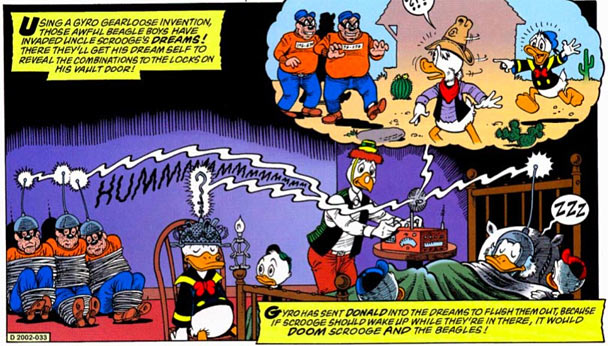
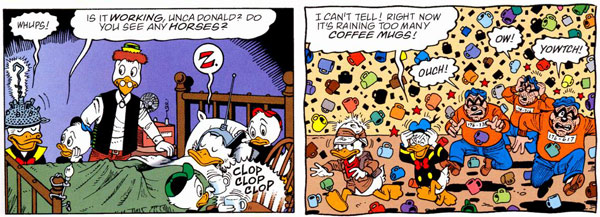
Many thanks to Videogum editor Gabriel Delahaye for having the balls to reveal the truth all others fear to blog: Christopher Nolan's Inception was nothing but a Scrooge McDuck ripoff. Read the full, original comic here: Uncle Scrooge in "The Dream of a Lifetime"


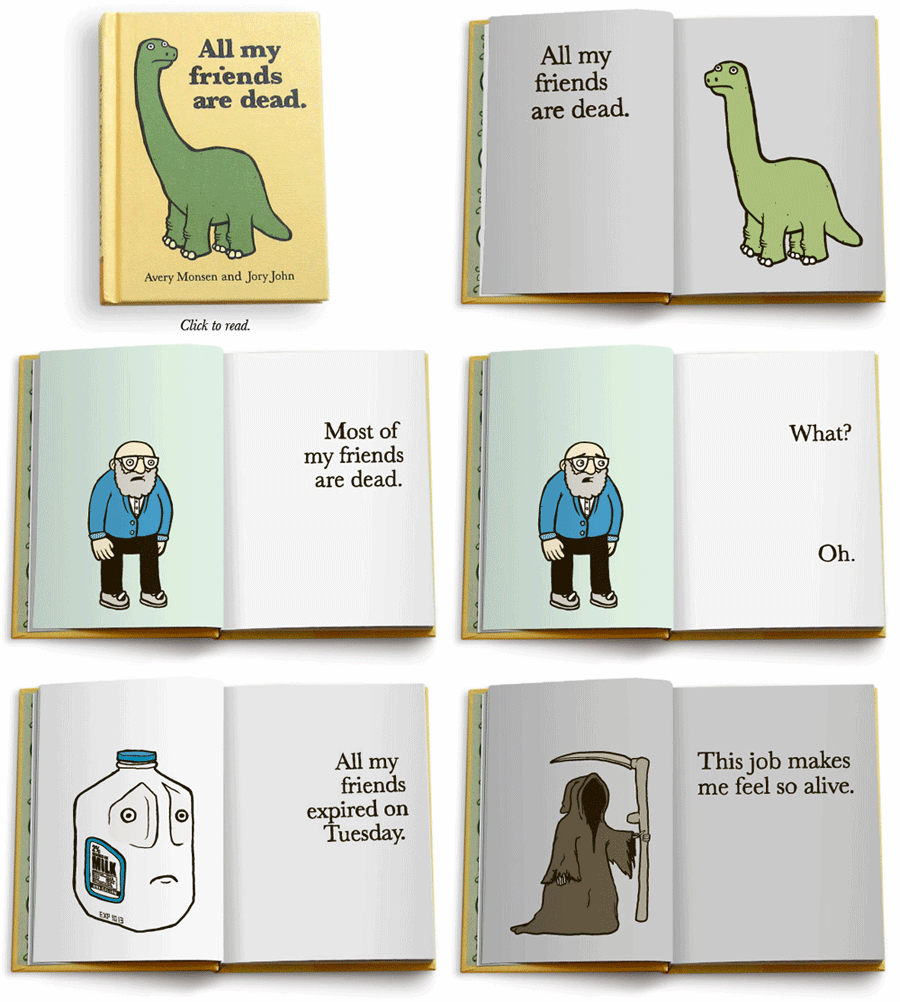
An animated gif made with the first 10 pages of Avery Monsen and Jory John’s book, All My Friends Are Dead…
[via the daily what]
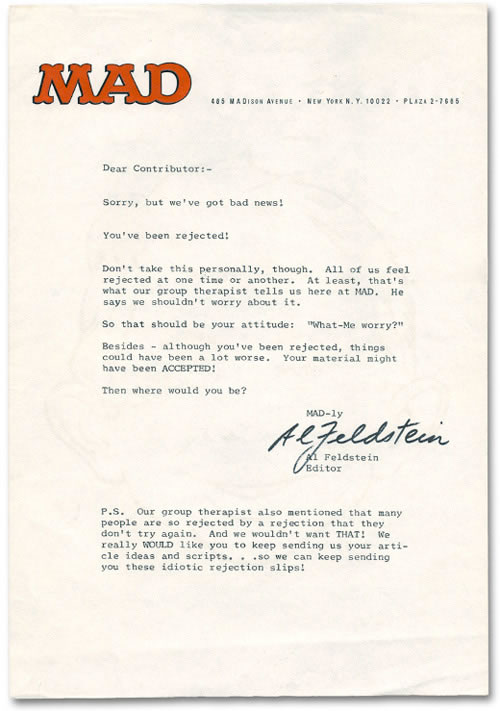
Leave it to Mad Magazine to craft a rejection letter that doesn’t leave you feel too rejected:
There’s nothing like a helping of light-hearted humour to ease the pain of rejection, as evidenced by this form letter from the offices of Mad magazine, one of the most influential humour publications ever released. The letter was sent to all unsuccessful submitters of material during the much-lauded reign of Al Feldstein.
From the always awesome Letters of Note – via Nerdcore

Photographer Sergey Larenkov uses computational rephotography (as shown above and explained here by Wired) to overlay extant WWII-era photographs on their corresponding modern settings. The results are both spooky and stunning:

The shots really do have to be seen large, so check out Larenkov's LJ page for the rest of 'em.
via gizmodo
 German scientists hit electrons with light and then measured how they soon they moved. The delay between the bombardment and the movement of those electrons is the shortest interval of time ever measured, which is 20 attoseconds. An attosecond is one quintillionth of a second.
When light is absorbed by atoms, the electrons become excited. If the light particles, so-called photons, carry sufficient energy, the electrons can be ejected from the atom. This effect is known as photoemission and was explained by Einstein more than hundred years ago. Until now, it has been assumed that the electron start moving out of the atom immediately after the impact of the photon. This point in time can be detected and has so far been considered as coincident with the arrival time of the light pulse, i.e. with “time zero†in the interaction of light with matter.
The scientists tested the assumption, and this is what happened:
Their measurements revealed that electrons from different atomic orbitals, although excited simultaneously, leave the atom with a small but measurable time delay of about twenty attoseconds.
In the comments, provide practical illustrations of the shortest intervals of time.
Link via Popular Science | Photo: Thorsten Naeser / Max-Planck-Institute of Quantum Optics