RSS
 

Author Archive

Did the Sultan of Brunei Buy 10 Aston Martin One-77s for His Billion-Dollar Car Collection?

29 Jul

Back in February we reported on the mysterious filthy rich individual who purchased 10 Aston Martin One-77 supercars, limited to just 77 examples, for $1.7 million apiece or $23 million in total including fees. Now educated insiders are speculating that the Sultan of Brunei bought the cars to add to his multi-billion-dollar, 7,000-strong car collection, the world's most expensive auto hoard. According to Guinness World Records the Sultan's collection includes over 600 Rolls-Royces, more than 450 Ferraris, 570 Mercedes-Benzes, 380 Bentleys, 170 Porsches, dozens of Koenigseggs, and 20 Lamborghinis to name a few. He owns several rare custom, one-off and concept cars, some worth tens of millions apiece, including a Ferrari Mythos, a Jaguar XJ220 by Pininfarina, a Bentley Java, a Bentley Dominator SUV, bespoke Rolls-Royce and Ferrari station wagons, a Porsche Carma and a Koenigsegg Agera. Known for buying multiple models of supercars in order to have one in every color, he owns several McLaren F1s, six Ferrari FXXs, four Ferrari F40s and three Ferrari F50s. The Sultan, who's worth an estimated $20 billion, stores the collection in five heavily-guarded airplane hangars and employs a team of mechanics and specialists to keep the cars in perfect working condition.

Filed under: ,

Did the Sultan of Brunei Buy 10 Aston Martin One-77s for His Billion-Dollar Car Collection? originally appeared on Luxist on Thu, 29 Jul 2010 18:02:00 EST. Please see our terms for use of feeds.

Read | Permalink | Email this | Comments


Add to digg Add to del.icio.us Add to Google Add to StumbleUpon Add to Facebook Add to Reddit Add to Technorati

Ferrari - Ferrari F40 - Rolls-Royce - Ferrari Mythos - Guinness World Records


The Amish Population Boom

29 Jul

Thanks to high birth rates and few people exiting the sect, the Amish population in the United States is surging:

The Amish population — a religious group that limits its member’s access to conveniences like telephones and electric lights — is growing at an estimated 5% a year and now stands at 249,500.

A new Amish settlement is being created at a rate of once every three weeks, the study found. Sixteen were established over the past year alone.

Researchers estimate that 85% of people who are raised Amish stay in the group as adults.

Link via Marginal Revolution | Photo by Flickr user Alotor used under Creative Commons license


When 2 dinosaurs become 1

29 Jul
2502278764_c5c517cd7a_o.jpg

Prepare to have your mind blown.

Certain dinosaurs—physically disparate enough that we've always thought of them as different species—may actually be the same animal at different stages of its life cycle. Also: Those big, protective-looking bone formations surrounding some dinos' heads and necks probably weren't all that useful as a defense against predators.

Case in point, triceratops. Or, maybe we should be calling it torosaurus now, I'm not sure. See, according to research done by scientists at Montana's Museum of the Rockies, the familiar triceratops is really just the juvenile form of the more-elaborately be-frilled and be-horned torosaurus.

This extreme shape-shifting was possible because the bone tissue in the frill and horns stayed immature, spongy and riddled with blood vessels, never fully hardening into solid bone as happens in most animals during early adulthood. The only modern animal known to do anything similar is the cassowary, descended from the dinosaurs, which develops a large spongy crest when its skull is about 80 per cent fully grown.

Scannella and Horner examined 29 triceratops skulls and nine torosaurus skulls, mostly from the late-Cretaceous Hell Creek formation in Montana. The triceratops skulls were between 0.5 and 2 metres long. By counting growth lines in the bones, not unlike tree rings, they have shown clearly that the skulls come from animals of different ages, from juveniles to young adults. Torosaurus fossils are much rarer, 2 to 3 metres long and, crucially, only adult specimens have ever been found. The duo say there is a clear transition from triceratops into torosaurus as the animals grow older. For example, the oldest specimens of triceratops show a marked thinning of the bone where torosaurus has holes, suggesting they are in the process of becoming fenestrated.

There are other species this might apply to, as well. Some with even bigger shifts in appearance.

While this is a Big Hairy Deal for dinosaur science, it also elicits a little bit of a "duh" moment when you go back and look at the animals in question. What you should really be getting out of this story is an illustration of how difficult it is to study a creature that's been extinct for millions of years.

After all—as my husband pointed out—nobody would be shocked to learn that a baby chick, an adult chicken, and plate of parmigiana were all the same animal. But that's because we've experienced chickens. Were an alien to drop in on Earth for one afternoon, they might be just as amazed at the life cycle of poultry as we are now at the triceratops/torosaurus'. Paleontologists are tasked with reconstructing the lives of animals nobody has ever seen alive. And that creates a world where the obvious just isn't.

New Scientist: Morph-o-saurs: How shape-shifting dinosaurs deceived us

(Via John Taylor Williams)

Image courtesy Flickr user lindseywb, via CC


Bugs Bunny at 70

29 Jul

The cartoon character Bugs Bunny turned 70 on Tuesday:

Bugs made his debut in the animated short film “A Wild Hare” on July 27, 1940. It’s in that film that he first pops out of his rabbit hole and asks Elmer Fudd in what has become his signature line – “Eh, what’s up, Doc?”

Though a rabbit resembling Bugs appeared in cartoons as early as 1938, animation historians consider “A Wild Hare” to be the first “official” Bugs Bunny short.

For about twenty years, I’ve advocated that Bugs appear on US currency as the quintessential American personality. Alas, this has yet to come to pass.

Link via Glenn Reynolds | Image: Warner Bros.


Anne Rice: 'I Quit Being A Christian'

29 Jul

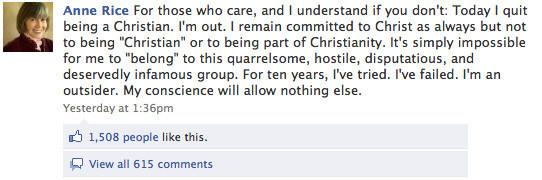
Anne Rice, the bestselling novelist most popularly known for "Interview with the Vampire" and her other creepy vampire novels, announced on Wednesday via Facebook that she has officially renounced Christianity. It's a bold move for the author who has become well-known for her vehement religiosity; the majority of her frequent tweets are related to religion in some way. The author has also recently launched a new series of novels about angels, which debuted in October 2009 with "Angel Time."

Rice declared on her Facebook account that she is "an outsider" in the Christian community:

I refuse to be anti-gay. I refuse to be anti-feminist. I refuse to be anti-artificial birth control. I refuse to be anti-Democrat. I refuse to be anti-secular humanism. I refuse to be anti-science. I refuse to be anti-life.

Rice affirmed that though she has decided to leave the Christian institution, she "remain[s] committed to Christ as always."


(via GalleyCat)


Are you the center of the Universe?

29 Jul

One topic which generated a lot of discussion at the Gravity and Cosmology meeting was the void model of the Universe. The basic argument is simple: the dark energy is an ugly addition to our cosmological standard model, with 70% of the energy density of the Universe some mysterious substance with weird properties. From a theoretical perspective, dark energy has the wrong density by many, many orders of magnitude, and worse, we may never be able to study it directly in the laboratory. Now suppose I told you I had a model which explained all of the observations, was based on general relativity, and appealed to no mysterious dark energy component (but still has dark matter, unfortunately). Sounds tempting, right? This is precisely what John Moffat, Chris Clarkson, Antonio Enea Romano, Chul-Moon Yoo, and others were advocating at the workshop (Kenji Tomita has also done a lot of work on this; the model has been around for decades). There’s one important caveat, however. The void model throws out the homogeneity and isotropy assumption. The Universe is now spherically symmetric, with a big hole in the middle. Even worse, we happen to be very, very close to the center of the hole.

ptolemyAs I discussed in a previous post, John Moffat argues that we shouldn’t be any more disturbed by this model than the standard model, because they’re both anti-Copernican: the void model in space, the standard model in time. As I discuss in that post, I’m not sure I completely agree with this. The fine tuning for the average void model is fairly involved. First, the matter density must be carefully set, as a function of radius, to agree with observation of the luminosity-distance relation. Then we have to be set down within roughly 1 Mpc of the center of the spherical void (which is at least a few Gpc on a side). If we were at a random spot in the Universe, there’s a probability of much less than 1 in 10 billion that we’d end up sufficiently close to the center of a void (assuming such voids existed). On the other hand, the standard Lambda CDM model of cosmology requires fine-tuning of the cosmological constant to a tiny, but non-zero number. To some this is unbearably ugly. But, at the end of the day, it’s just one additional, arbitrary number.

All this being said, what’s great about void models is that they aren’t just a philosophical alternative to the standard model. This is physics. There are measurements that can be done to differentiate (and possibly falsify) these models. Stebbins & Caldwell have come up with one particularly interesting approach, exploiting the fact that “random” observers in a void model see a different sky (and hence, a different CMB) from the one we do in our privileged position. It is surprising that a model so radically different from our standard model is still viable (although under pressure). Tests over the next few years are expected to distinguish these models, and we’ll know definitively whether we are at the center of the Universe.


In North Korea, Even the HTML Coding Is Very Strong [HTML]

29 Jul
Hmmmm, I'm not sure what message they're trying to send with the source code of the official webpage of the Democratic People's Republic of Korea. [Daily WTF via The Daily What] More »


Sand Drawings :: Jim Denevan

29 Jul

JimDenevan_01
Jim Denevan is an artist based out of Santa Cruz, California who travels the globe creating large scale pieces of land art.  Drawn on sand, earth, and ice, these incredible works of art are both created and destroyed by the very materials that enable their existence.

JimDenevan_02
Unlike Robert Smithson, known for the Spiral Jetty, Denevan's work feels less about sticking it to The Man (the over-commercialization of art) and more about the ephemeral nature of man himself.  Or, maybe he just does it because it looks cool.  Thoughts?

See more: www.jimdenevan.com

More pics after the jump!

JimDenevan_03
JimDenevan_04
JimDenevan_05
JimDenevan_06
JimDenevan_07
JimDenevan_08


Ten key indicators show global warming “undeniable”

29 Jul

By Deborah Zabarenko, Environment Correspondent

WASHINGTON (Reuters) - Melting glaciers, more humid air and eight other key indicators show that global warming is undeniable, scientists said on Wednesday, citing a new comprehensive review of the last decade of climate data.

[More]


10 Reasons Why Software Project Estimates Fail

29 Jul

Think about the web and software projects you’ve completed. How many were delivered on time and on budget? How many estimates were accurate? IT projects are notorious for over-running, and here are several reasons why it occurs…

1. The project is poorly scoped
How can you estimate time on a project when you don’t know what that project is? It’s rare to find a client who appreciates exactly how their system should work.

Almost every large project I’ve undertaken has requested “flexibility”. In other words, the client wants the system to handle anything they want at any future point in time — even though they have no idea what those features might be. Flexibility is not a requirement!

2. Development time is estimated by non-programmers
If you’re not a programmer, don’t guess at development times. A project is doomed the moment a manager writes their own fictional estimate. At best, they’ll be completely incorrect. At worst, the programmers will be tempted to prove them wrong.

3. Developer estimates are too optimistic
Developers think in terms of coding hours. Time passes quickly when you’re in the zone and it’s difficult to assess your own speed. Appreciating the speed of other developers is impossible.

Many developers are over-optimistic. They tend to forget the softer side of the development process, such as project management, collating requirements, discussions with colleagues, absences, PC problems, etc.

4. The project is not adequately dissected
Be wary if the development estimate for an individual feature exceeds a week. That chunk should be sub-divided further so the developer can analyze a complex problem in more detail.

5. Estimated time is used
Give a programmer 5 days to complete a task and it’ll take 5 days. Software development is infinitely variable and any code can be improved. If a developer takes 3 days to finish the task, they’ll spend the remaining time tweaking it or doing other activities.

Unfortunately, this results in a situation where estimates become the minimum number of development days. The actual delivery time can only get worse.

6. More developers != quicker development
A 100-day project will not be completed in 1 day by 100 developers. More people results in an exponential increase in complexity. See Why Larger Teams Do Not Result in Faster Development…

7. The project scope changes
This is perhaps the most irritating problem for a developer. A feature is changed or added because customer X has requested it or the CEO thinks it’s a cool thing to do.

Is the impact of that new feature documented?…

8. Estimates are fixed
Estimates should be continually assessed and updated as the system development progresses. Programmers often believe they can make up lost time — it rarely happens.

9. Testing time is forgotten
It’s impossible for a developer to adequately test their own code. They know how it should work, so they consciously or sub-consciously test in a specific way. In general, you can expect to spend another 50% of the development time on testing and debugging.

10. Estimates are taken too literally
Non-programmers rarely appreciate the complexity of software development yet few businesses plan for schedule slippages. The project often sits at the bottom of a huge unstable tower of other activities, such as literature printing, marketing, distribution, etc.

Development hold-ups can cause a costly chain reaction of delays. Unfortunately, it becomes easy to blame the programmer at the bottom of the pile. That’s doesn’t bode well for future projects — the programmer will either refuse to provide estimates or inflate them dramatically.

Have you encountered other reasons why project estimates fail?

Related Posts

  1. How To Estimate Time For A Project
  2. Has project management gone out the window?
  3. Windows 7 Launch Marred by Software Pirates