RSS
 

10 ways you can help to build the Internet

01 Apr

On November 22, 1977 a van drove onto Interstate 280 and into history. Most histories of the Internet begin with the ARPANET, the US Defense department network that gave birth to today’s Internet. But the true Internet began when that van used TCP to bridge between three networks: ARPANET, a satellite network and a packet radio network. It’s this networking of networks — or internetworking — that first demonstrated the future Internet.

It was only in 1996 that this moment was recognized for its historical significance, and in 2007 it was celebrated with a special event at the Computer History Museum. Reflecting on those early days of the Internet, Vint Cerf — part of the original van crew, and by 2007 the chief Internet evangelist for Google, was quoted in a news story as saying: “A lot of people think the Internet just happened. But it was a lot of hard work.”
Cerf may have been speaking in the past tense, but the work isn’t done: new technologies and standards are developed all the time. And these are still early days: of the 2 billion people online today, only half were online in 2006. You can reckon that we’ve still got lots of growth ahead, not just in how many of us are online but in what we do there and how we do it.
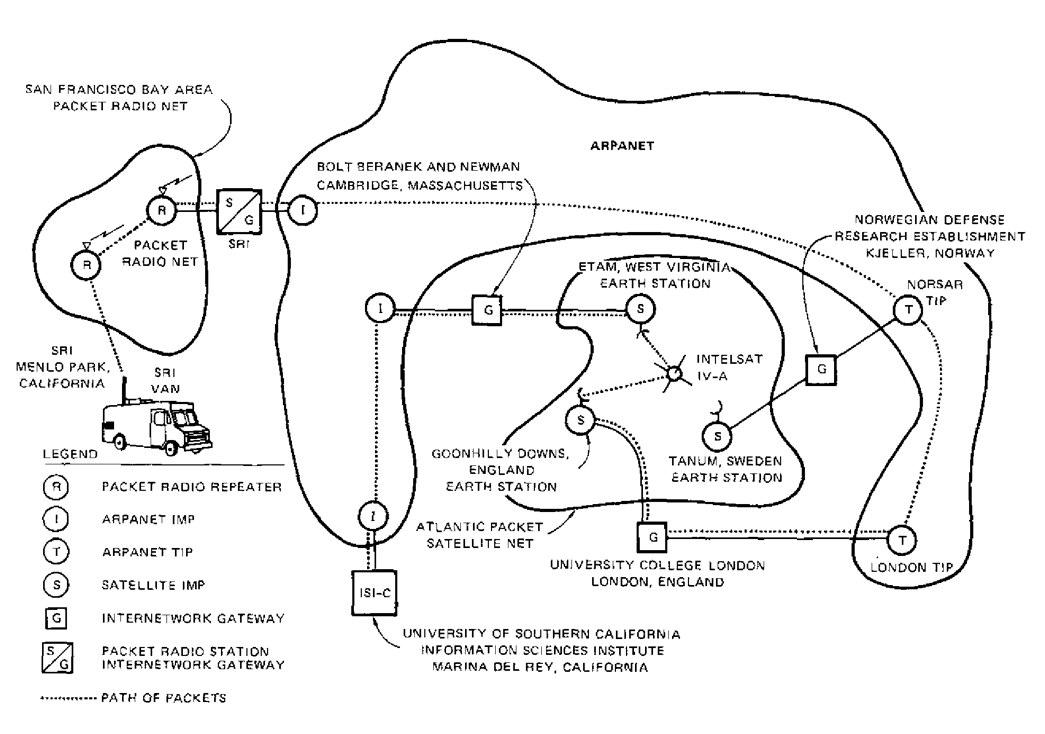
Map shows connections made by SRI packet van experiment

Network map for packet van demonstration

When Cerf and his collaborators took to the Interstate, the hard work of creating the Internet was best left to the programmers. Today, thanks largely to social media, user-generated content and the emergence of the programmable web, you can help to create the Internet without writing a single line of code. You can help create the online world in which you and your children are going to live. You can take on some of that hard work. Here’s how:

  1. Tithe your time online. The Internet is not a religion (usually) but it is a community. The same way that members of a religious community might contribute 10% of their income to the church, members of the Internet community can contribute 10% of their time online to the health of the network itself. If the average American now spends 13 hours a week online, that means dedicating about 80 minutes to the kinds of active contributions described in this list.
  2. Be a good colonist. I wanted to tell you that you’re the Columbus of the Internet, but let’s face it, the Columbus thing didn’t work out too well for a whole lot of people. So do Columbus one better: as you help to discover this new world of the Internet, do it without the evangelizing, land-stealing and disease-spreading. Get to know and appreciate what already exists online and think about how to add to it. Try not to bulldoze anything (or anyone) who is already there.
  3. Make a node. The Internet is not a series of tubes. It’s a series of nodes and connections. You can make one of those nodes by creating your own blog or web site. It doesn’t have to be fancy. It just has to be useful or interesting to at least one other person.
  4. Aim for 49%. That’s the maximum amount of your online energy that should go into promoting the Brand of You. (If you think you can keep it to 48%, or maybe even want to be a human being instead of a brand, so much the better.) The other 51% can go to talking about other people and ideas and maybe even to just listening. This is the hard work of building an Internet that is not simply a monument to narcissism.
  5. Make a connection. Remember how the Internet is both nodes and connections? That’s not just a description of the Internet’s underlying architecture: it’s also a description of the way it connects information and people. You can make a connection between two pieces of information by posting a hyperlink: that is the most basic level at which the Internet connects something over here to something over there. Or you can make a connection between two people by introducing them via e-mail, tweet or blog post.
  6. Tell us how you did it. If you’ve ever been delighted to find a tech solution, recipe or business tip online, you know that a big part of the Internet’s value is the help it provides on just about any topic. You can help make our global repository of how-to information as complete as possible, by sharing the step-by-step version of how you’ve done something. It could be how to got your kid to sleep through the night, how to set up an RSS to email newsletter, or how to perform an emergency tracheotomy. Write (or photograph, or video) how you did it, and put it online.
  7. Report a problem. People often say that one of the Internet’s strengths is that it is self-healing. For example, if someone writes something incorrect on a Wikipedia page, somebody else will correct it. But as that example suggests, the Internet isn’t self-healing: it’s healed by the active participation of people who take the time to correct a mistake or solve a problem. And the first step to solving a problem is knowing it’s there. Whether it’s taking a moment to report a Twitter spammer, capturing a screenshot of an error message and sending it to the site in question, or letting someone know that you got a 404 on their blog, reporting a problem can help keep the Internet shipshape. If they don’t know it’s broke, they can’t fix it.
  8. Answer a question. How long to wait before sending a follow-up email when submitting a résumé? How do the Chinese concept of the self differ from the Western view of the self? How can I install Plex on my AppleTV? If the Internet now has 2 billion users, you can figure it’s got at least that many questions. Answer one every week.
  9. Add an issue to your basket. Political scientists like to talk about the “basket of preferences”: the assortment of positions on a range of issues that determine how a given person votes or engages in other kinds of political action. If your basket of preferences currently includes (let’s say) lower taxes, the legalization of gay marriage and stronger controls on carbon emissions, consider adding an Internet-related issue to your basket. It might be online privacy or net neutrality or Internet freedoms in China. Pick an issue and help to shape the policy environment for the Internet by voting or volunteering for politicians who champion that issue, by supporting lobbying efforts, or by engaging in direct action.
  10. Make something. I know, I know: you’re not a programmer. Neither am I. But you can actually help develop some part of the Internet’s technical assets, whether that’s by creating a customized widget or documenting a web application or making (and sharing) a pipe. Try it out and you will feel like a super stud. And you will feel just a little bit more part of the team that is making the Internet.

If you’re the kind of person who has always dreamed about moving into fully finished, fully furnished home, with everything supplied down to the last washcloth and spoon, then by all means sit this one out and let the rest of us do the hard work. But if you’re the kind of person who’s always dreamed about designing and building your own home, then roll up your sleeves: you’re going to be living a big chunk of your life online, and you get to help decide what that living space will look like.

And if you’re the kind of person who has always dreamed of living in a van…well, the Computer History Museum has just the place.
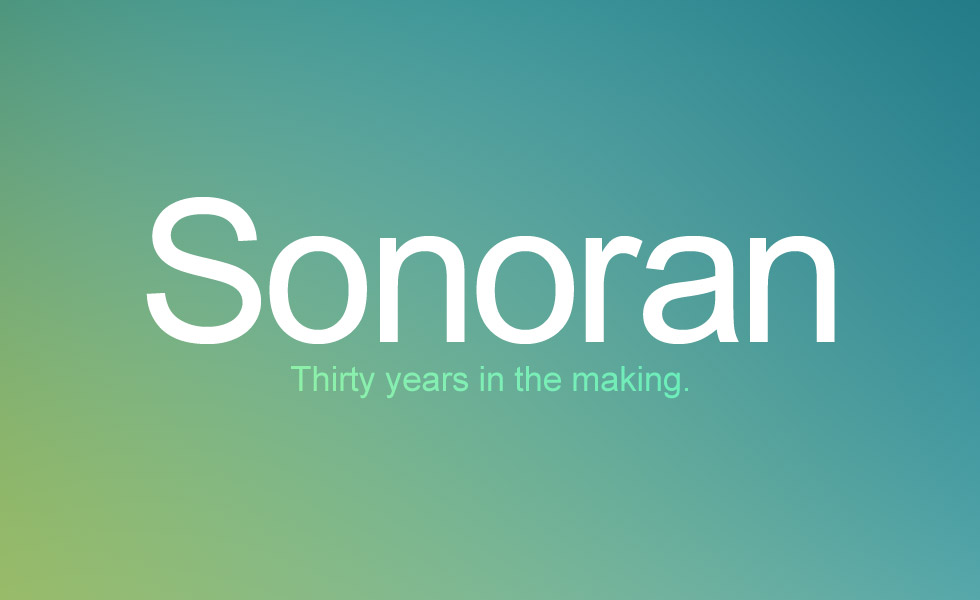



Sonoran: The next Helvetica

31 Mar

Image

Introducing Sonoran, 2011’s most anticipated typeface release.

Nearly thirty years in the making, the highly anticipated Sonoran is finally here.

Typeface designers Robin Nicholas and Patricia Saunders first began work on Sonoran in the early 1980s, drawing inspiration from the classic Swiss typeface Helvetica. “Helvetica is a great font, people really love it. But it does have its flaws,” says Nicholas. “With Sonoran, our main goal was to fix Helvetica’s mistakes.”

Designed in 1957 by Max Miedinger, Helvetica is one of the most commonly used typefaces today. Itself based on Akzidenz-Grotesk, Helvetica was designed as a neutral typeface that could serve a variety of uses. Over the years, the typeface has turned into an modern icon of sorts, becoming the first font acquired for the Museum of Modern Art’s permanent collection. Its legacy was documented in the 2007 film Helvetica, directed by Gary Hustwit.

Despite Helvetica’s success, graphic designers have struggled for years with its quirks.

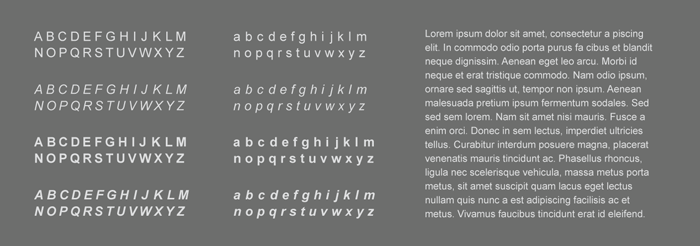
With Sonoran, attempts have been made to solve these problems. Sonoran’s improvements are subtle, yet important, remaining metrically equivalent to Helvetica. When we inspect individual letters, you can really see how the typeface was improved:

Helvetica (top) compared with Sonoran (bottom)

“Helvetica is [almost] our ultimate typeface: objective, powerful, and delicate according to weight,” says respected designer Massimo Vignelli, a known Helvetica proponent. “If only its capital G didn’t have that annoying spur,” adds Vignelli, who once hired an intern for the sole purpose of de-spurring Helvetica. “Sonoran is a godsend.”

It’s not everyday we hear such high regards for a new typeface—it’s already been called the world’s first perfect typeface.

Reacting to the news, it seems some type foundries have taken down their websites today, perhaps to brace for the fallout—or as a sign of giving up.

“We’ve solved typography,” notes Saunders, one of the typeface’s designers.

Part of Sonoran’s success can be attributed to its robust multilingual character support (covering Arabic, Cyrillic, Greek, Hebrew, Thai, and Turkish, to name a few), which is becoming increasingly important in today’s global marketplace. The typeface is also available in several weights and widths, including Narrow, Light, Black, Rounded, and Monospaced.

Image

Image

Filmmaker Gary Hustwit, who first learned about Sonoran during the filming of Helvetica, has been closely following the development of Sonoran ever since. With the typeface now complete, Hustwit announced a special director’s cut of Helvetica, part of the Design Triliogy boxset. “Sonoran is rewriting history, I had to tell the whole story,” says Hustwit. The special edition box set is due out late 2011 to early 2012.

Microsoft has also announced it will include Sonoron as its default operating system font starting with Windows 7.1, as well as with its latest Zune Phone.

The typeface will be released for public sale Monday, available from Fonts.com.


UPDATE: The truth is out, see Sonoran: The hidden truths (April 4, 2011).


U.S. Government Open-Sources IT Dashboard to Help Cut Tech Costs

31 Mar


The United States government has made its IT Dashboard, a cost-cutting tool for federal transparency, freely available for anyone, especially other governments, to use and customize.

The IT Dashboard gives citizens important information on how the government uses tax money for technology initiatives across various agencies. Citizens can see how government investments are paying off, and they can compare types of IT spending over time by accessing easy-to-reach charts and graphs.

But this clarity of and access to vital information isn’t just good for citizens; it’s also used by the Federal Government, including Congress, to make important decisions about IT budgets and spending. Open-sourcing this cost-saving tool is part of the government’s larger plan to save on IT by eliminating redundant efforts. In other words, the IT Dashboard already exists and has been paid for, and the government isn’t going to hide that light under a bushel.

Here’s a video demonstrating some of the features of the federal IT Dashboard:

The government is working with Code for America for this release. In am announcement, CfA said, “The IT Dashboard was a major component of the process the Federal Government employed to save over $3 billion in just its first two years of deployment.”

In addition to the Dashboard, the government is also open-sourcing the complementary TechStat Toolkit, a set of tools and processes for reviewing any yellow or red flags that might pop up while using the Dashboard.

In this video, U.S. CIO Vivek Kundra talks about the results the government has seen by using the IT Dashboard and how those results were achieved:


But open-sourcing something like this isn’t a cakewalk. The government worked with FOSS and government experts, Code for America and CfA’s Civic Commons project to get the job done.

Project lead Karl Fogel wrote on the Civic Commons blog, “We knew from the beginning that a high-profile project can’t be open sourced casually. It’s not enough to just put an open license on the code, move development out to a publicly visible repository, and call it done.”

He continued to note that for the Dashboard, Civic Commons had to ensure that all the code and documentation was safe for public use (i.e., not classified or a government secret) and audit the code; reduce dependencies on proprietary libraries; write documentation; ceate non-sensitive, non-classified sample data; work with the Drupal community; and much more.

Interested parties can download the Dashboard code now at SourceForge. While the Dashboard is intended to help governments cut costs and manage IT budgets, we can see such tools coming in handy at just about any large company, tech or otherwise.

Image courtesy of iStockphoto, GottfriedEdelman

More About: code for america, it dashboard, open source, U.S. government

For more Dev & Design coverage:


Zetros, Zetros, Golly! Ultra-Luxury Mercedes-Benz 6×6 RVs Tackle Mongolian Wilderness (And We’ve Got Interior Photos)

31 Mar

In Ulaanbaatar, Mongolia, there are a couple of guys who’ve done well for themselves in the business world. One owns a brewery that specializes in German-style beer; the other made his bones in the mining industry. Sometimes, they like to use eagles to hunt for wolves in the Altai mountains.

Now, after a long day of raptor-vs.-lupine action, your average Mongolian businessman might be content to retire to a lean-to by the side of his Land Rover, settling down with his companions and birds of prey for the night. These two, however, have decided to wet-sand the bejeezus out of the concept of roughing it. They bring the indoors with them, bolted to the chassis of Mercedes-Benz Zetros 6×6 trucks. Equipped with a 7.2-liter diesel inline-six that thwacks out 959 lb-ft of torque, the Zetros has three locking differentials and routes the power to all six wheels through a transfer case with a 1.69:1 low ratio.

The interior’s where things really get nutty. Far more opulent than our beloved GMC MotorHome, these custom-built living stations were designed and constructed by Hartmann in Alsfeld, Germany and outfitted by RV-interior specialist Huenerkopf. They feature fully insulated walls, furniture designed to withstand the harsh realm of the Gobi desert, a fully equipped galley, and perhaps most important, heated marble floors and a combo bidet/toilet in the head. One of the trucks also features a parking bay for a quad.

Tech amenities include two TV monitors (in 40- and 46-inch diagonals)—ironically seen in these pics showing a documentary about the wonders of the wild world—satellite communications and a Mac-mini based media hub plugged into a Bose sound system. It’s all run off four 220-Ah batteries charged automatically by a diesel generator and two 80-watt solar panel units mounted on the roof.

In the 1982 cinema classic Conan the Barbarian, the eponymous hero spends some time bunking with a Mongol horde. After a day of battle, a general asks his jubilant charges a simple question, “What is best in life?”

A proud Mongol warrior immediately replies “The open steppe! Fleet horse! Falcons at your wrist and the wind in your hair!”

“Wrong!” interjects the General. “Conan! What is best in life?”

“To crush your enemies, see them driven before you, and to hear the lamentation of their women!”

What if the answer were actually both? These custom Zetros trucks may well be your rides.

(Check out our gallery below for even more photos.)


Interview with a Successful 10 Year Old Blogger

31 Mar

I often get asked a lot about what it takes to make a blog, and if it’s really possible to make money online. The answer is always the same… it all depends on the amount of work and time you put into it. It is possible to build a business through blogging, affiliate marketing and have it become your full time job. The interview below is with Bradley Nordstrom, a 10 year old affiliate and blogger who is very well known for commenting on several Internet marketing blogs. While juggling his homework, after school activities and just being a kid… we were lucky enough to snag this exclusive interview and I think you’ll find that it is a very entertaining read and a great look into the life of one of the youngest affiliates and bloggers the world has ever known.

Tell us a little about your background info about yourself. Where are you from? How old are you? How long have you been using the Internet?
I am from Wellington, Florida and I still live there now. I am an awesome 10 year old and my birthday is October 20th. I have been using the internet for 5 years now. I first started blogging with my blog cthen when I turned 9 I got into affiliate marketing. Affiliate marketing is one of the most important things I do to make money now next to blogging. My parents and I also run an infotainment paper called “Tidbits”. You might have heard of it.

What accomplishments so far are you most proud of?
The accomplishments I am most proud of is being a young 10 year old that makes over $5,000 a month. I am also proud of being invited to People To People International which is a organization that picks kids from all over the world and those kids get to go to different countries. I will be going to Ireland, England, Wales, and Scotland.

Your main website is BradleyIsCool.com. How cool are you and how did you get to be so cool?
I am awesomely cool and I got this cool because I have a cool blog. My cool blog helped me get really cool because my blog has cool blog posts.

How did you get to be so good at creating websites at such a young age?
Well it all started at “StarBucks”. My dad owned a company that created websites. I was really bored at Starbucks so I asked my dad if he could teach me how to make a website and he said yes. So from that day on he kept teaching me all kinds of stuff I couldn’t even understand. From that day on whenever we went to the bookstore I got either a HTML or CSS book that taught me everything I needed to know to make my website the best in the world.

How did you come to learn about affiliate marketing? Is this something you want to do when you grow up?
I learned about affiliate marketing when I was 8 1/2. My dad was an affiliate marketer when he was young and he taught me some affiliate marketing. Everyday after school he would teach me one part about affiliate marketing.

What do you think it takes to be successful as an affiliate?
To be a successful affiliate you have to be able to sell at least one product a day. You also have to be able to like being an affiliate.

What have been your biggest failures and frustrations with your websites and schoolwork?
My biggest failure was not listening to my parents for my science project. I had a different answer than they had and I was wrong and they were of course right. My biggest frustration I had with my website bradleyiscool was not posting in 3 weeks! I was on vacation and had no access to the net so I just had to deal with it.

What have you been up to recently? What projects are you working on?
I am creating a business that is going to make wordpress blogs for people. The name of the business is WildWebPro.

What are your greatest strengths?
My greatest strengths are meeting people and making friends.

What are your greatest weaknesses?
Milk is probably my greatest weakness. I can’t stand the look and taste of milk.

What motivates you?
Being invited to special groups pretty much is the only thing that motivates me.

What is the best advice you’ve been given and try to apply it to your life?
My dad teaching me how to blog is the best advice I ever got in my life pretty much.

Who has impacted you most in your life, and how?
My dad because if it wasn’t for him I wouldn’t be getting this interview right now.

Where do you want to be 10 years from now?
I would like to be living on Hibiscus Island in Miami and have a few high end cars like maybe a 7 series BMW and a few Lambo’s and Ferrari’s. I would also like to make a million dollars a day. I actually know someone that does make a million dollars a day.

How do you like to spend you free time? What do you do for fun?
I like to spend my free time sleeping. What I do for fun is blog. Blogging to me is my favorite thing to do. It is fun and is easy to do. I can tell my fans that I have been to disney world or I can tell them about affiliate marketing.

As you get older, what career choices do you think you will make?
I will probably have the same career choice as a blogger and being an affiliate marketer. I think I might own a multi-blillion dollar business.

Feel free to leave any questions you may have for Bradley, as I’m sure he will be active in the comments area. You can also visit Bradley’s blog at http://www.bradleyiscool.com.


Copyright © 2011 Blogging Tips. This Feed is for personal non-commercial use only. If you are not reading this material in your news aggregator, the site you are looking at is guilty of copyright infringement. Please contact us so we can take legal action immediately.

POSTLINK

Blogging Tips Books
A selection of e-books to help you improve as a blogger. Find out more at www.bloggingtips.com/books/


Today’s New Funny Pic

30 Mar

Simba


What if JC Penney Link Buying is Just the American Way?

30 Mar

British SEO tools company, Linkdex, has released data to Search Engine Watch that suggests, in their assessment, that JC Penney's link buying strategy was simply just good business sense.

Linkdex (not to be mistaken with Searchdex, the company accused of brokering the links), argues that from their analysis of competitor links JC Penney saw a gap in the market and aggressively chased the opportunity. Perhaps, the SEO should be commended for clearly understanding how Google's algorithm works, rather than villified for using 'dirty little secret' tactics that are proven to work and generate money? After all, it's not like anyone can get arrested for buying and selling links. Not yet, anyway.

Click to read the rest of this post...


Meet +1: Google’s Answer To The Facebook Like Button

30 Mar
Nearly a year after Facebook Like buttons spread out across the web, Google has announced its own rival, the +1 button. It launches today as part of Google’s search engine, allowing you to “+1″ the search results and ads that you like. And in a few months, it’ll be arriving...

Please visit Search Engine Land for the full article.


Are You Sure It’s Not a Banana?

30 Mar

funny graphs - Are You Sure It's Not a Banana?

‘Cept Banana Is Weird in English Too


Graph by:

nelde

Submitting 1 LOLVoting 100 TimesVoting 10 Times

Via: made it myself


‘Scam’ Keyword Suggestions Vanish from Google Autocomplete

30 Mar

Google's autocomplete feature no longer contains the word scam. The autocomplete feature offers results based off search volumes (i.e., if you're seeing something suggested, it is being heavily searched for). However, search queries containing the word "scam" are now filtered out, forcing users to type in scam for themselves rather than see it offered as a top suggestion.

Click to read the rest of this post...