RSS
 

Tiny Spheres Turn Regular Microscopes Into Nanoscopes

01 Mar

Ordinary microscopes can see 8 times more minutely than known physical limits if miniature glass spheres are sprinkled onto samples, according to a new study.

The cheapest and most common microscopes use white light to magnify objects, but the nature of light and the limitations of our eyes mean those microscopes can’t image things smaller than bacteria. Other microscopy techniques, which use lasers, metamaterials and electron beams to image microscopic and nanoscopic worlds, can exceed such limits. But they are difficult, time-consuming and expensive to use, and they can kill live samples.

Glass microspheres about the size of red blood cells, however, described March 1 in Nature Communications, act like tiny magnifying glasses and bring normally invisible structures into sight. Stitching the microspheres’ images together with software could create unprecedented white-light photos.

“We have broken the theoretical limits of optical microscopy in white light,” said engineer Lin Li of the University of Manchester, a co-author of the study. “The surprising thing is the simplicity. One hundred dollars buys you about 100 million microspheres. Using conventional optical microscopes, almost anyone can do this.”

The microspheres may allow microscopes to image viruses in action or the insides of living cells. But the technique may not be as simple to use as the study’s authors say.

An independent group of microscope experts at Purdue University, led by physicist and engineer Vladimir Shalaev, couldn’t replicate similar images on their first attempt. But Shalaev said they’re working with the paper’s authors to be certain they did it correctly.

“It can be very hard to reproduce new experiments,” Shalaev said. “I have to admit this all sounds too good to be true. But if it is true, it’s going to be a huge, huge development.”

Microscope resolution is limited by diffraction, or the bending and spreading of light when it encounters obstacles like glass. What we see through microscopes is also restricted by cells in the eye’s retina, which can only detect light with wavelengths between 390 and 750 nanometers (between violet and red colors, respectively).

Image: Nature Publishing Group

These limitations prevent us from directly seeing objects smaller than 200 nanometers — just larger than a rabies virus or Mycoplasma, the smallest-known bacteria. Physicists and engineers have circumvented the 200-nanometer barrier with electron microscopy, laser fluorescence and nanoscale metamaterials, but they’re expensive, kill live samples or are difficult to use. So Li and his colleagues sought a new method.

In one experiment with glass beads between 2 microns and 9 microns wide, they could see 50-nanometer-wide holes in gold foil, or 8 times beyond the limits of conventional microscopy (image below). They were also able to see the tiny data grooves on a Blu-Ray disc (image above).

“This is quite cheap and easy to implement, while the alternatives are far more expensive and complicated,” Li said.

Physicist and engineer Igor Smolyaninov of the University of Maryland, who wasn’t involved in the research, has used metamaterials to image objects as small as 70 nanometers in size. He doesn’t think the new results are unreliable or untrue, but does see some limitations to the technique.

“They looked at artificial structures. Metal lines, holes and such. These are not a virus or bacteria, which are much, much more difficult to see because they move around,” Smolyaninov said. “I tried to do this before but couldn’t convince myself it was real. If they can pull it off, I’ll be extremely happy.”

Image: Top row: Three blocks of lines etched into a metal surface, as seen with a scanning electron microscope, with bunched-up microspheres covering the bottom block (left). The top blocks of lines aren't visible with a light microscope, but under the microspheres they are (right). Bottom row: A gold surface with 50-nanometer holes punched in it, as seen with SEM. A microsphere covers the bottom right (left). The same mesh, with the holes visible under the microsphere with a light microscope (right). Nature Publishing Group

Image: Top row: A Blu-Ray disc’s 100- and 200-nanometer grooves under a Scanning Electron Microscope (left). The same grooves are visible using microspheres with a light microscope (right). Bottom row: A 1,000-nanometer star etched into a DVD under SEM (left). The same star as seen through a microsphere (right). (Nature Publishing Group)

Citation: “Optical virtual imaging at 50 nm lateral resolution with a white-light nanoscope.” Zengbo Wang, Wei Guo, Lin Li, Boris Luk’ yanchuk, Ashfaq Khan, Zhu Liu, Zaichun Chen &
Minghui Hong.
Nature Communications,  Vol. 2 Issue 218. March 1, 2011. DOI: 10.1038/ncomms1211

See Also:


Word lengths are optimized for efficient communication [Psychological and Cognitive Sciences]

01 Mar
We demonstrate a substantial improvement on one of the most celebrated empirical laws in the study of language, Zipf's 75-y-old theory that word length is primarily determined by frequency of use. In accord with rational theories of communication, we show across 10 languages that average information content is a much better predictor of word length than frequency. This indicates that human lexicons are efficiently structured for communication by taking into account interword statistical dependencies. Lexical systems result from an optimization of communicative pressures, coding meanings efficiently given the complex statistics of natural language use.


WPS Portal and WCM

01 Mar

WPS Portal and WCM

Updated Collection of Feeds for your Google Reader
  • Base22 - Enterprise Web Evolution
  • The Tech Connection
  • Portal Solutions Blog
  • Uploads by IBMWebSpherePortal
  • Best Practice : WebSphere Portal & WCM
  • The Connections Blog
  • Twitter: Base22
  • A Portal to a Portal
  • Cody Burleson (cody_d_burleson) on Twitter
  • Latest News from WebSphere Journal
  • WebSphere Community Blog
  • WebSphere Notes
  • Lotus Connections wiki
  • Lotus Connections Wiki - Edits
  • WebSphere Portlet Factory wiki
  • WebSphere Portal wiki
  • WebSphere - WebSphere Application Server
  • Ben Shoemate
  • Ed Brill
  • developerWorks: Message List - WebSphere Portal
  • IBM developerWorks : Lotus
  • Lotus Rock Star
  • IBM Redbooks | Just Published
  • Support Forums : Thread List - News
  • WebSphere-World
  • WebSpherePower Magazine
  • The WebSphere Portal Blog
  • Google Alerts - lotus connections
  • Google Alerts - websphere portal
Preview this bundle


WPS Portal and WCM

01 Mar

WPS Portal and WCM

Feeds I read in Google Reader on IBM Websphere Products
  • The Tech Connection
  • Portal Solutions Blog
  • Uploads by IBMWebSpherePortal
  • A Portal to a Portal
  • WebSphere Notes
  • Lotus Connections wiki
  • Lotus Connections Wiki - Edits
  • WebSphere - WebSphere Application Server
  • Ed Brill
  • developerWorks: Message List - WebSphere Portal
  • IBM developerWorks : Lotus
  • Google Alerts - lotus connections
  • Google Alerts - websphere portal
Preview this bundle


Re: theme policy -import xml giving FileNotFound Exception

01 Mar
Hi Jim,
Hopefully by this week i will be given admin access for our test portal by the admin team.Once I get that i will try it and see how it goes. Will keep you posted with the status.

thanks


Have data graphics progressed in the last century?

01 Mar

Received a wonderful link via reader Lonnie P. to this website that presents a historical reconstruction of W.E.B. DuBois's exhibit of the "American negro" at the 1900 Paris Expo. Amusingly, DuBois presented a large series of data graphics to educate the world on the state (plight) of blacks in America over a century ago.

You can really spend a whole afternoon examining these charts (and more); too bad the charts have poor resolution and it is often hard to make out the details.

***

Judging from this evidence, we must face up to the fact that data graphics have made little progress during these eleven decades. Ideas, good or bad, get reinvented. Disappointingly, we haven't learned from the worst ones.

Exhibit A 

  Dubois_a

(see discussion here)

Exhibit B

Dubois_b

 (see discussion here)

Exhibit C 

  Dubois_c

(See discussion here.)

Exhibit D

Dubois_dd
 (see the Vampire chart here)

Exhibit E

Dubois_e
(see the discussion here.)

Exhibit F

Dubois_f
(see discussion here.)


IBM: Why We’re No Google or Bing

28 Feb
While IBM could probably use Watson technology to power a public search engine, it seems they have no interest in unseating Google.

Read | Permalink


ASSISTING IT PROFESSIONALS SINCE 1999
You are invited to visit the largest directory of IT newsletters on the 'Net -- where IT newsletters, whitepapers and RSS feeds from elite publishers are listed.

FreeTechMail is a unique place to view sample newsletters and RSS feeds as well as subscribe and manage your newsletter subscriptions.

Find out why 2.6 million IT professionals use FreeTechMail. Visit today.


Typography Deconstructed Poster

28 Feb

Ready to pump up your type vocab and sound smart next time you bump into Matthew Carter? Well then, this beauty of a poster designed by Drew Binkley at 38pages is just for you. They have a nifty site called typographydeconstructed.com with great typographic anatomy content. This poster is for sale there too – ready to release the inner type freak in all of us.  Get yours with promo code SOFMARCH2011 for good for $10 off all of March.

We letterpress printed this poster on our Heidelberg 21 x 28 cylinder. You can see in the photo details, the polymer plate is positioned in the press on a custom made full size 21 x 28 inch Boxcar Base. The poster is printed with extra tight register (no trapping) on 100% cotton Crane Lettra Fluorescent White 110lbC and trimmed to a final size of 16 x 24 inches.

_0000_Typography_poster_letterpress_drew_binkley _0001_Typography_poster_letterpress_title_detail _0002_Typography_poster_letterpress_comprehensive_guide _0003_Typography_poster_letterpress_anatomy_of_type _0004_Typography_poster_letterpress_detail4 _0005_Typography_poster_letterpress_detail3 _0006_Typography_poster_letterpress_detail2 _0007_Typography_poster_letterpress_detail1 _0008_Typography_poster_letterpress_credits _0009_Typography_poster_letterpress_boxcar_base_21x28 _0010_Typography_poster_letterpress_heidelberg_feed_pile _0011_Typography_poster_letterpress_heidelberg_delivery

del.icio.us StumbleUpon Technorati TwitThis Digg Tumblr Facebook


Best Rare-Bird Pictures of 2010 Named

28 Feb
From the marvellous spatuletail to a flightless parrot, see 12 award-winning pictures of birds most in danger of extinction.

Email this Article Add to del.icio.us Add to digg Add to Facebook Add to StumbleUpon Add to Google Add to Reddit


WordPress 3.1 Is Big Leap Into CMS

28 Feb

WordPress 3.1 Is Big Leap Into CMS

This content from: Duct Tape Marketing

Regular readers to this blog know that I’m a WordPress fan. You may have noticed that I updated the look of the blog with a new theme. At that time I also converted the entire site to WordPress – a feat that I think shows off the power and flexibility of this publishing tool to be a singular content management tool for small business.

The most recent update to WordPress includes some significant feature upgrades and in my opinion moves the tool even farther into the ability to serve as the tool of choice for any web site.

Key feature additions include:


Quick overview of the Internal Linking function

Internal link – This has to be my favorite new feature and reason enough to upgrade if you’re stalling. A very common practice in blogging is to link to other relevant content from past blog posts. In the past this was accomplished by finding the other post and copying the URL to embed in a link. No big deal unless you’ve got over 2,000 posts. Now, when you are editing a post (only when using the visual editor :( ) you have the ability add a link from any page or blog post, including searching through all posts, right from the link editing tool.
Post formats – The new style of WordPress theme takes advantage of multiple page templates in order to accomplish things like I’ve done on thhis site (my home page is a WordPress page template using the Builder Theme from iThemes) With the advancement of WordPress 3.1 comes something called Post Formats. Post Formats allow theme designers to create multiple views of blog post so that sites can have different post layouts inside the same theme for different content.

Theme designers now have the ability to create post formats that include:

  • Aside – Typically short pieces of content, published without a title.
  • Image Gallery – A collection of pictures in a gallery format.
  • Link – A single link.
  • Image – A single image.
  • Quote – An inspirational or noteworthy quote with a citation.
  • Status – Status updates, similar to Facebook and Twitter updates.
  • Video – A single video.
  • Audio – A single audio clip, like a song or a podcast.
  • Chat – An instant message transcript.

The ability to create custom post formats (post types) has been around for some time, but now designers have an ordained set of format names that will allow for standardization across themes. For a tutorial on how to get started with Post Formats visit this Wordcast Tutorial:Add Tumblr Style Features To Your Blog with WordPress 3.1

You might also want to check out this online seminar from my friends at iThemes – WordPress Advanced Custom Post Formats – Wed March 2nd 11 am CT

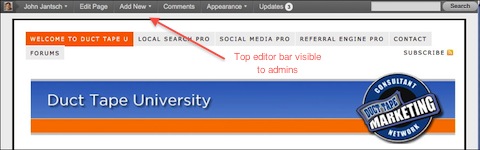
Admin bar – Next up is a new editing bar that appears above posts for admins when viewing live content. The idea behind this feature is that it offers easy editing and navigation directly from any blog page. I kind of like this as I tend to edit some things this way, but a lot of admins are complaining that it’s in the way and needlessly adds more clutter. (Top nav bars like the Hello Bar are getting popular as well and this may cause some conflicts with these kinds of scripts.) The top nav is turned on by default, but you can switch it off by visiting your account settings.

This nav bar appears by default for admins